
A Conceptual Model for Permafrost Thawing
Permafrost—frozen soil, sediment, or rock that remains completely frozen at or below a temperature of zero degrees Celsius for at least two consecutive years—covers 24 percent of the surface of land masses in the northern hemisphere [1]. It typically has an active layer at the top that melts and refreezes with the changing seasons, a center frozen layer, and an unfrozen layer at the bottom which is closest to the Earth’s core. With the rise in global temperatures, permafrost has begun to thaw, posing a threat to local infrastructure and further contributing to the release of carbon dioxide into the atmosphere [1].
Due to these growing threats, models that can predict how quickly permafrost will thaw can be a useful tool for scientists and the public alike. However, because permafrost is a complex system of frozen sediment, soil, organic material, and water, it can be difficult to represent. “The best models can take this really complex system and include all the factors involved to create a better picture of what’s happening,” Kaitlin Hill of St. Mary’s University said. Hill and her collaborators took on this challenge, aiming to create an energy-focused conceptual model for permafrost thawing.
In her minisymposium presentation at the 2026 SIAM Conference on Mathematics of Planet Earth—which is currently taking place in Cleveland, Ohio, concurrently with the 2026 SIAM Annual Meeting—Hill introduced a new way of thinking about modeling permafrost. “Although these kinds of models have existed since the 1950s, we wanted to think about this as an energy flow problem,” she said. “The [model] is not a particularly novel idea, but the novelty comes from rethinking this problem in a conceptual setting.”
Hill explained that existing models can be arduous to run and produce results that are difficult to communicate to the public. A more accessible model would be particularly relevant to homeowners that live in areas with the potential for permafrost subsidence, or the collapse or sinking of the ground surface when permafrost melts. This type of situation introduced the researchers’ secondary motivation for pursuing a conceptual model of permafrost: the ability to run a model with specific configurations, varying types of soil, and increasing temperatures would enable the prediction of the extent of permafrost subsidence that someone may see over the next couple of years.
To create their model, Hill and her collaborators looked at heat conduction in frozen soil, formulated as a single-column partial differential equation for energy density with explicit phase transitions. “We converted temperature to energy using a relationship between the two variables that respects the phase changes from a solid to a liquid state,” Hill said. “However, in the phase change, energy is taken up without temperature changing, called the zero-energy curtain; after that period, it takes a linear rate of change to change the temperature. This eventually leads us to a piecewise energy density formulation that includes thermal conductivity.”
Using their model, Hill and her team were able to hypothesize future rates of permafrost melting. “We simulated a raise in the temperature of the surface by three degrees Celsius over 100 years … and found that the permafrost indeed thawed,” Hill said. “One thing I did not expect, though, was that even though we maintained constant heat flux from below and raised the temperature from the surface, the permafrost actually melted from below.”
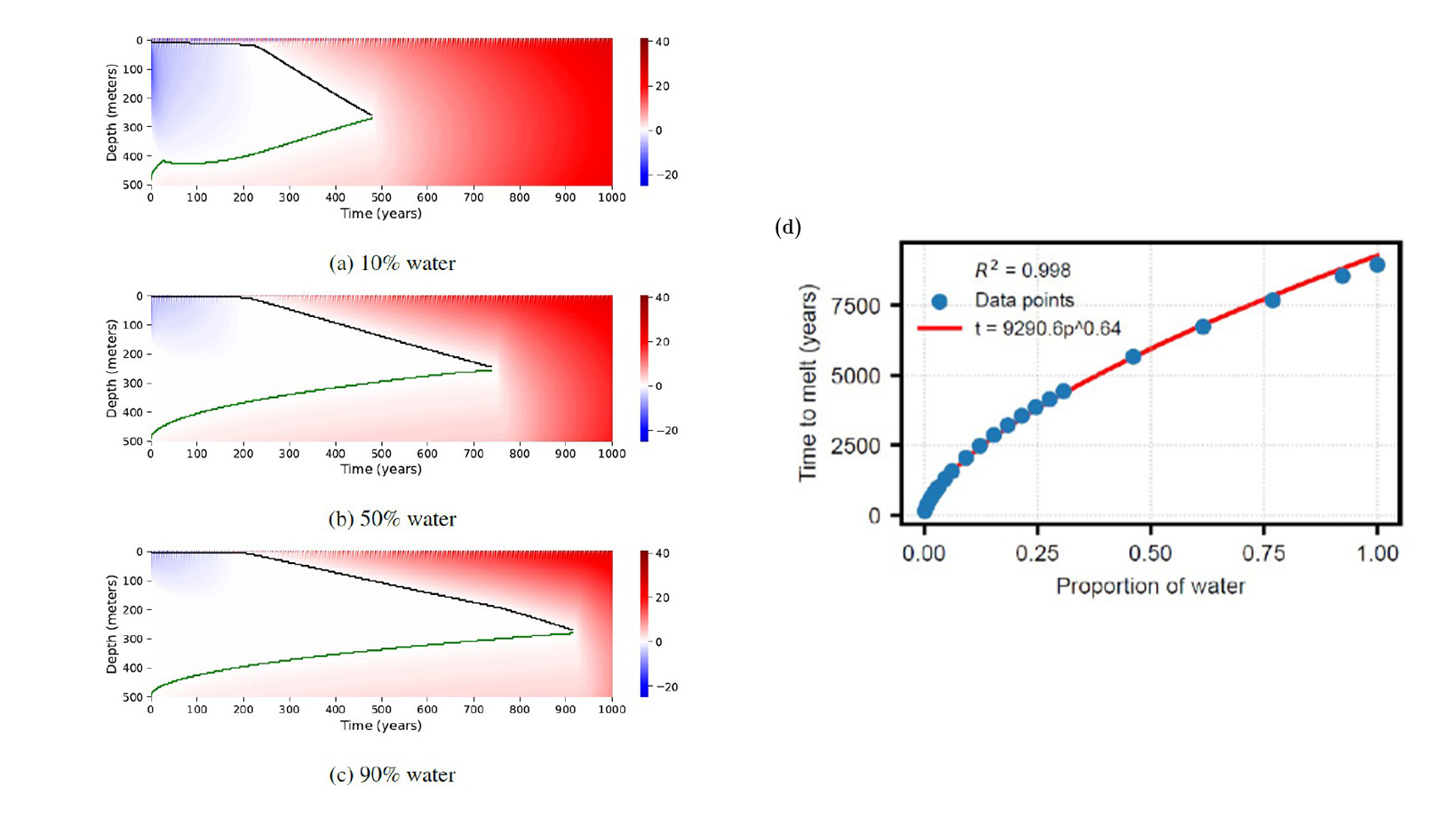
Once they validated their model, the team was able to analyze the impact of different variables on the rate of thawing (see Figure 1). “We wanted to see what happened if we varied the composition of the permafrost itself,” Hill said. “By varying the ice content, or the percent of water within the permafrost, we saw that an increase in water content caused an increase in time that it takes to thaw.” They collected data from the model on many different water compositions of the permafrost and found that the relationship between water and thaw time formed a power-law relationship (see Figure 1d). “Ideally, this could help say if [the permafrost] has this percentage of water, this is likely how long it will take to thaw, and that could be communicated to those potentially at risk for subsidence,” Hill continued.
![<strong>Figure 2.</strong> Model comparisons between the presented conceptual model and the model used in [4]. The model created by Hill and her collaborators is represented with the red solid line, while the model from [4] is represented with a blue dashed line. All the graphs are based on data published in [4]. Figure courtesy of Kaitlin Hill.](/media/kkfhdz1q/figure-3.jpg)
When compared with peer permafrost models, the conceptual model measured up well; the energy characteristics that the collaborators introduced made their model simpler to run and easier to understand while still producing qualitatively similar results. Considering a comparable model [4] that has the same partial differential equation profile but does not include energy flow, both predicted similar results (see Figure 2). Even when it came to a more complex model that evolves enthalpy [2] as opposed to energy density, the team’s new model still roughly fit the more sophisticated model’s predictions.
“Although when compared against more complex models, it doesn’t do as well, I would still argue that for a conceptual model, that’s okay,” Hill said. “We’re still going to tweak some, add more variables, and keep working.”
Acknowledgements: Kaitlin Hill acknowledged collaborators María Sánchez Muñiz and Rosanny De Leon of the City College of New York, and Richard McGehee and Nic Jelinski of the University of Minnesota.
References
[1] Bykova, A. (2020). Permafrost thaw in a warming world: The Arctic Institute’s permafrost series fall-winter 2020. The Arctic Institute. Retrieved from https://www.thearcticinstitute.org/permafrost-thaw-warming-world-arctic-institute-permafrost-series-fall-winter-2020/https://www.thearcticinstitute.org/permafrost-thaw-warming-world-arctic-institute-permafrost-series-fall-winter-2020/.
[2] Jafarov, E.E., Marchenko, S.S., & Romanovsky, V.E. (2012). Numerical modeling of permafrost dynamics in alaska using a high spatial resolution dataset. The Cryosphere, 6(3), 613–624.
[3] Sánchez-Muñiz, M. (2025). Modeling Permafrost Thaw Dynamics: A Conceptual and Energy-Based Approach [Ph.D. thesis, Department of Mathematics, University of Minnesota]. University of Minnesota Twin Cities Digital Conservancy.
[4] Sun, Z., Zhao, L., Hu, G., Qiao, Y., Du, E., Zou, D., & Xie, C. (2020). Modeling permafrost changes on the qinghai–tibetan plateau from 1966 to 2100: A case study from two boreholes along the qinghai–tibet engineering corridor. Permafr. Periglac. Process., 31(1), 156–171.
About the Author
Nya Wynn
Associate editor, SIAM News
Nya Wynn is the associate editor of SIAM News.

Related Reading
Stay Up-to-Date with Email Alerts
Sign up for our monthly newsletter and emails about other topics of your choosing.