A Strange Collision
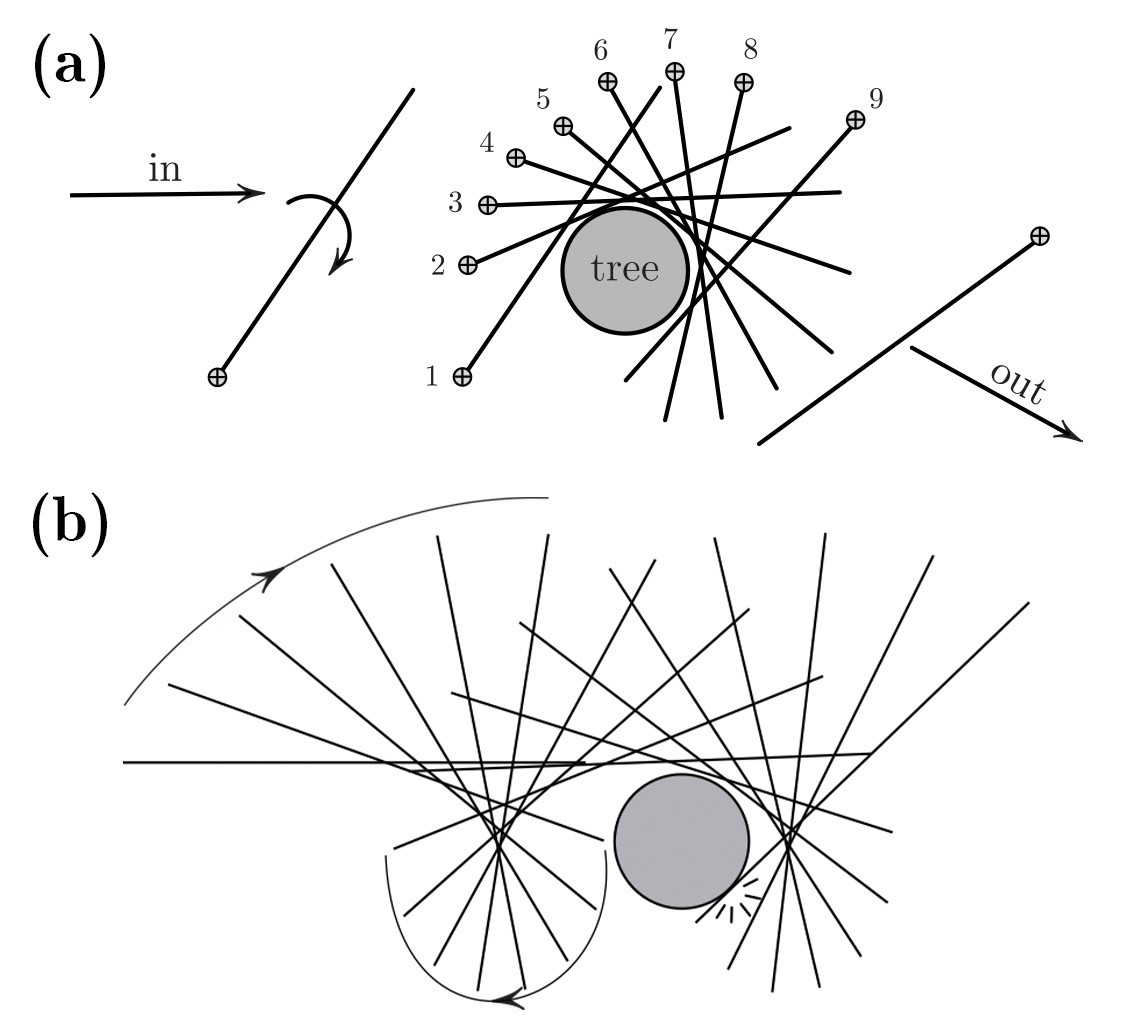
Like many dogs, our dog Lina likes to fetch sticks. On one of our walks, I threw a stick for her to fetch and accidentally hit a tree. Instead of bouncing off, the stick did something unexpected. It seemed as if the stick wrapped around the tree and changed direction (see Figure 1a). It was almost as though the tree pulled the stick and deflected its path in the direction opposite to the expected.
Was my perception distorted? Could the stick actually change direction in this unexpected way, at least in principle?
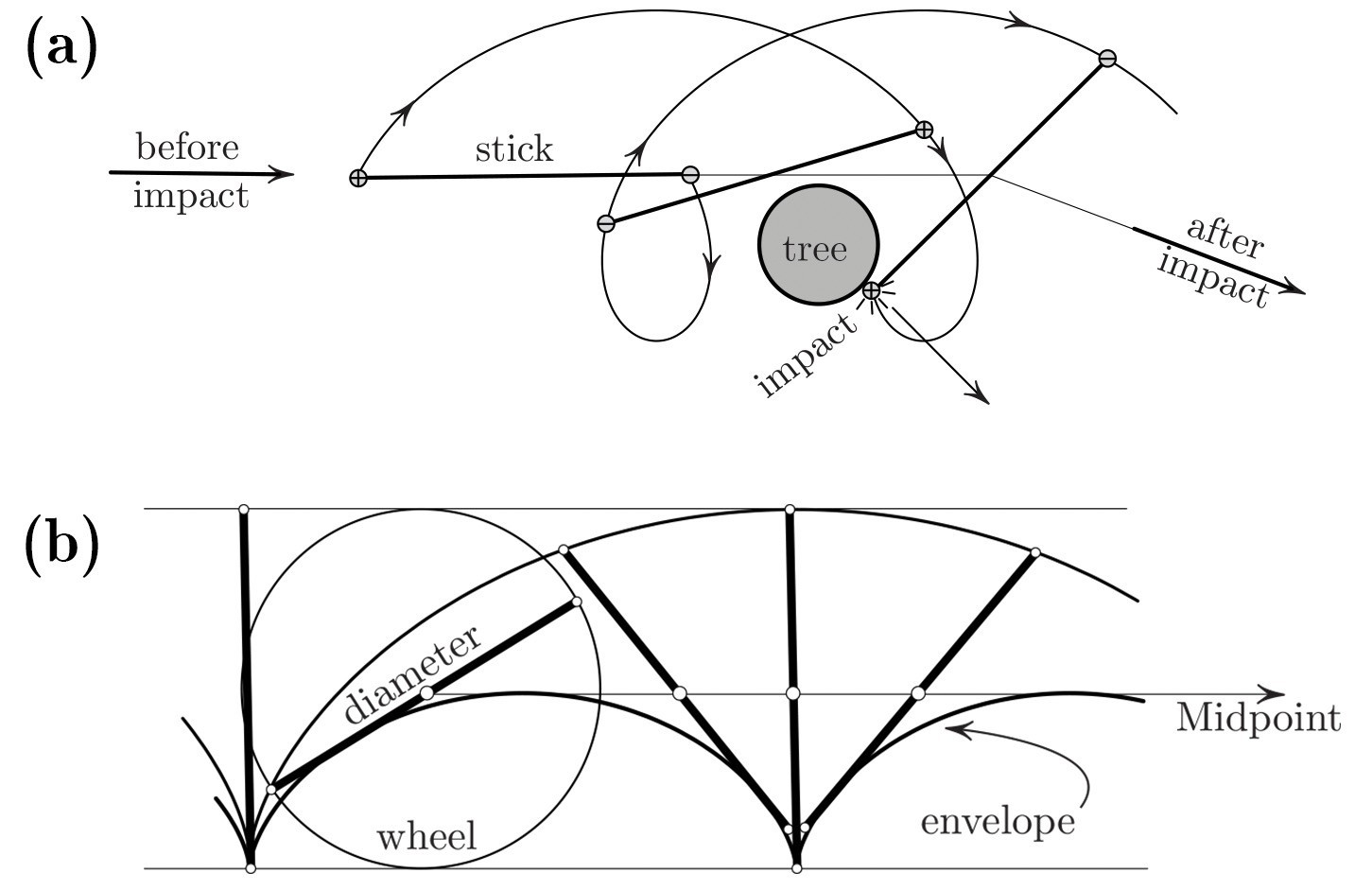
Figures 1b and 2a illustrate a possible scenario in which a strange deflection can indeed happen.1 According to Figure 1b, it is possible to have no previous collisions before the fateful impact, something that may not be as clear in Figure 2a.
Some Geometry
Material points of a freely moving stick describe trochoids; two of them are shown in Figure 2a. A trochoid may or may not contain loops, depending on whether the speed of the midpoint is smaller or greater than the speed of the point in question relative to the midpoint. If these speeds are equal, the trochoid becomes a cycloid (see Figure 2b). One can produce a cycloid by spinning a stick on its end and releasing it; both ends will then describe cycloids, moving exactly like the ends of the diameter in Figure 2b.
Hidden Cycloids
Returning to Figure 1a, we ask: can the flying segment “wrap” around the tree, remaining tangent to it for longer than an instant? Leaving this question aside for now,2 here is a partial answer: if the disk’s boundary in Figure 1a is not circular but contains an arc of a cycloid, then the answer is “yes.” This is because of the beautiful fact that the envelope generated by a segment that rotates and translates simultaneously is a cycloid [1] (see Figure 2b).
In particular, all lines in Figure 1b are tangent to the same cycloid (not shown).
The Envelope is a Cycloid: A Proof
Here is the short proof of the claim that a rolling wheel or an equivalently freely flying stick is tangent to the cycloid of half the size of the cycloid that is generated by a diameter’s endpoint. Figure 3 shows \(AB\) to be a material diameter painted on a disk that rolls without sliding. Consider also the disk of half the diameter (inner) tangent to the large disk at the contact point \(C.\) Let \(P\) be the foot of the perpendicular onto \(AB\) from \(C.\)
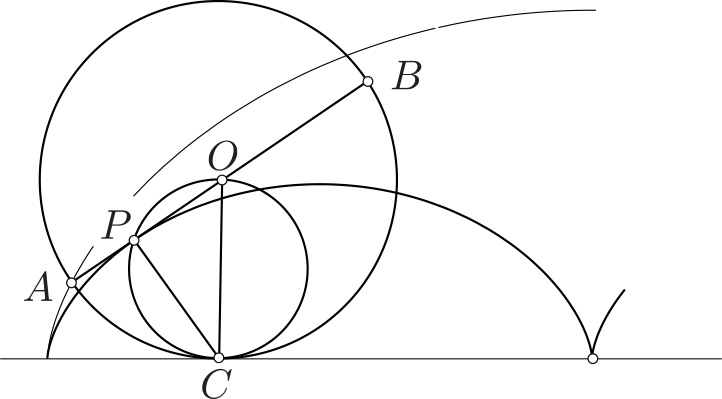
Since \(C\) is the instantaneous center of rotation of \(AB\) (no sliding), velocity \(v_P{\cdot}CP=0.\) However, this means that lies on the envelope, which is characterized by the property that the enveloping curves (\(AB\textrm{s}\) in this case) have zero velocity, normal to the envelope at the point of contact. So, \(P\) traces out the envelope of \(AB\textrm{s}\) as the disk rolls.
On the other hand, \(P\) always lies on the small circle, since \({\angle}OPC=\pi/2\) and \(CO\) is a diameter. Furthermore, from the already established \(v_P\;||\;AB\) we have \(v_P\;||\;PO.\) To summarize, point \(P\) on the small circle has its velocity pointed at the top point \(O\) at all times. But this is the characteristic property of a cycloid! Thus, \(P\) traces out a cycloid generated by the small circle, in addition to tracing the envelope, proving that the envelope is a cycloid. Q.E.D.
1 Gravity is ignored throughout since we are interested in the top view. All our sticks have uniform mass distribution.
2 Wishing to avoid discussing impacts, friction, etc.
The figures in this article were provided by the author.
References
[1] Lockwood, E.H. (1961). A Book of Curves. Cambridge, U.K.: Cambridge University Press.
About the Author
Mark Levi
Professor, Pennsylvania State University
Mark Levi ([email protected]) is a professor of mathematics at the Pennsylvania State University.
Related Reading
Stay Up-to-Date with Email Alerts
Sign up for our monthly newsletter and emails about other topics of your choosing.