
Ab Initio Simulation of Light-matter Interaction on the Fugaku Supercomputer
Light-matter interaction is an essential topic that is relevant to many areas of basic science and engineering, including sensors, lighting, optical communications, photosynthesis, and solar cells. This area of study is related to two major branches of physics: electromagnetism and quantum mechanics. Maxwell’s equations of electromagnetism describe light propagation in a medium, whereas a quantum mechanical approach to electronic motion in matter can explain the optical properties of materials such as transparency of glass and high reflection from metal surfaces. Two reasons account for this separation: (i) Weakness of interaction between electromagnetic fields and electrons, and (ii) difference in spatial scales between light wavelength and atomic size. In response to these aspects, researchers have developed two computational approaches to study light-matter interaction: (i) Electromagnetism analysis that solves Maxwell’s equations in space and time, and (ii) first-principles quantum mechanical calculations of dielectric functions that characterize the optical response of matter.
At the forefront of optical science, however, the situation continues to change rapidly and drastically. The development of a method to generate strong pulsed light, which received the 2018 Nobel Prize in Physics, has opened new scientific disciplines—like attosecond science—and wide applications, such as laser processing and surgeries. Furthermore, a fusion of laser physics and nanoscience has created nano-optics. In these cutting-edge frontiers of optical science, traditional approaches via either electromagnetism or quantum mechanics are no longer useful; instead, a novel computational technique that combines electromagnetism and quantum mechanics is necessary.
We are developing computational approaches that describe light-matter interaction at the atomic scale based on first-principles computational methods in materials science. Our computational code is called SALMON (for Scalable Ab initio Light-Matter simulator for Optics and Nanoscience) and is available online as an open-source software [2]. Its most extensive calculation describes light-matter interaction by simultaneously solving Maxwell’s equations for light propagation, the time-dependent Kohn-Sham equation for electronic motion (the basic equation of a first-principles method), and the Newtonian equation for ionic motion [3].
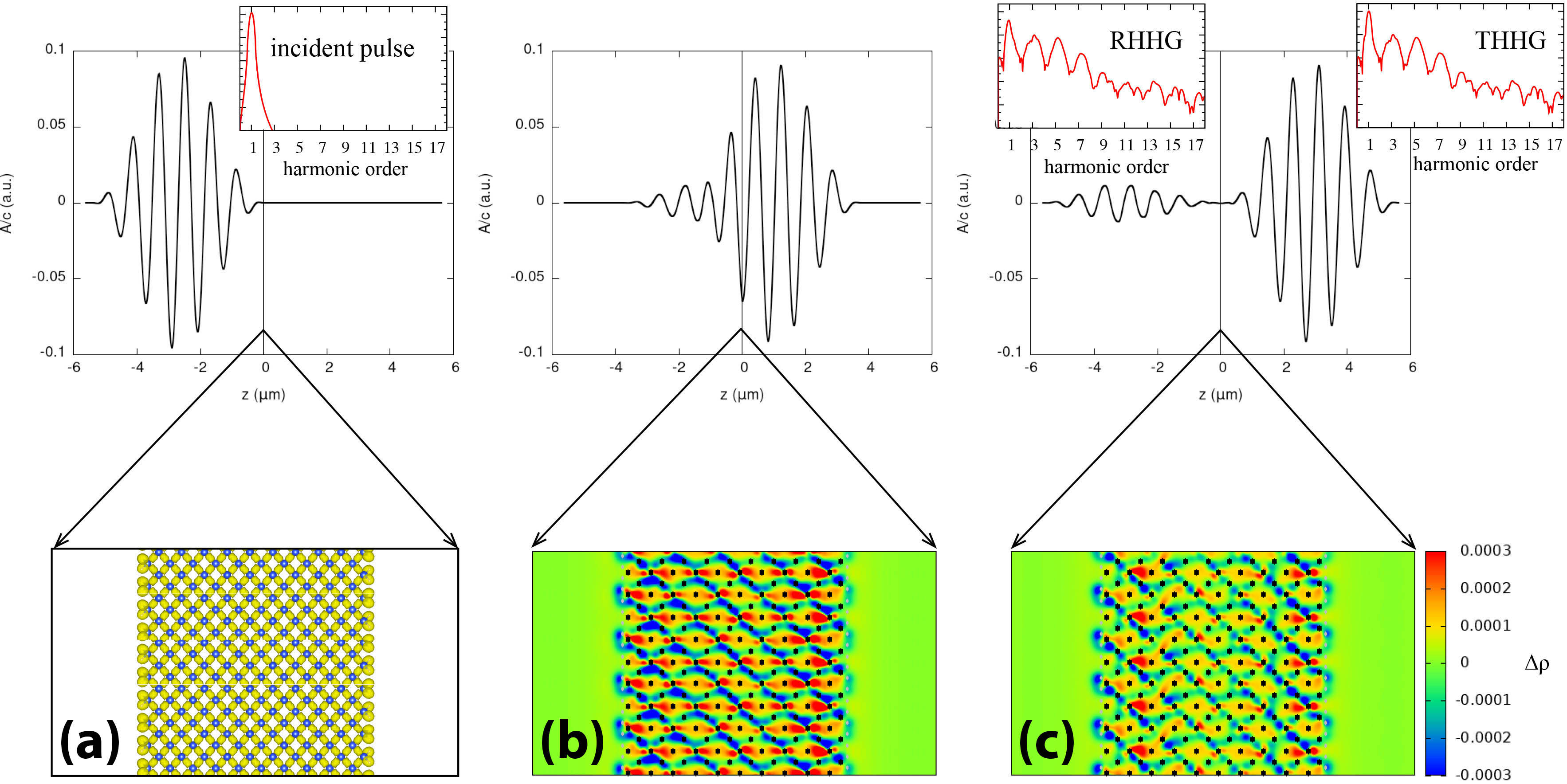
Figure 1 illustrates an example of our calculation [4] for a strong pulsed light that irradiates on a silicon nanofilm that is composed of roughly 10 atomic layers. The upper panels describe the vector potential of the light pulse, while the lower panels depict the electronic motion in the thin film. Figure 1a portrays the initial condition; the incident pulse is in front of the thin film (in the top panel) and the film’s electronic state is the ground state in the first-principles density functional theory (in the lower panel). As we calculate the system’s time evolution, the light pulse penetrates the thin film while the electron density changes from the ground state (see Figure 1b). Here, the pulsed light excites electrons in the film and the polarization that results from this excitation affects the light propagation. In Figure 1c, the light pulse separates into transmitted and reflected waves as electronic excitations remain in the film. Fourier spectra of the incident, reflected, and transmitted waves appear as insets in Figure 1. High harmonic components develop in the spectra of reflected and transmitted waves. These typical nonlinear optical signals are garnering much attention in high-field optics.
Because the aforementioned simulation is multiscale and multiphysics in nature, it is only feasible in large-scale supercomputers. We can significantly reduce computational costs for periodic solids by utilizing crystalline symmetries; however, symmetries are much less common in nanomaterials. Moreover, symmetries in real materials are often lifted by the thermal motion of atoms and disorders in the structure. Therefore, researchers seek a large-scale computational method that enables simulations of complex systems that are composed of a large number of atoms.
![<strong>Figure 2.</strong> A large-scale calculation on the Fugaku supercomputer. <strong>2a.</strong> A pulsed light irradiates a thin film of amorphous glass (SiO<sub>2</sub>) that is composed of more than 10,000 atoms. We calculate this system with approximately one-sixth of Fugaku. <strong>2b.</strong> Electron density in the ground state. <strong>2c.</strong> Electron density change during laser irradiation. Figure courtesy of [1].](/media/kzqfwa1w/figure2.jpg)
We carried out a large-scale calculation via the Fugaku supercomputer—currently the fastest supercomputer in the world—at the RIKEN Center for Computational Science in Japan. Using about one-sixth of Fugaku with more than 27,000 central processing units (CPUs), we successfully carried out a calculation of a light-matter interaction: an irradiation of a strong pulsed light on a thin film of amorphous glass (SiO2) that is composed of over 10,000 atoms [1]. Since four processes run on each CPU, more than 100,000 processes occur simultaneously in message passing interface parallelization. Electronic orbitals—which are expressed with a three-dimensional (3D) Cartesian grid—are the most time- and memory-consuming part of the calculation. We implemented parallelizations for divisions of spatial grids, orbitals, and atomic indices; Figure 2 illustrates the computed system. It comprises a thin film of amorphous SiO2 of thickness 6.6 nanometers (nm) that includes a total of 10,224 atoms (see Figure 2a). We prepare a vacuum region above and below the thin film and assume that periodicity exists in horizontal directions. Figure 2b shows the electronic density in the ground state, while Figure 2c illustrates the density change during the laser irradiation.
![<strong>Figure 3.</strong> A breakdown of computational time for four differently-sized systems: 13,632 atoms via 27,648 central processing units (CPUs), 6,816 atoms via 6,912 CPUs, 3,408 atoms via 1,728 CPUs, and 1,704 atoms via 432 CPUs. “Hamiltonian” is a quantum-mechanics calculation of electrons, “Hartree” is the solution of the Poisson equation in electromagnetism, and “Force” is for Newtonian mechanics of ions. Courtesy of [1].](/media/duef02iz/figure3.jpg)
Figure 3 provides a breakdown of computational time for four differently-sized systems. The time evolution calculation shows size-scaling of \(O(N^2)\), where \(N\) is the number of atoms. The figure visualizes the execution time for 13,632 atoms via 27,648 CPUs, 6,816 atoms via 6,912 CPUs, 3,408 atoms via 1,728 CPUs, and 1,704 atoms via 432 CPUs. It also illustrates the realization of reasonable weak scaling, as the computation spends approximately one second per each step. This time-to-solution performance is allowable for applications of real problems. Reflecting the problem’s multiphysics nature, several kinds of computations appear. “Hamiltonian” is a quantum mechanics calculation of electrons that includes stencil operations, “Hartree” is the solution of the Poisson equation in electromagnetism that is carried out using a fast Fourier transform (FFT), and “Force” is required for Newtonian mechanics of ions. In terms of scalability, the FFT is the most challenging computation — although the cost is not dominant in the present simulation.
The above calculation describes light-matter interaction for a thin film material with a thickness of several nm. While it is important to model film materials and a prototype of bulk surfaces, pulsed light’s interaction with nanomaterials of various 3D structures—either isolated or placed on surfaces—will also be interesting. Inclusion of more complex interactions like electronic spin-orbit force will further extend the phenomena that this method can explore. We plan to develop SALMON even more so that it becomes an indispensable tool for future nano-optics research.
References
[1] Hirokawa, Y., Yamada, A., Yamada, S., Noda, M., Uemoto, M., Boku, T., & Yabana, K. (2022). Large-scale ab initio simulation of light–matter interaction at the atomic scale in Fugaku. Int. J. High Perform. Comput. Appl., 36(2), 182.
[2] Noda, M., Sato, S.A., Hirokawa, Y., Uemoto, M., Takeuchi, T., Yamada, S., ... Yabana, K. (2019). SALMON: Scalable ab-initio light–matter simulator for optics and nanoscience. Comp. Phys. Comm., 235, 356-365.
[3] Yamada, S., Noda, M., Nobusada, K., & Yabana, K. (2018). Time-dependent density functional theory for interaction of ultrashort light pulse with thin materials. Phys. Rev. B, 98, 245147.
[4] Yamada, S., & Yabana, K. (2021). Determining the optimum thickness for high harmonic generation from nanoscale thin films: An ab initio computational study. Phys. Rev. B, 103, 155426.
About the Author
Kazuhiro Yabana
Professor, University of Tsukuba
Kazuhiro Yabana is a professor of physics and computational science and a deputy director of the Center for Computational Sciences at the University of Tsukuba. His research focuses on computational materials, optical sciences, and theoretical nuclear physics.
Stay Up-to-Date with Email Alerts
Sign up for our monthly newsletter and emails about other topics of your choosing.