
Circadian Rhythms of Spiders
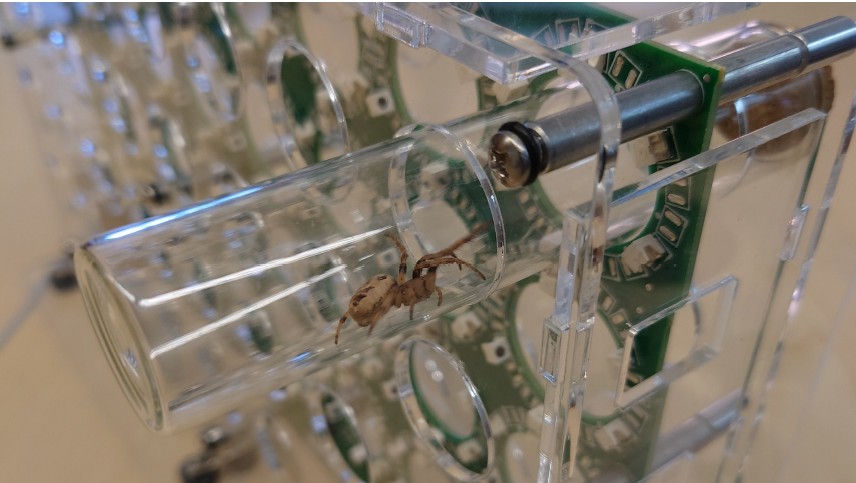
Life on Earth has evolved synchronizing circadian rhythms in accordance with the rotation of the Earth around its axis [4]. Indeed, it appears that most eukaryotes, such as fungi, plants, and animals, as well as some prokaryotes, such as cyanobacteria, have functional biological clocks [2]. Moreover, circadian rhythms often persist even in the absence of environmental cues, this yields what is known as a free-running period (FRP). While the circadian rhythms of certain model organisms, such as Drosophila and Neurospora, have been studied extensively, relatively less is known about the circadian rhythms of spiders. Recent research found exceptional variability in the FRP of multiple species of spiders, with FRPs as low as 19 hours and as high as 30 hours [9]. In contrast, most human FRPs range between 24 and 25 hours [3]. Our work aims to use conceptual mathematical models to explore possible biological mechanisms for both the observed inter- and intra-species variability in the circadian rhythms of spiders.
To better understand both the patterns and the mechanisms of spider behavior, laboratory experiments monitor locomotor activity in three different conditions: constant light (LL), constant darkness (DD), and alternating 12-hour periods of light and dark (LD). The period observed in DD corresponds to the FRP, while the LD conditions simulate entrainment to a 24-hour cycle. LL conditions, meanwhile, provide insight into the effects of light on the circadian systems.
We begin our modeling endeavor with a three-variable Goodwin oscillator, building on the work in [7].
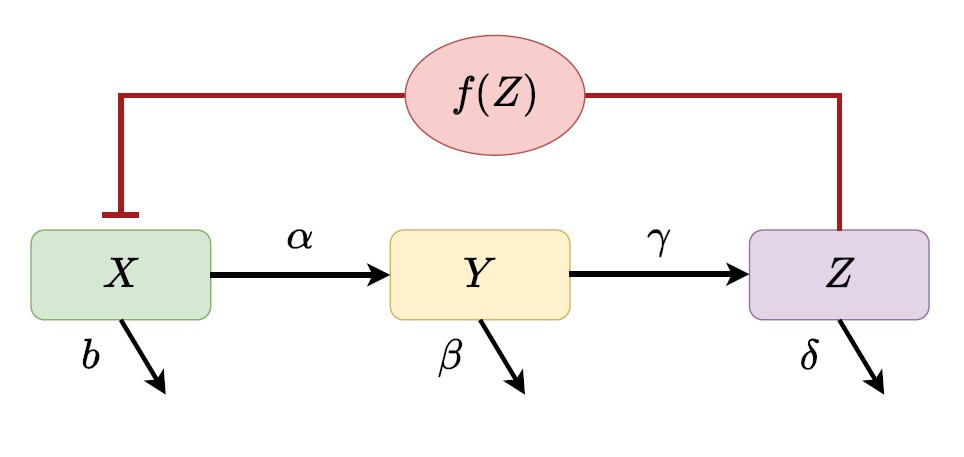
\[\begin{align}\dot{X}=f(Z)-bX\tag1\\ \dot{Y}=\alpha{X}-\beta{Y}\tag2 \\ \dot{Z}=\gamma{Y}-\delta{Z}\tag3 \\ f(Z)=\frac{a}{1+\eta{Z}^n}\tag4\end{align}\]
In \((1),\) we can interpret \(X\) as a measure of circadian protein that is regulated by the metabolite \(Z,\) with \(Y\) representing a reaction intermediate. In \((2),\) the Hill function \(f(Z)\) describes how \(Z\) regulates the production of \(X.\) The production constants \(a, \alpha,\) and \(\gamma\) and the degradation constants \(b, \beta,\) and \(\delta\) are system parameters. The state diagram in Figure 2 illustrates the corresponding regulatory feedback mechanism. In this modeling framework, circadian rhythms correspond to limit cycles in the dynamical system. While the Goodwin oscillator \((1)\) provides a robust modeling framework to produce limit cycles, it is well known that the exponent \(n\) in \((2)\) must be greater than eight in order for limit cycles to exist [8]. Indeed, the limit cycles originally reported by Goodwin in [6] are now thought to be numerical artifacts. To address the problematic requirement \(n>8,\) numerous variants of \((1)\) have since been constructed over the years [5, 6].
In current work, which is motivated by experimental observation, we aim to extend the Goodwin modeling framework to include a mechanism for the masking of locomotor activity by light. The role of light in the regulation of biological clocks is well-documented (see [1] and the references therein); however, there is not an agreed-upon method for modeling light effects. Observations of spiders in a laboratory setting reveal significant variability in light response both within and across different species. In particular, there is a striking difference in the propensities for entrainment in LD conditions across species. Whether or not a common clock architecture based on the Goodwin model can be used to explain these differences remains to be seen.
James Broda delivered a minisymposium presentation on this topic at the Third Joint SIAM/CAIMS Annual Meetings, which took place last summer in Montréal, Québec, Canada.
Acknowledgments: This article is informed by collaboration with Nadia Ayoub and Natalia Toporikova, both of Washington and Lee University, and Daniel Robb of Roanoke College. The work of Ayoub and Toporikova is supported by the National Science Foundation (IOS-2235711).
References
[1] Challet, E. (2007). Minireview: Entrainment of the suprachiasmatic clockwork in diurnal and nocturnal mammals. Endocrinology, 148(12), 5648–5655.
[2] Dunlap, J.C., Loros, J.J., Liu, Y., & Crosthwaite, S.K. (1999). Eukaryotic circadian systems: Cycles in common. Genes to Cells, 4(1), 01–10.
[3] Eastman, C.I., Molina, T.A., Dziepak, M.E., & Smith, M.R. (2012). Blacks (African Americans) have shorter free-running circadian periods than Whites (Caucasian Americans). Chronobiol. Int., 29(8), 1072-1077.
[4] Edery, I. (2000). Circadian rhythms in a nutshell. Physiol. Genomics, 3(2), 59–74.
[5] Gonze, D. & Abou-Jaoude, W. (2013). The Goodwin model: Behind the hill function. PloS one, 8(8), e69573.
[6] Gonze, D. & Ruoff, P. (2021). The Goodwin oscillator and its legacy. Acta Biotheoretica, 69(4), 857-874.
[7] Goodwin, B.C. (1965). Oscillatory behavior in enzymatic control processes. Adv. Enzyme Regul., 3, 425-437.
[8] Griffith, J.S. (1968). Mathematics of cellular control processes i. negative feedback to one gene. J. Theor. Biol., 20(2), 202-208.
[9] Mah, A., Ayoub, N., Toporikova, N., Jones, T.C., & Moore, D. (2020). Locomotor activity patterns in three spider species suggest relaxed selection on endogenous circadian period and novel features of chronotype. J. Comp. Physiol. A, 206(4), 499-515.
About the Author
James Broda
Assistant professor, Washington and Lee University
James Broda is an assistant professor of mathematics at Washington and Lee University. He is interested in the study of dynamical systems and their applications.

Related Reading

Stay Up-to-Date with Email Alerts
Sign up for our monthly newsletter and emails about other topics of your choosing.