
Colorado SIAM Student Members Visit the National Center for Atmospheric Research Mesa Laboratory
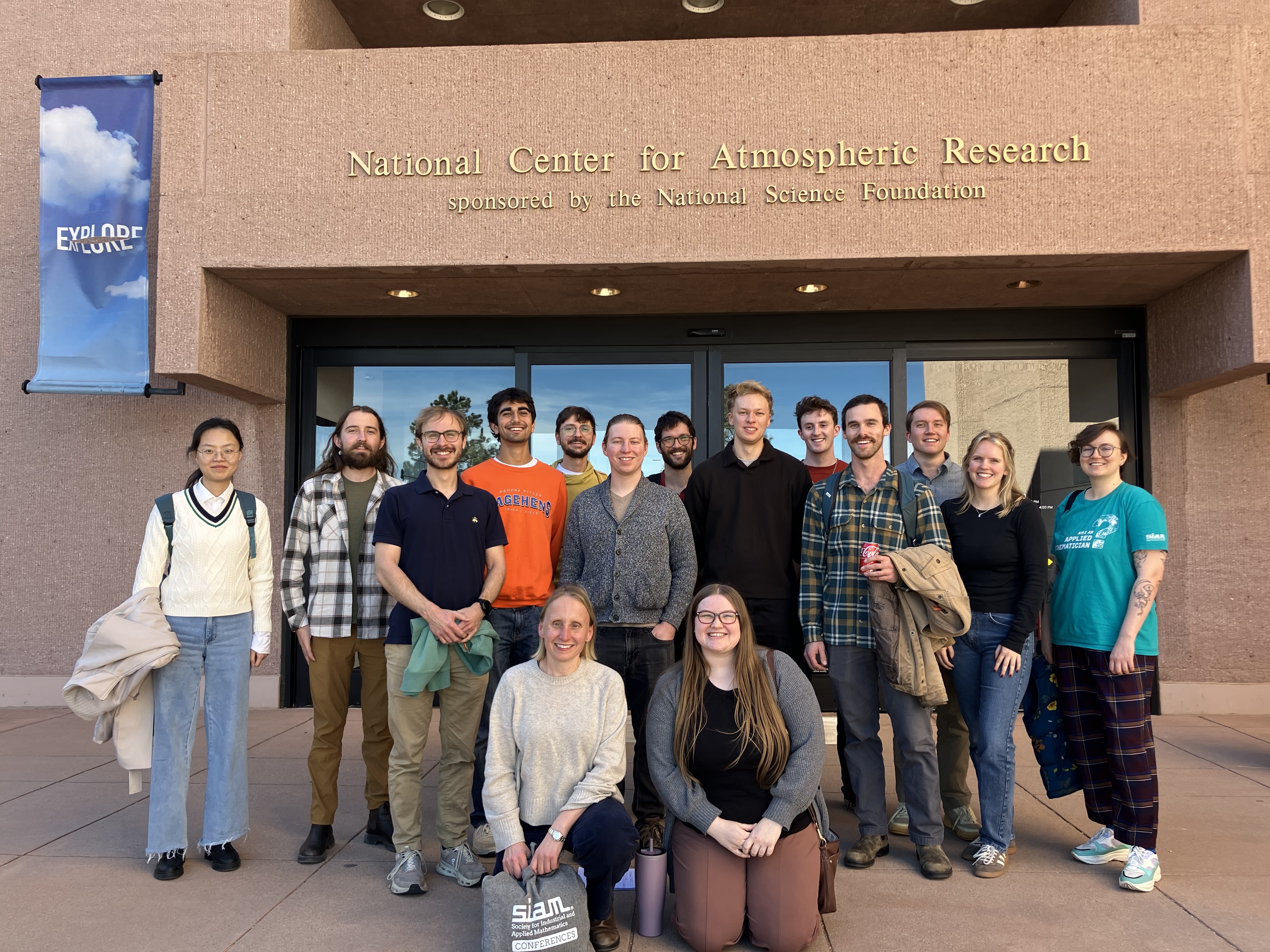
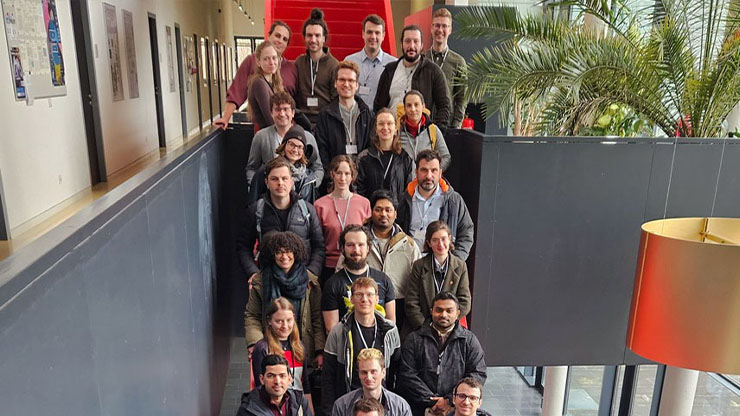
On February 5, student members of SIAM stepped inside one of the nation’s premier hubs for atmospheric science: the National Center for Atmospheric Research (NSF NCAR) in Boulder, Colo. Organized by the SIAM student chapters at Colorado State University and the University of Colorado Boulder, the visit brought together graduate students from both institutions to explore how mathematics informs contemporary atmospheric science and learn about the role of federally-funded research centers in sustaining long-term scientific infrastructure.
The group met at NSF NCAR’s iconic Mesa Laboratory, which is set against the foothills of the Rocky Mountains. Designed by architect Ieoh Ming Pei in 1961, the building seems to rise out of the surrounding sandstone cliffs and is a testament to the close connection between science and the environment. Researchers at NSF NCAR work in a variety of disciplines ranging from meteorology and atmospheric chemistry to solar and space weather.
The day began with a seminar on sea ice modeling led by applied mathematician Christopher Horvat of Brown University and visiting researchers from the Polar Climate and Ocean Modeling Working Group. The discussion moved between mathematical theory, numerical computation, and real-world data, offering students a clear example of how mathematicians and atmospheric scientists collaborate to understand polar processes. Following the seminar, students had lunch in the Mesa Cafe, which provided informal time for conversation with NSF NCAR scientists about career paths, interdisciplinary collaboration, and the practical realities of working at a national research center.
In the afternoon, tropical weather researcher and NSF NCAR postdoctoral fellow Quinton Lawton led a guided tour of the Mesa Laboratory. In addition to serving as NSF NCAR’s primary research facility, the laboratory also houses a public visitor center that features interactive exhibits on cloud physics, hurricane dynamics, Sun-Earth connections, and weather impacts on aviation and emergency response. Students touched a cloud, stepped into a simulated tornado vortex, and explored how severe winds influence aircraft performance during takeoff and landing. The tour also highlighted how NSF NCAR supports the broader scientific community by providing specialized instruments, research aircrafts, high-performance supercomputing, and open-access Earth science datasets to the public.
The timing of the visit was especially meaningful, as NSF NCAR’s funding has faced recent scrutiny, underscoring the importance of public understanding and support for foundational atmospheric scientific research. Several students said that they had not realized how deeply mathematics shape the tools used for disaster forecasting, policy decisions, and societal resilience during severe weather events.
Another joint laboratory tour took place a month later on March 5; students from both chapters visited the CSU Energy Institute’s Powerhouse Campus in Fort Collins, Colo., and attended a seminar on mathematical modeling of methane emissions with Energy Institute mathematician Michael Moy. In previous years, the Colorado SIAM chapters have also toured the National Oceanic and Atmospheric Administration facilities in Boulder, the National Laboratory of the Rockies (formerly National Renewable Energy Laboratory) in Golden, Colo., and the NCAR-Wyoming Supercomputing Center in Cheyenne, Wyo. These visits continue a tradition of connecting mathematics students with leading scientific research centers across the Rocky Mountain region.
About the Author
Kristina Moen
Ph.D. student, Colorado State University
Kristina Moen is a Ph.D. student at Colorado State University (CSU), where she studies shape and texture in weather satellite imagery at the Cooperative Institute for Research in the Atmosphere. She served as president of the CSU SIAM Student Chapter in 2024-2025 and is the current liaison officer connecting SIAM students to other institutions.
Related Reading
Stay Up-to-Date with Email Alerts
Sign up for our monthly newsletter and emails about other topics of your choosing.