
Dealing with the After-math: Finding Your Niche in the Mathematical Sciences
“Maths? What on Earth are you going to do with that?” Throughout my education in mathematics, I heard this question more times than I can recall, yet the question itself reveals less about the subject and more about the widespread misunderstanding of its significance.
Mathematics is the unseen architecture of the modern world, too often dismissed as abstract or impractical. Such attitudes reflect not the limitations of mathematics, but rather a failure to recognize its profound influence on systems, ideas, and innovations.
The real question, then, is not what one can do with mathematics, but what could be done without it.
That said, even though I was captivated by the subject itself, I was never entirely sure what path I would pursue after my undergraduate graduation. Mathematics felt logical and structured, with each idea building naturally on the last, forming a coherent whole w=hen viewed in full. Yet it was also profoundly creative. Solving a problem was never merely a matter of applying rules; it required pattern recognition, the ability to make connections, and the drive to discover new pathways and shortcuts to a solution. In that sense, mathematics resembled a vast and intricate puzzle that could be approached from countless directions, each offering a new insight into the underlying structure.
These ideals were omnipresent in academia. Every course, project, and tutorial problem seemed designed to reinforce the delicate balance between structure and imagination — the discipline of following logic while also being free to explore new ideas. But beyond that world, I wasn’t sure where those qualities took root. I hadn’t yet seen how the kind of thinking I loved—the careful reasoning, the creative problem-solving, the thrill of uncovering elegant solutions—translated into the work people did in industry.

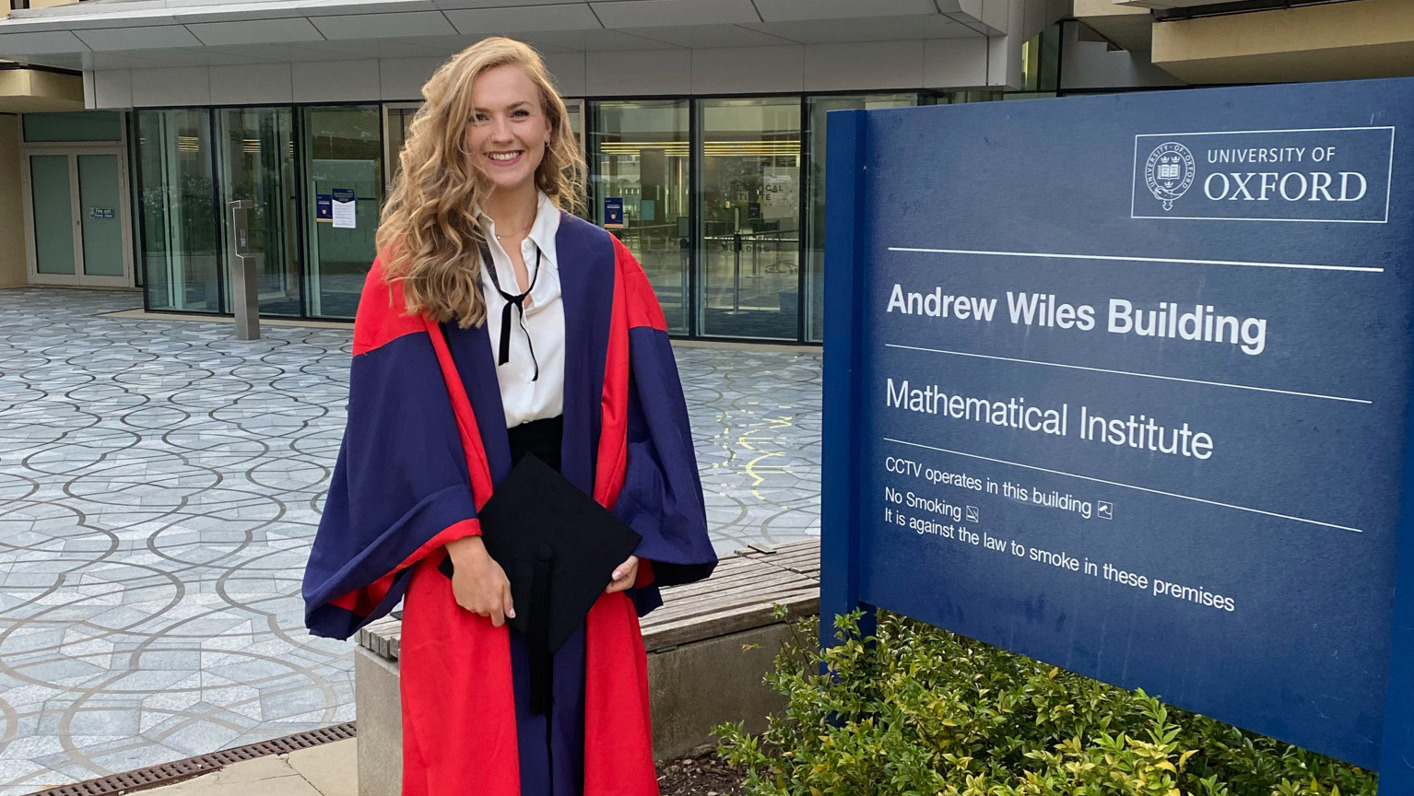
My desire to deepen my understanding of mathematics and its practical applications ultimately motivated me to pursue a Ph.D. in industrially-focused mathematical modeling at the University of Oxford. My classes and projects illustrated how I could turn fundamental mathematical ideas into innovative solutions to real-world problems. I began to see how mathematics could drive tangible progress, not just in theory. What struck me most was that the very qualities that first drew me to mathematics—the logical reasoning, puzzle-like problem solving, and the satisfaction of uncovering solutions—remained at the heart of these approaches, now expressed in ways that were both practical and impactful.
I began to wonder where else math could be applied. I came to realize that I could combine my love of mathematics with my long-standing fascination for space, where analytical thinking, modeling, and creative problem-solving are essential. I started to see how the mathematical principles I had studied in school could be used to model astrophysical objects, understand orbits, optimise trajectories, analyse satellite data, and tackle the complex challenges of space exploration. It was exciting to think that the skills I had developed could contribute to something as vast and inspiring as the space industry.
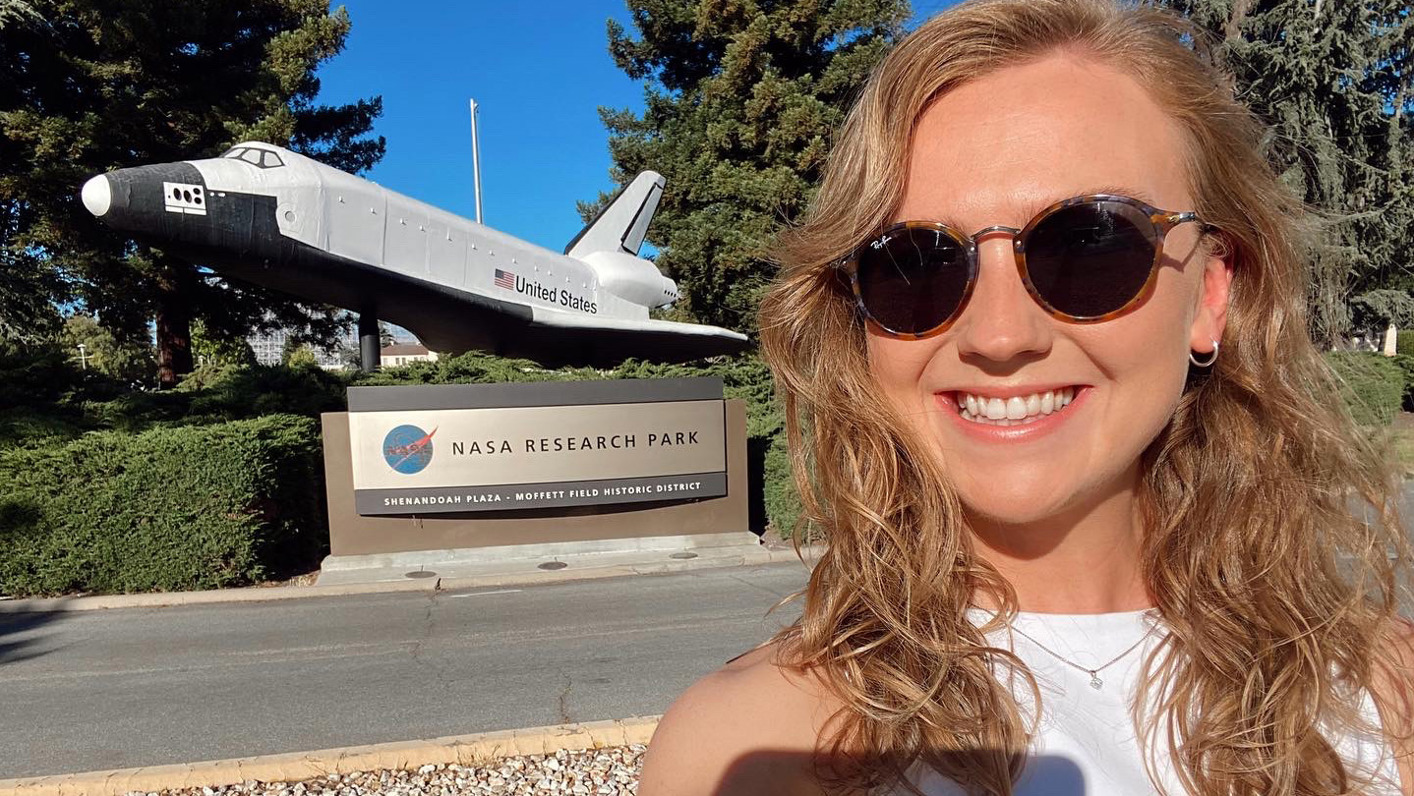
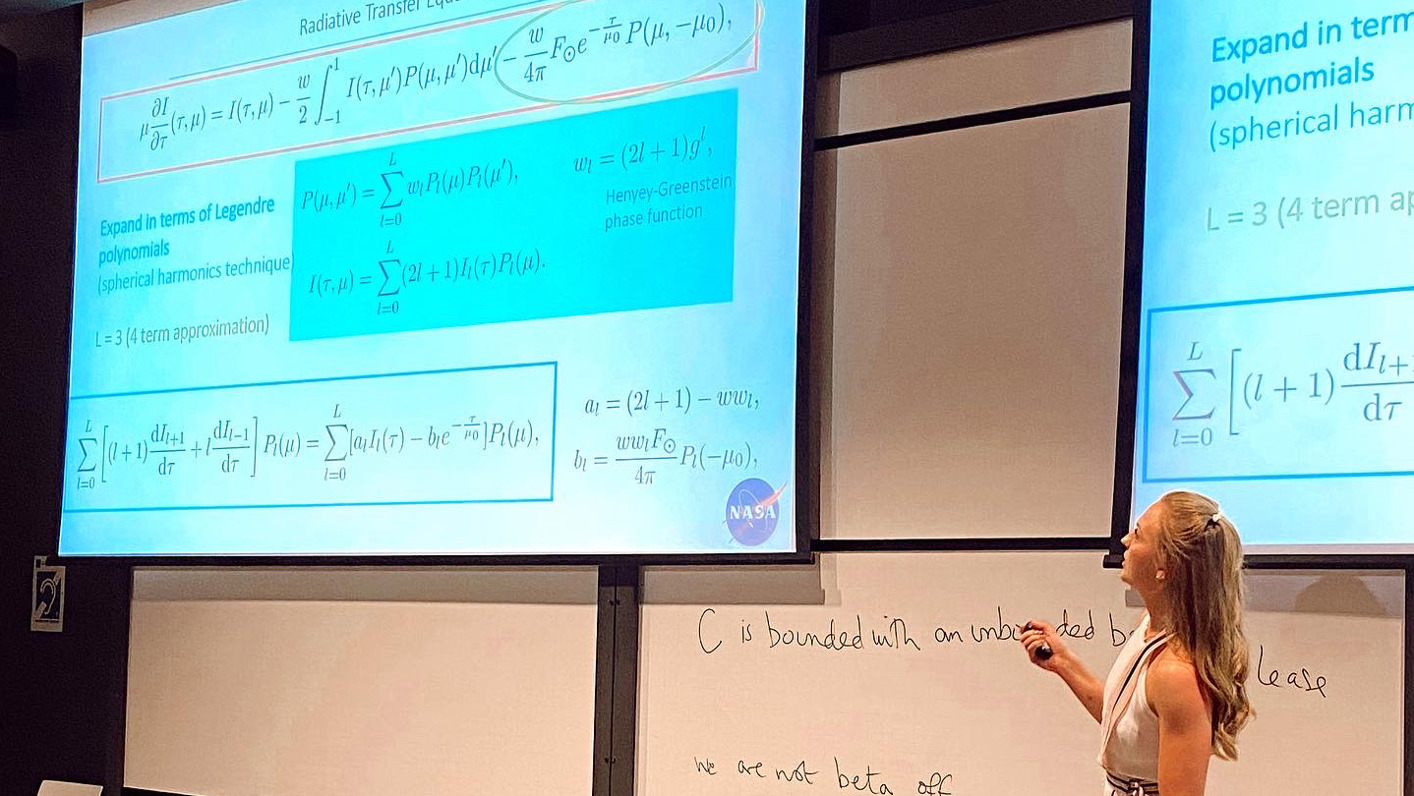
Following my Ph.D., I received a postdoctoral fellowship at the National Aeronautics and Space Administration (NASA) Ames Research Center, where I applied mathematical models to understand the atmospheres of distant exoplanets. Since we cannot physically travel to these bodies, we rely on the light that reaches us to infer the chemical composition of the atmospheres of these planets. By collecting this light through powerful telescopes and breaking it down into its electromagnetic spectrum, we can identify subtle patterns and features, commonly referred to as a spectral signature. Each element or molecule leaves a unique fingerprint in the spectrum, which allows us to infer the chemical composition of the planet’s atmosphere. The most exciting part of this job was seeing how the mathematical skills I had developed throughout my studies proved fundamental in developing these models that can understand and decipher real exoplanetary atmospheres.
Studying exoplanets was an incredible experience; it deepened my understanding of how mathematics can reveal the unseen and expanded my sense of curiosity about the universe. It also inspired me to broaden my skills and apply them to something closer to home, where the impact could be more immediate and tangible. I wanted to use the same mathematical and analytical approaches to contribute to real missions that could make a direct difference to life on Earth while advancing our ability to explore space. I was drawn to the idea of being part of a mission from start to finish; I wanted to help design, develop, and operate systems that could fly, turning equations and theory into something real.
That dream brought me to Astroscale—a company focused on the development of innovative solutions for space sustainability, including actively removing debris and servicing satellites in orbit—where I joined as a flight dynamics engineer. The flight dynamics team offered me the bridge between mathematics and engineering that I’d been looking for: a position where I could apply my problem-solving skills, analytical thinking, and coding experience to develop algorithms for cutting-edge space missions. Beyond the algorithm development, I had the rare opportunity to operate an active space mission, demonstrating some of the world’s first achievements in mission called ADRAS-J. This experience allowed me to rapidly grow from a space mathematician into a fully-fledged space engineer, bridging theory and practice on real missions.
One of the things that struck me most at Astroscale was how deeply collaborative space missions are. Every mission is the product of multidisciplinary effort. Beyond the critical work of the flight dynamics engineers, the flight software team designs the algorithms on board the spacecraft; the Guidance, Navigation, and Control team design how a spacecraft will navigate and orient itself in orbit; the mechanical team designs and builds the spacecraft itself; and the systems team designs the mission plan while making sure every part worked seamlessly together (just to name a few). Everyone works on a critical component needed to achieve a single, shared goal. The entire company moves together to make one mission succeed, fostering a sense of collective purpose that I feel is incredibly rewarding. It was a refreshing change from academia, where work could often feel more independent or isolated. The more I learned about systems engineering and how all the pieces come together to create a functioning, reliable spacecraft, the more I wanted to challenge myself to apply my mathematical and analytical skills in this broader, integrated context.
This prompted my move to the ground segment team, where I now work as a senior ground segment systems engineer. In this role, I work on flight dynamics in addition to the broader systems needed for mission control and planning — from the ground station network to the software and processes that enable the safe and effective operation of the spacecraft. Although my day-to-day work is less mathematical than before, I still rely heavily on the same problem-solving mindset and logical thinking that mathematics trained me to develop. Much of my role involves understanding how all the different elements fit together to meet the mission requirements and ensuring the systems are robust, reliable, and ready for operations. My background as a mathematician has given me the versatility, adaptability, and analytical thinking to approach complex engineering problems from multiple angles — skills that have proven invaluable well beyond equations. And thankfully, I still have the opportunity to code up a solution to a software problem every now and again!
Looking back, my love of mathematics led me to one of the most exciting and versatile careers. It has taken me from exploring distant exoplanets to operating real spacecraft in orbit, and throughout it all, I’ve realized that mathematical skills allow me to do so much more than simply solve equations. They present a different way of thinking, a logical, analytical, and creative approach to understanding and tackling complex problems. Mathematics has taught me how to break challenges down, find patterns, and build solutions — skills that extend far beyond the classroom and can be applied across countless industries, roles, and disciplines. It’s a universal language for problem-solving, and it continues to shape the way I approach every new challenge.
Looking back again on all the times I was asked, “Maths? What on Earth are you going to do with that?” I have to laugh, because it turns out the answer was “something not on Earth at all.”
About the Author
Caoimhe Rooney
Senior ground segment systems engineer, Astroscale U.K.
Caoimhe Rooney is a senior ground segment systems engineer at Astroscale U.K., where she works on the design and development of mission-critical space systems to tackle the ever-increasing space-debris problem. She previously conducted research on exoplanet atmospheres at the National Aeronautics and Space Administration (NASA) Ames Research Center, focusing on the characterization of distant worlds. Caoimhe holds a Ph.D. in applied mathematics from the University of Oxford, where her work combined advanced mathematical modeling with industrial, real-world problems.
Stay Up-to-Date with Email Alerts
Sign up for our monthly newsletter and emails about other topics of your choosing.