
Designing Responses to the COVID-19 Outbreak: From Simulation to Optimization
COVID-19 first appeared in Wuhan, China in December 2019. The virus spread rapidly to all Chinese provinces and was present in many countries by the end of January 2020; the World Health Organization declared it a pandemic on March 11 of the same year [5]. At that time, the SARS-CoV-2 virus had swept through Northern Italy and overloaded its health care system [4].
The scientific community’s response to this dramatic turn of events was remarkable. Specialists in all areas swiftly joined forces to assess the threat and propose response strategies [3]. During those initial moments, mathematical epidemiology simulations played a major role in predicting the eminent catastrophe by offering a qualitative point of view and producing actual figures of estimated causalities that could occur in the absence of strict suppression measures [15]. Such simulations clearly inspired an acute awareness of the gravity of the situation and helped decision-makers to declare essential intervention measures [6, 8, 13].
The main ingredients of these simulations are the compartmental models of infectious disease spread [1], which divide a population into different stages with respect to the disease in question. The most famous—and most simple—is the SIR model. It splits the individuals among three categories: Susceptible \((S)\), which comprises all people who can become infected because they do not have sufficient immunological protection against the pathogen; Infectious \((I)\), which comprises those who are currently transmitting the disease; and Recovered \((R)\), which comprises the recovered patients who acquired (possibly temporary) immunological protection. Researchers have used this class of models extensively during the COVID-19 pandemic, usually in the SEIR variant — the SEIR model introduces an extra compartment, called Exposed \((E)\), that represents people who have already contracted the disease but are not propagating it yet (see Figure 1). Researchers can use these models in stochastic simulations with agents or through their mean-field limit, which leads to a deterministic ordinary differential equation (ODE).

The models capture the transmission behavior of a specific disease, like COVID-19, via its parameters. The main parameters in a SEIR model are the mean time in the exposed state \((T_\textrm{exp})\); the mean time in the infectious state \((T_\textrm{inf})\); and the basal reproduction number \((r_0)\), which represents the mean number of infections that a sick individual is expected to produce in a fully susceptible population. The first two parameters are mostly related to the physiology of the patients and the virus; they usually only change with pharmacological measures, like effective medicines and vaccines.
In contrast, \(r_0\) simultaneously conveys biological information—especially in terms of the virus’ capacity to spread—as well as demographic characteristics and a population’s social behavior, such as a region’s population density, the typical number of encounters with other individuals, and people’s tendency to remain in enclosed crowded spaces. In this sense, \(r_0\) is not a static parameter; one can modulate or control it by changing the population’s behavior. In fact, non-pharmacological mitigation measures like social distancing, strict lockdowns, and mask wearing decrease \(r_0\) and slow down disease propagation.
Armed with this knowledge, we are now ready to move from simulation to control and optimization. In applied mathematics, a problem that one can model as an ODE with parameters that can be modulated—or controlled—is called an optimal control problem [7, 12]. The goal is to find admissible values for the control parameters that drive the ODE trajectory to achieve specific goals. This tactic is precisely what all governments were trying to achieve early in the COVID-19 pandemic: decrease the \(r_0\) parameter to contain the trajectory of infected individuals and avoid the collapse of public health systems while also allowing society and the economy to keep functioning as well as possible.
![<strong>Figure 2.</strong> Daily commute patterns from different cities in the state of São Paulo, Brazil. Figure courtesy of Pedro da Silva Peixoto and [9].](/media/tvsgmq0i/figure2.jpg)
This concept marked the starting point of my research with colleagues the ModCOVID-19 group. We considered discretized variations of such control problems, which ultimately led to optimization models that tried to achieve desirable outputs. In doing so, we faced three main problems.
First, many subpopulations interact during a pandemic. They are usually not part of the same epidemiological moment, as different fractions of the subpopulations are in the various SEIR states. We modeled this situation with the state of São Paulo, Brazil, as an example. This state has a major metropolitan area; the first COVID-19 cases appeared there due to its connection with the rest of the world through major airports. At the same time, many people from different regions of the state commute daily to the metropolitan area. These individuals then spread the disease to the state’s interior, where other regional poles expedited the dispersion even further (see Figure 2). We built a SEIR model with many populations to represent the regional poles and used the model to better understand the interrelationship between the different regions. We also showed that places can avert the collapse of health care systems by alternating strict social distancing measures among the many regions and always keeping portions of the state economically active [9].
Second, Brazil—and São Paulo itself—had limited testing capacity. We can incorporate testing’s effect on disease dynamics into the SEIR model with an extra state that represents infectious individuals who leave their state early for a quarantined state in which they do not propagate the disease any further. After developing such a model for the state’s interconnected regions, we wrote an algorithm to optimize the testing effort in the different regions to better control the disease [10].
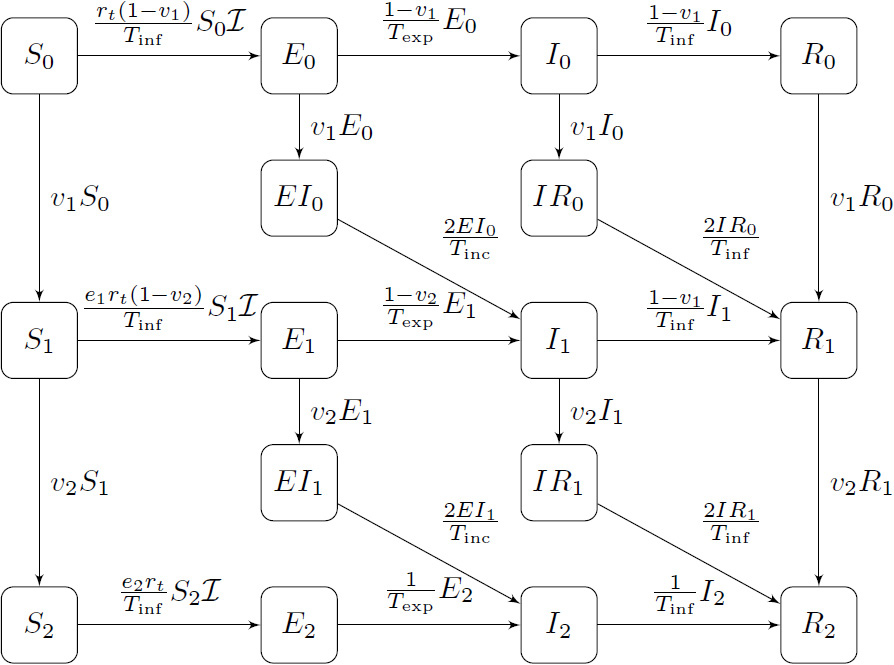
Our third problem was related to Brazil’s vaccination campaign, which began in early 2021. At that point in time, some countries had already decided to postpone the vaccine’s second dose in order to maximize the coverage of individuals with a single dose and slow down the pandemic. We then built a new model that accounts for two-dose vaccines (see Figure 3). The model could design an optimized vaccination campaign and define the ideal moment for the second dose within a given time window. The objective was not only to confirm that the optimized campaign would naturally delay the second dose, but also to compare the trajectories of alternative campaigns and estimate the delay’s impact. Considering the effectiveness of a single dose versus two doses of the AstraZeneca vaccine that Brazil was distributing, we showed that the delay of the second dose was desirable — doing so could avoid up to 40 intensive care unit admissions per 100,000 people over 200 days or more in a population where the virus’ original Alpha variant dominates. However, the same work showed that the situation changes completely in a population where the Delta variant is prevalent, as this variant greatly decreases the efficacy of a single dose [11].
We were able to achieve all of these results thanks to many tools from the applied mathematics community; we started with flexible compartmental models and used control theory, ODE discretization methods, and optimization and operations research modeling techniques. Stochastic time series models allowed us to estimate the intensive care unit demand, the JuMP optimization modeling language enabled rapid prototyping and experimentation [2], and the high-quality nonlinear optimization solver IPOPT [14] successfully coped with problems that involved hundreds of thousands of variables and constraints.
Ultimately, the mathematical community’s role in the pandemic response has proven and continues to prove that tackling any nontrivial real-world problem is a collective endeavor.
Paulo J.S. Silva presented this research during a minisymposium at the 2021 SIAM Conference on Optimization, which took place virtually last year in conjunction with the 2021 SIAM Annual Meeting.
References
[1] Brauer, F. (2008). Compartmental models in epidemiology. In F. Brauer, P. van den Driessche, & J. Wu (Eds.), Mathematical epidemiology (pp. 19-79). Heidelberg: Springer.
[2] Dunning, I., Huchette, J., & Lubin, M. (2017). JuMP: A modeling language for mathematical optimization. SIAM Rev., 59(2), 295-320.
[3] Gronvall, G.K. (2020). The scientific response to COVID-19 and lessons for security. Survival, 62(3), 77-92.
[4] Horowitz, J. (2020, March 12). Italy’s health care system groans under coronavirus — a warning to the world. The New York Times. Retrieved from https://www.nytimes.com/2020/03/12/world/europe/12italy-coronavirus-health-care.html.
[5] Hu, B., Guo, H., Zhou, P., & Shi, Z.-L. (2021). Characteristics of SARS-CoV-2 and COVID-19. Nat. Rev. Microbiol., 19(3), 141-154.
[6] Johns, S. (2020, August 11). The global impact of Imperial’s COVID-19 Response Team. Imperial College London. Retrieved from https://www.imperial.ac.uk/news/198737/the-global-impact-imperialscovid-19-response.
[7] Kirk, D.E. (2004). Optimal control theory: An introduction. Mineola, NY: Dover Publications.
[8] Landler, M., & Castle, S. (2020, March 17). Behind the virus report that jarred the U.S. and the U.K. to action. The New York Times. Retrieved from https://www.nytimes.com/2020/03/17/world/europe/coronavirus-imperial-college-johnson.html.
[9] Nonato, L.G., Peixoto, P., Pereira, T., Sagastizábal, C., & Silva, P.J.S. (2020). Robot Dance: A mathematical optimization platform for intervention against Covid-19 in a complex network. Eprint, Optimization Online.
[10] Silva, P.J.S., Pereira, T., Sagastizábal, C., Nonato, L., Cordova, M.M., & Struchiner, C.J. (2021). Smart testing and critical care bed sharing for COVID-19 control. PLOS ONE, 16(10), e0257235.
[11] Silva, P.J.S., Sagastizábal, C., Nonato, L.G., Struchiner, C.J., & Pereira, T. (2021). Optimized delay of the second COVID-19 vaccine dose reduces ICU admissions. PNAS, 118(35), e2104640118.
[12] Sontag, E.D. (1998). Mathematical control theory. New York, NY: Springer.
[13] van Elsland, S.L., & O’Hare, R. (2020, March 17). COVID-19: Imperial researchers model likely impact of public health measures. Imperial College London. Retrieved from https://www.imperial.ac.uk/news/196234/covid-19-imperial-researchersmodel-likely-impact.
[14] Wächter, A., & Biegler, L.T. (2006). On the implementation of an interior-point filter line-search algorithm for large-scale nonlinear programming. Math. Program., 106(1), 25-57.
[15] Wu, J.T., Leung, K., & Leung, G.M. (2020, February). Nowcasting and forecasting the potential domestic and international spread of the 2019-nCoV outbreak originating in Wuhan, China: A modelling study. Lancet, 395(10225), 689-697.
About the Author
Paulo J.S. Silva
Associate Professor, University of Campinas, Brazil
Paulo J.S. Silva is an associate professor in the Department of Applied Mathematics at the University of Campinas, Brazil. His main research interests are convex and nonlinear optimization and applications.

Stay Up-to-Date with Email Alerts
Sign up for our monthly newsletter and emails about other topics of your choosing.