
From Opinion Polarization to Climate Action: A Social–climate Model of the Opinion Spectrum
![<strong>Figure 1.</strong> Schematic representation of the model with input variables for each component. Figure courtesy of [10].](/media/vtrg3kot/figure-1.jpg)
Understanding and responding to climate change starts with evaluating how changes in human behavior and social dynamics influence climate dynamics. However, conventional climate models describe the physical processes that govern climate evolution, neglecting the fact that emissions trajectories are ultimately shaped by human decisions. Our research aims to bridge this gap using social-climate models that explicitly couple social dynamics with climate dynamics [1, 3, 9, 13]. This modeling technique has increased in use across the broader class of coupled human-environment systems research [7, 11], demonstrating that interdisciplinary approaches can open new pathways for sustainability science.
Recent social-climate modeling studies identified social factors such as policy, social interaction, societal norms, and opinion polarization as critical determinants of future emissions pathways [3, 5, 16]. However, most of the existing coupled social-climate models represent climate-related opinions as binary choices, solely differentiating between mitigation and non-mitigation behaviors [1, 3, 9, 12]. This simplification contrasts sharply with empirical evidence, which shows that opinions typically lie on a continuous spectrum [4]. In the context of climate change, opinions range from strong support, neutrality or ambivalence, and ultimately to strong opposition towards mitigation behaviors [14].
Continuous Opinion Dynamics and Social Influence
Models of opinion dynamics highlight how social influence, network structure, and cognitive biases shape opinion formation. One of the earliest continuous opinion models is the DeGroot model, which describes belief updating through weighted averaging of neighbors’ opinions [6]. A prominent extension of the DeGroot model is the Friedkin–Johnsen (FJ) model, which incorporates stubbornness, or the tendency of individuals to resist changing their opinions [2]. The FJ model has been applied to real-world collective decision-making, including modeling negotiation dynamics during the Paris Agreement, where national-level stubbornness played a key role [8].
But, despite their long history and broad applicability, continuous opinion models are primarily studied in isolation from environmental and climate systems and have not previously been incorporated into coupled social-climate models. This omission is surprising given the wealth of empirical evidence on how opinions form and polarize (i.e., individuals typically weigh their own opinions more heavily than those of others [15]), and because previous work shows that coupling social and environmental systems—even with binary decisions—produces regimes that do not exist when either system is studied in isolation [1, 3, 9].
A Coupled Social-climate Model with Continuous Opinions
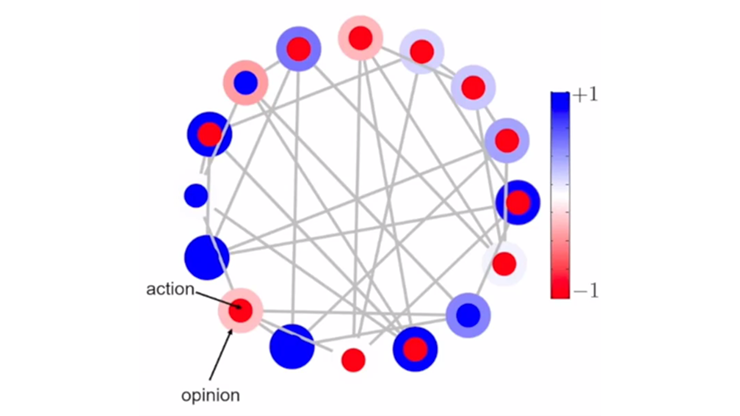
To study both systems, we modified the FJ model and coupled it to a simplified Earth system model. In our framework, individuals hold opinions on a continuous spectrum, and opinions are assumed to translate directly into actions: those with stronger pro-mitigation opinions corresponded to lower emissions, stubborn individuals placed less weight on others’ opinions, and social learning governed the strength of interpersonal influence. Climate feedback entered through individual responsiveness to temperature change.
![<strong>Figure 2.</strong> Temperature response and cost of mitigation have a major influence on emission and peak temperature Heatmap showing the influence of variation in \(R_{\textrm{max}}\) and mcost on <strong>2a.</strong> emission levels and <strong>2b.</strong> peak temperature anomaly. Figure courtesy of [10].](/media/tgacb3ua/figure-2.jpg)
This coupled model allows us to explore how stubbornness, social influence, mitigation costs, and climate responsiveness interact to shape emissions trajectories and temperature trends. We can also examine whether polarization can emerge from initially uniform opinions, if it can be reduced or eliminated, and how social or environmental perturbations affect long-term outcomes.
Key Insights and Implications
Our analysis revealed that opinion polarization can emerge robustly across a broad range of parameters. To our knowledge, this is the first demonstration of polarization arising endogenously in a coupled human-environment system. Importantly, polarization did not preclude climate mitigation, i.e., even with polarized opinions, an average pro-mitigation stance in the population substantially reduced emissions.
Additionally, the simulation revealed that if at least 50 percent of the population adopted mitigation-oriented opinions, global warming would be halted. Achieving this threshold did not require unanimous agreement; lowering mitigation costs and increasing responsiveness to climate change—through mitigation-friendly lifestyles and social norms—were effective enough strategies. Interestingly, our model identified the critical mitigation cost values at which polarization collapses, suggesting that heightened climate responsiveness can temporarily outweigh cost concerns.
Social learning also emerged as a key factor; higher learning rates reduced temperature anomalies, while highly stubborn populations could exceed a global mean temperature anomaly of two degrees Celsius. High stubbornness corresponded with societal resistance to evidence or persuasion, potentially driven by political ideology, misinformation, or low trust in science. In contrast, reduced stubbornness—enabled by education, climate literacy, and social consensus—facilitated mitigation.
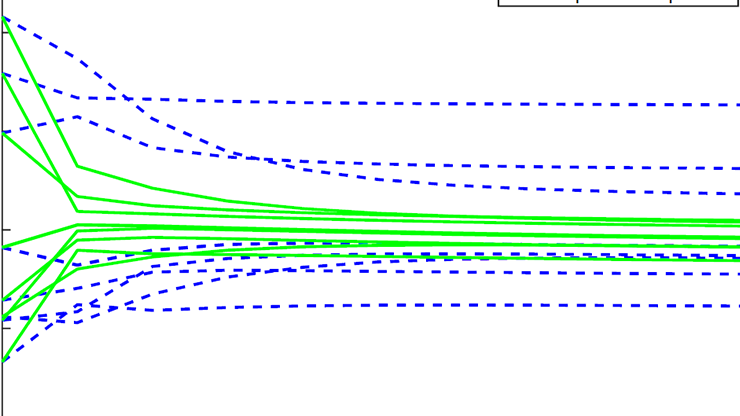
![<strong>Figure 3.</strong> Time series for the coupled social-climate model Times series showing <strong>3a.</strong> the opinion dynamics, <strong>3b.</strong> emission scenario \((\textrm{Gt}\textrm{CO}_{2}\textrm{yr-1}),\) and <strong>3c.</strong> temperature anomaly \((^{\circ}\textrm{C})\) for baseline parameter values. Time series for <strong>3d.</strong> average opinion, <strong>3e.</strong> emission scenario \((\textrm{Gt}\textrm{CO}_{2}\textrm{yr-1}),\) and <strong>3f.</strong> temperature anomaly \((^{\circ}\textrm{C})\) for different parameter scenario. Figure courtesy of [10].](/media/45kbq4f1/figure-3.jpg)
Looking Ahead
Our model is intentionally theoretical and was not empirically validated. Future work could calibrate it using data on environmental attitudes, renewable energy costs, and emissions pathways. Scaling mitigation costs to match real-world trajectories could allow comparison with representative concentration pathway scenarios over the next several decades.
We also see that random noise also plays a significant role in long-term dynamics. Recent research demonstrated that stochasticity could produce nontrivial effects in other coupled human-environment systems. As climate change increases the frequency of extreme events, another topic worth exploring is the effect of skewed noise distributions with fat tails, as our results suggested that frequent, unexpected shocks—either social or environmental—can reduce pro-mitigation opinion and lead to higher peak temperatures.
While our framework omits factors such as media influence, economic inequality, and political power [8], it provides a foundation for incorporating such complexities. Extensions could include multiple mitigation pathways, such as carbon pricing, renewable subsidies, or emissions caps, thus allowing policymakers to explore optimal strategies within a dynamically evolving opinion landscape.
Even in its simplicity, this coupled social-climate model highlights the profound importance of opinion dynamics in shaping climate outcomes. By moving beyond binary representations and embracing the full spectrum of social beliefs, mathematical models can offer deeper insight into the pathways and obstacles toward effective climate action.
Athira Satheesh Kumar delivered a minisymposium presentation on this research at the 2025 SIAM Conference on Applications of Dynamical Systems (DS25), which took place in Denver, Colo. in May 2025. She received funding to attend DS25 through a SIAM Early Career Travel Award. To learn more about Early Career Travel Awards and submit an application, visit the online page.
References
[1] Beckage, B., Moore, F.C., & Lacasse, K. (2022). Incorporating human behaviour into earth system modelling. Nat. Hum. Behav., 1, 1-10.
[2] Bernardo, C., Wang, L., Vasca, F., Hong, Y., Shi, G., & Altafini, C. Achieving consensus in multilateral international negotiations: The case study of the 2015 paris agreement on climate change. Science Advances, 7(51).
[3] Bury, T.M., Bauch, C.T., & Anand, M. (2019). Charting pathways to climate change mitigation in a coupled socio-climate model. PLoS Comput. Biol., 15(6), e1007000.
[4] Castellano, C., Fortunato, S., & Loreto, V. (2009). Statistical physics of social dynamics. Reviews of modern physics, 81(2):591–646.
[5] Choudhary, G., Sihag, D., & Dutt, V. (2024). Climate decision making: influence of prevailing social norms and probability of climate change. Front. Earth Sci., 12:1397857, 2024.
[6] DeGroot, M.H. (1974). Reaching a Consensus. JSTOR, 69(345), 118-121.
[7] Farahbakhsh, I., Bauch, C.T., & Anand, M. (2022). Modelling coupled human environment complexity for the future of the biosphere: strengths, gaps and promising directions. Philos. Trans. R. Soc. Lond. B Biol. Sci., 377(1857): 20210382.
[8] Friedkin, N.E. & Johnsen, E.C. (1990). Social influence and opinions. J. Math. Sociol., 15(3-4), 193-206.
[9] Kumar, A.S., Bauch, C.T., & Anand, M. (2025). Climate-denying rumor propagation in a coupled socio-climate model: Impact on average global temperature. PLoS ONE, 20(1), e0317338.
[10] Kumar, A.S., Josic, K., Bauch, C.T., & Anand, M. (2026). From opinion polarization to climate action: A social-climate model of the opinion spectrum. Preprint, https://arxiv.org/pdf/2503.04689.
[11] Liu, J., Dietz, T., Carpenter, S.R., Alberti, M., Folke, C., Moran, E., ... Taylor, W.W. (2007). Complexity of coupled human and natural systems. Science, 317(5844), 1513-1516.
[12] Menard, J., Bury, T.M., Bauch, C.T., & Anand, M. (2021). When conflicts get heated, so does the planet: coupled social-climate dynamics under inequality. Proc. Biol. Sci., 288(1959):20211357.
[13] Moore, F.C., Lacasse, K., Mach, K.J., Shin, Y.A., Gross, L.J., Beckage, B. (2002). Determinants of emissions pathways in the coupled climate–social system. Nature, 603(7899), 103-111.
[14] Morrison, M., Parton, K., & Hine, D.W. (2018). Increasing belief but issue fatigue: Changes in Australian Household Climate Change Segments between 2011 and 2016. PLoS ONE, 13(6): e0197988.
[15] Moussaïd, M., Kämmer, J.E., Analytis, P.P., & Neth, H. (2013). Social Influence and the Collective Dynamics of Opinion Formation. PLoS ONE, 8(11): e78433.
[16] Perri, S., Levin, S.A., Cerasoli, S., & Porporato, A. (2024). Socio-political dynamics in clean energy transition. Environ. Res. Lett., 19(7), 074017.
About the Author
Athira Satheesh Kumar
Postdoctoral trainee, Boston Children’s Hospital
Athira Satheesh Kumar is a postdoctoral trainee at Boston Children’s Hospital and Harvard Medical School. Kumar earned her Ph.D. in applied mathematics from the University of Waterloo under the supervision of Chris Bauch and Madhur Anand. She is interested in how human behavior interacts with complex environmental and health systems; her work integrates mathematical modeling, agent-based simulations, and empirical data to study dynamics in climate change, disaster response, and infectious disease, with a focus on feedback, tipping points, and emergent patterns.

Stay Up-to-Date with Email Alerts
Sign up for our monthly newsletter and emails about other topics of your choosing.