
Gravitational Wave and Neutrino Signatures Reveal Details about Supernovae
Recent global collaborations have spurred exciting development in computational and theoretical astrophysics. A lot of exciting work along these avenues was presented at the 2021 SIAM Conference on Computational Science and Engineering, which took place virtually last week. During a minisymposium presentation at the conference, David Vartanyan of the University of California, Berkeley described his research into modeling the gravitational wave and neutrino signatures of core-collapse supernovae. Using a multidimensional radiation hydrodynamic code called FORNAX, Vartanyan and his collaborators have successfully modeled stellar explosions with energies that are commensurate with observations of stars across dozens of stellar models.
"Core-collapse supernova research has a rich—and at times anguished—history," Vartanyan said during his talk. Supernova models must incorporate a lot of detailed physics, and the mechanisms of explosions still remain only tenuously understood. Over the last several years, simulations have transitioned from three-dimensional models of individual stars to encompass entire stellar populations. This has been beneficial to supernova research, as core-collapse supernova—explosions of massive stars that occur when they run out of fuel to consume, thus collapsing inwards and rebounding to explode outwards—result from a diverse range of progenitor stars. Though this endeavor has cost many millions of central processing unit hours on supercomputers, it has contributed to significant results within the field of theoretical astrophysics.
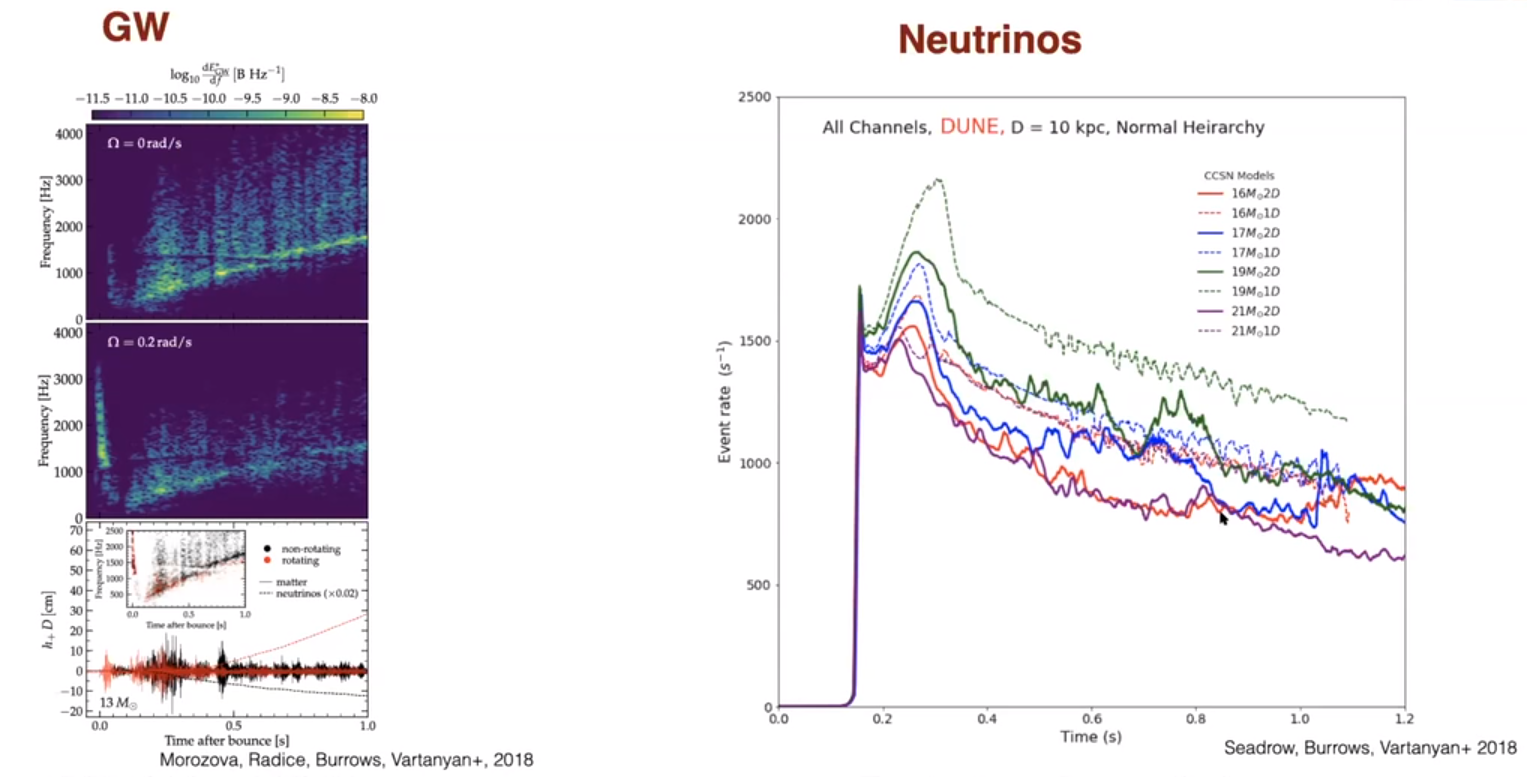
During his presentation, Vartanyan focused on the predictive power of these multidimensional simulations for constraining the gravitational wave and neutrino signatures produced by supernovae. A sample template of the kinds of signatures that one might expect to observe from real supernovae is shown in Figure 1. Vartanyan and his collaborators modeled the gravitational waves depicted in the figure to resemble signatures that could be detected by the advanced Laser Interferometer Gravitational-Wave Observatory. They modeled two scenarios—one that resulted from a non-rotating stellar progenitor and one that resulted from a rotating star—and found the signatures to have distinct differences. Figure 1 also displays the neutrino event rates expected to be measured by the Deep Underground Neutrino Experiment. The event rates correspond to four possible progenitor masses, each modeled with both one-dimensional and two-dimensional symmetry. In all cases, Vartanyan expects thousands of neutrinos to be detected within the first second. These templates show that distinctive signatures correspond to supernovae from different progenitors, and thus can provide insight into the multidimensional dynamics of the explosion.
Simultaneous observations of gravitational waves and neutrinos from a single supernova can provide further insights into the mechanisms of the star’s core, such as rotation and instabilities. As a star shrinks in the early stages of a supernova, it creates higher frequency gravitational waves. The detected gravitational waves can also provide a constraint on properties of the stellar core, such as mass and radius. In addition, neutrino measurements allow researchers to constrain the binding energy of the neutron star that could be created after the explosion. The gravitational wave and neutrino intensities together can probe the star’s accretion rate and aspects of the morphology of the supernova shock, such as its radius and the direction in which matter is being funneled.
In their modeled supernova explosions, Vartanyan and his collaborators noticed two instabilities: lepton emission self-sustained symmetry and standing accretion shock instability. The latter is often seen in models where the star fails to explode (in the existing literature, stars with masses 13 to 15 times greater than the Sun have been found to be more difficult to explode in models than more massive stars), because this form of instability requires that the shockwave of the supernova be stalled.
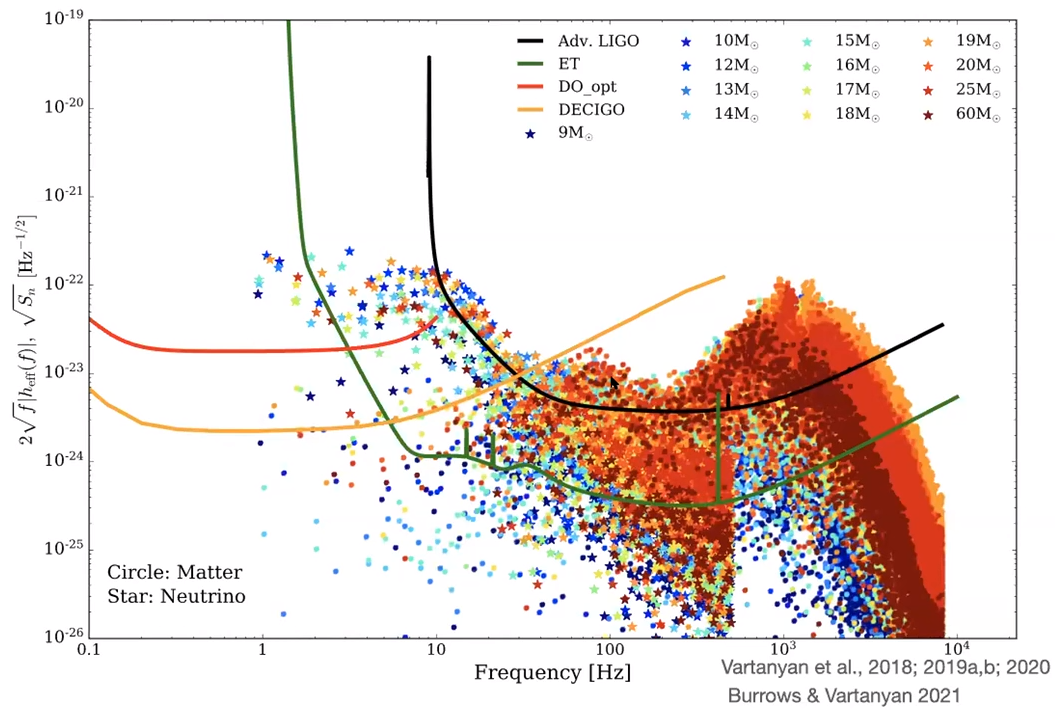
Research over recent years has generally paid more attention to the contribution of stellar matter to core-collapse supernovae than that of neutrinos. However, both neutrino and matter asymmetries can lead to gravitational waves, though with different signatures. Neutrino-sourced gravitational waves have less energy, higher amplitudes, less variation over time, and lower frequencies — the waveforms resulting from neutrinos have frequencies less than 100 Hertz, while the waveforms resulting from matter have a greater frequency. Neutrino contributions also occur at timescales on the order of tens of milliseconds, as opposed to matter’s shorter timescales on the order of single milliseconds.
Broadband gravitational wave spectra span four orders of magnitude in frequency, but different detectors are able to pick up the signals throughout various parts of that range. Figure 2 shows the detection capabilities of four different facilities as compared to signals that one would expect supernovae with progenitors of varying masses to produce. "We are well-poised with current and future space- and ground-based missions to detect galactic events over a wide range of masses and frequencies," Vartanyan said. Based on the results of multidimensional simulations, researchers will be able to glean more insight from future detections of gravitational waves and neutrinos emitted by core-collapse supernova, thus learning more about the structure and morphology of these energetic events.
About the Author
Jillian Kunze
Master's student, Drexel University
Jillian Kunze is the former associate editor of SIAM News. She is currently a master’s student in data science at Drexel University.

Stay Up-to-Date with Email Alerts
Sign up for our monthly newsletter and emails about other topics of your choosing.