
Mathematical Modeling of Pulsating Soft Corals
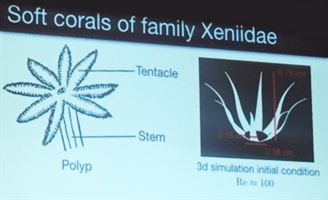
Coral ecosystems are of interest for environmental conservation due to the notable diversity exhibited by them. While coral reefs are composed of hard corals with calcium carbonate skeletons, soft coral of the Xeniidae family have an active pulsating motion, which is unusual among sessile organisms. While this behavior expends energy, it has been shown to enhance photosynthesis rates in these organisms.
“Is the pulsating motion really adding anything to the flow dynamics that's already exists and really benefiting the animals?"
That’s the question Shilpa Khatri (University of California, Merced) asked during her talk, “Modeling of Pulsating Soft Corals” at the minisymposium celebrating Charles S. Peskin's 70th Birthday, “Mathematical Modeling in Biological Fluid Dynamics and Systems Biology”. Khatri proceeded to answer the question by describing a combination of mathematical models and experiments.
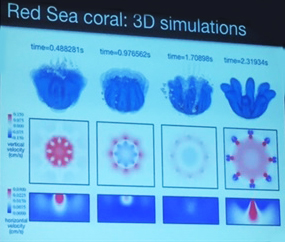
Preliminary data sets indicate that somehow the pulsating motion is helping the coral: pulsating increases turbulence which may increase mixing. Their data also shows that it's beneficial for photosynthesis. However, the corals don't pulse only in the presence of light; they pulse 24 hours a day, so open questions remain.
Her group is also studying the pulsing dynamics’ effect on particle capture, nutrient exchange, and waste removal. Khatri presented direct numerical simulations of the coral pulsations, and the consequent fluid flow by solving the Navier-Stokes equations coupled with the immersed boundary method. She described kinematics methods used by her group to simulate the movement, six points along a tentacle are tracked using image processing and tracking methods.
About the Author
Karthika Swamy Cohen
Former Managing Editor, SIAM News
Karthika Swamy Cohen is the former managing editor of SIAM News.

Stay Up-to-Date with Email Alerts
Sign up for our monthly newsletter and emails about other topics of your choosing.