
Mathematical Models for Cell Polarization and Gradient Sensing
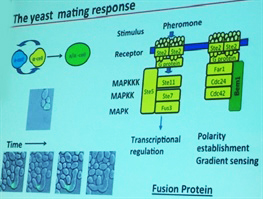
Moving or projecting up a chemical gradient is a universal feature of living organisms. Cells often sense and respond to spatial and chemical gradients.
Timothy Elston of University of North Carolina at Chapel Hill gave an invited talk, “Mathematical Models for Cell Polarization and Gradient Sensing” at the SIAM Conference on the Life Sciences being held in Boston this week. Elston described mathematical approaches to study polarized growth and gradient sensing, two processes essential to cellular growth. Combining mathematical analysis with experimental observations, Elston’s group studies the biochemical and molecular mechanisms behind directed growth and gradient sensing.
In polarized growth, a front is maintained, allowing migration and differentiation in multicellular organisms.When cells polarize, they distribute protein in an asymmetric way.
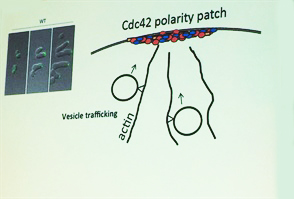
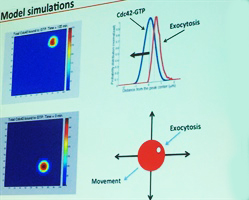
The destabilization of uniform chemical distribution to spatial patterns at a given wave number is commonly called Turing type pattern formation. If a Turing instability is present, an as yet un-polarized cell would react to spatially varying stimulus by forming a chemical pattern and breaking symmetry. Hence, Turing instabilities are used to model polarization.
"Symmetry breaking happens in the context of polarization,” explained Elston. “Here, each individual cell can break symmetry, and this happens through Turing instability.”
Elston explained gradient sensing and polarization with examples from yeast, which undergo polarized growth in two contexts --when they form a bud during cell division, and during the mating process. While yeast are typically diploid, they can also exist as haploids a - males and alpha female. The haploids then find each other during mating by chemotropic growth. In the case of budding, internal cues are involved, and in mating, the cues are external.
Using the example of the protein Cdc-45, and its movement in the cytoplasm, he explained how polarity is established in yeast cells. Not surprisingly, Cdc-45 is essential for cell division and mating in yeast. Quite simply, Elston explained a simple model of polarity, "There's always competition and the bigger people always win." Elston described a stochastic model, which tracks the position and chemical state of each molecule. The process is analyzed in more detail by switching to reaction diffusion equations.
About the Author
Karthika Swamy Cohen
Former Managing Editor, SIAM News
Karthika Swamy Cohen is the former managing editor of SIAM News.

Stay Up-to-Date with Email Alerts
Sign up for our monthly newsletter and emails about other topics of your choosing.