
Mathematizing in Times of Trouble
More than five years ago, we addressed the immediate ethical challenges that faced the mathematical community amidst the urgency of the COVID-19 pandemic — a crisis that thrust many mathematicians into public service roles. In that environment of post-normal science, which necessitated mathematical contributions under uncertainty and at great speed, we proposed eight “Questions of Responsibility” to serve as guidelines that promote ethical mathematical modeling practices [3]. Although the pandemic has passed, public reliance on applied mathematics in high-stakes decision-making scenarios has only accelerated. In fact, the proliferation of machine learning and data analytics means that mathematical expertise is now embedded in our society more deeply than ever. The lessons and takeaways from COVID-19 were not merely temporary adjustments; instead, they demonstrated that applied mathematics research does not occur in a political or ethical vacuum. This realization highlighted the global need for a more systematic approach to responsibility, which felt urgent back then and has since become a professional necessity for many.
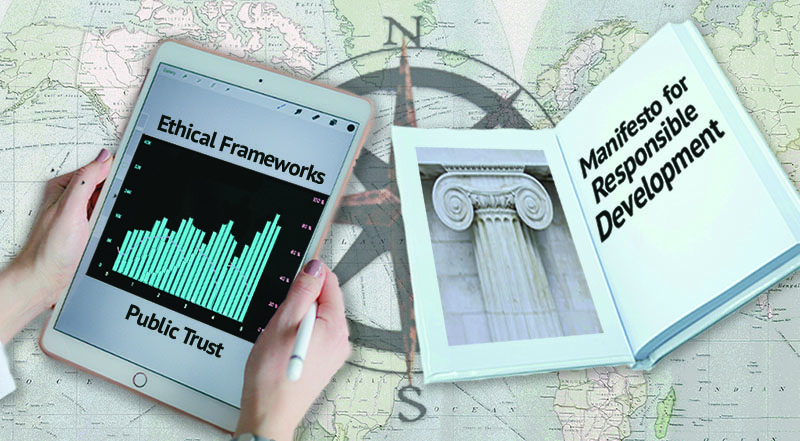
With these realities in mind, we spent the last several years expanding our original eight questions into a more comprehensive, process-oriented framework that we call the Manifesto for the Responsible Development of Mathematical Works [4]. This updated framework is centered around 10 pillars, which we present here with slightly reformulated wording:
- Decide whether to begin: Why are you providing the mathematical product or service in question, and should you even do so?
- Consider diversity and perspectives: Do you, your coworkers, and your superiors have sufficient perspective on the issues at hand? Do you understand the limitations and biases in your thinking?
- Handle data and information responsibly: Are you using authorized and morally obtained datasets in a responsible manner?
- Consider data manipulation and inference: Do you have the expertise to properly manipulate data while ensuring quality and ethics?
- Review the mathematization of the problem: What optimization objectives and constraints are you choosing, and what are their real-life consequences? Who might be impacted by your mathematics and actions?
- Communicate and document your work: Are you properly considering how to best comment and document your work and communicate the results to those who need them?
- Evaluate falsifiability and feedback loops: Is your work falsifiable, and can you handle its large-scale impact and any feedback loops that may arise?
- Establish explainable and safe mathematics: Is your mathematical output explainable, and have you followed up with proper monitoring and maintenance practices?
- Acknowledge that mathematical artifacts have politics: Are you aware of other non-mathematical aspects and the political nature of your work? What are you doing to earn public trust in yourself and your product?
- Identify emergency response strategies: Do you have a nontechnical response strategy for when things go wrong? Do you have an established support network, including peers who support you and with whom you can talk freely?
We taught these pillars in an advanced seminar at the University of Cambridge in 2024, using a worked example of artificial intelligence (AI)-powered bus timetabling and routing. Students were “surprised” by the ethical scope of this public-facing mathematics project [7], realizing that even something as simple as a bus timetable could have “ramifications for citizens, democracy, and the environment” [10]. Since a framework’s effectiveness relies on adoption, our involvement with the Ethics in Mathematics Project seeks to translate these principles into both practice and education. In doing so, we found that sustainable and ethical mathematics must be localized to its specific context, as blindly following a general philosophical framework designed to “apply everywhere” risks alienating mathematicians and students alike [7].
We therefore implement a critical pragmatic approach that meets students at their current level of philosophical understanding, rather than frontloading abstract philosophy. Our technique aims to foster ethical responsibility without taking the fun out of mathematics, gradually guiding students toward ethical abstraction by repeatedly showing them a problem from different angles — i.e., employing a “spiral structure” similar to that of standard mathematical curricula. We soon noticed that “leveling up” ethical awareness [2, 7] can happen rather quickly, as long as students refrained from hastily conducting mathematics without the proper initial considerations (Pillar 1) and widened their perspective before working with any data (Pillar 2).
From 2023 to 2025, we also participated in a project titled “Anticipating the Future of War: AI, Automated Systems, and Resort-to-Force (RTF) Decision Making.” This domain typically shields mathematicians from scrutiny even as their research impacts one of the most public-facing decisions imaginable: When should a nation go to war? By considering the three primary stakeholder groups in this domain—developers who create AI systems, integrators who embed them into established decision-making processes, and users (including senior political and military leaders, as well as their advisors)—we observed that effective communication requires more than just a shared language [5, 8]. In fact, it is equally critical that mathematicians and political scientists bridge their respective disciplines and discuss their differing perspectives and priorities.
When we presented our framework at two of the project’s workshops about AI for RTF decisions, we observed a fundamental epistemological divide — that is, a deep gap in technical and non-technical experts’ understanding of both the nature of the problem and the required evidence for a solution. Various issues and questions—such as, When is it okay to treat certain aspects as a black box problem?—were interpreted differently by different groups. We found that our 10 pillars can challenge traditional assumptions about military accountability by decentralizing ethical responsibility to include developers and integrators, rather than relying solely on political leaders.
This experience left us with several observations that are relevant to the entire mathematical community. First, in 2021, Shoshana Zuboff wrote in The New York Times that “[w]e can have democracy, or we can have a surveillance society, but we cannot have both” [11]. This outlook prompted Moshe Vardi to conclude, right here in SIAM News, that “the current situation is a crisis of public policy, not a crisis of ethics” [9]. The fact that AI-assisted RTF decision-making has become a public concern—even though many mathematical and technical education tracks only teach a minimum of ethics and almost no policy—demonstrates that the political and moral reality is evolving rapidly and might leave our students behind in that regard, despite their mathematical prowess.
Second, mathematicians and computer scientists wield growing influence that, during emergencies, often transforms into direct power. Governments in crisis may “hand over the keys to the city” [1], granting outside technical experts major decision-making authority and operational control in order to provide a solution. As illustrated in the aforementioned AI-RTF scenarios, scientific and mathematical experts receive technological and scientific “keys” that are vital to infrastructure, policy choices, and (inter)national security [1]. However, great danger can result when these transfers occur with minimal oversight. In such situations, authority shifts from democratic processes toward purely technocratic solutions — potentially eroding the self-correcting mechanisms that safeguard democratic governance [6]. What begins as emergency delegation can ultimately become a gradual, unaccountable concentration of power if either ethics or policy are lacking.
Finally, while ethics alone may not remedy the situation [9], we still believe it to be a crucial component. Without ethical awareness and properly localized process-oriented frameworks, both the individual mathematician and the mathematical community may soon have difficulty navigating the rapid sociopolitical changes in our society.
References
[1] Chiodo, M., Mbeva, K., Müller, D., & Snell, C. (2025). Handing over the keys to the city: When governments may inadvertently solve one crisis with a bigger one. Preprint, SSRN.
[2] Chiodo, M., & Müller, D. (2018, November 1). Mathematicians and ethical engagement. SIAM News, 51(9), p. 6.
[3] Chiodo, M., & Müller, D. (2020, September 1). Questions of responsibility: Modelling in the age of COVID-19. SIAM News, 43(7), p. 6.
[4] Chiodo, M., & Müller, D. (2025). Manifesto for the responsible development of mathematical works — a tool for practitioners and for management. J. Theor. Marg. Math. Educ., 4(1), 0404.
[5] Chiodo, M., Müller, D., & Sienknecht, M. (2024). Educating AI developers to prevent harmful path dependency in AI resort-to-force decision making. Aust. J. Int. Aff., 78(2), 210-219.
[6] Krastev, I. (2017, March 14). Democracy as self-correction. Aspen Review. Retrieved from https://www.aspeninstitutece.org/article/
2017/democracy-as-self-correction.
[7] Müller, D., & Chiodo, M. (2025). Ethical and sustainable mathematics is localised: Why global paradigms fail and culturally-situated practices are essential. Preprint, arXiv:2510:05892.
[8] Müller, D., Chiodo, M., & Sienknecht, M. (2026). Integrators at war: Mediating in AI-assisted resort-to-force decisions. Camb. Forum AI: Law Gov. To be published.
[9] Vardi, M.Y. (2022, April 1). Artificial intelligence: Ethics versus public policy. SIAM News, 55(3), p. 8.
[10] Yasmine, Z., & Siewert, P. (2024). Our experience and learnings from the Cambridge University ethics in mathematics course 2023/24. Cambridge University Ethics in Mathematics Society Blog. Retrieved from https://cueims.soc.srcf.net/blog.
[11] Zuboff, S. (2021, January 29). The coup we are not talking about. The New York Times. Retrieved from https://www.nytimes.com/2021/01/29/opinion/sunday/facebook-surveillance-society-technology.html.
About the Authors
Dennis Müller
Research associate, University of Cologne
Dennis Müller is a research associate at the Institute of Mathematics Education at the University of Cologne in Germany and a research affiliate at the Centre for the Study of Existential Risk at the University of Cambridge in the U.K. He is a founding member of the Ethics in Mathematics Project.

Maurice Chiodo
Research associate, University of Cambridge
Maurice Chiodo is a research associate at the Centre for the Study of Existential Risk at the University of Cambridge in the U.K. and principal investigator of the Ethics in Mathematics Project. A research mathematician by training, his work now addresses the ethical challenges and risks that are posed by mathematics, mathematicians, and mathematically-powered technologies.
Stay Up-to-Date with Email Alerts
Sign up for our monthly newsletter and emails about other topics of your choosing.