
“Modeling Life” Course Connects Life Science Students to Calculus Through Mathematical Modeling
The vast majority of undergraduate life sciences degrees require students to complete some level of calculus in addition to their regular coursework. Often, subsequent classes build upon the mathematical skills learned in introductory calculus to help teach students how to use mathematics in their specialized disciplines.
For many life science students, however, mathematics acts as a barrier to entry. “Calculus is often a gatekeeper for life science majors, and when the textbook is focused on physics- or finance-based examples it can be difficult to connect the math that a student is learning to what they’ll use in their careers,” said Emily Nielson, an undergraduate applied mathematics student at Utah State University. “Additionally, students typically have many years of math experience from high school, but don’t know how to use the skills they learned in a collegiate setting.”
In her contributed presentation at the 2026 SIAM Conference on Applied Mathematics Education—happening now in Cleveland, Ohio, co-located with the 2026 SIAM Annual Meeting—Nielson detailed the success of a new mathematical modeling course targeted specifically toward life science students.
The goal of the “Modeling Life” (MATH1100) course is to provide an effective alternative to traditional calculus courses that has a strong focus on mathematical modeling. “This is a quantitative course that gives [students] a new opportunity to connect the mathematics they know with the career they’re going to step into,” Nielson said. “When students participate in modeling, evidence suggests that it helps them connect the math they’re learning to a real-world application that they can make sense of.”
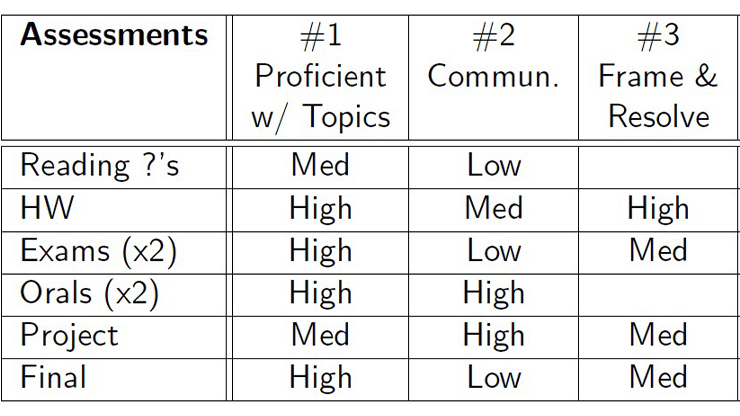
After speaking with life science professors at Utah State University, Nielson and her advisor, Sindura Kularajan, determined what level of mathematical knowledge professors were looking for students to bring from an introductory calculus course into their more specialized life science courses.
Professors said they expected students to be proficient in basic concepts like derivatives, but they also emphasized the importance of procedure-based math and understanding how to solve problems computationally.
They also expressed that they wanted students to effectively use “scaffolding,” or resources given to further support students on assignments and exams; this can include things like a list of relevant equations given to students to use during an exam. “Students need to be able to regurgitate on exams what the mathematical assumptions are and identify where different equations are relevant,” Nielson said. “Scaffolding shows that professors are aware that students need support, but it can also take away from the creative problem-solving they’ll need in their careers.”
According to Nielson, this is why incorporating modeling into introductory mathematics courses is so important; students need to be able to effectively use the tools that they’re given by professors in their life science courses but also creatively think about “messy” mathematics problems and conceptualize their real-world applications.
With these parameters in mind, Nielson and Kularajan investigated the academic success of over 180 students after they completed the Modeling Life course. “We looked at a student’s Modeling Life course grade, their grade-point average (GPA) prior to taking the course, and their grade in the next course that they took that required calculus as a prerequisite,” Nielson said.
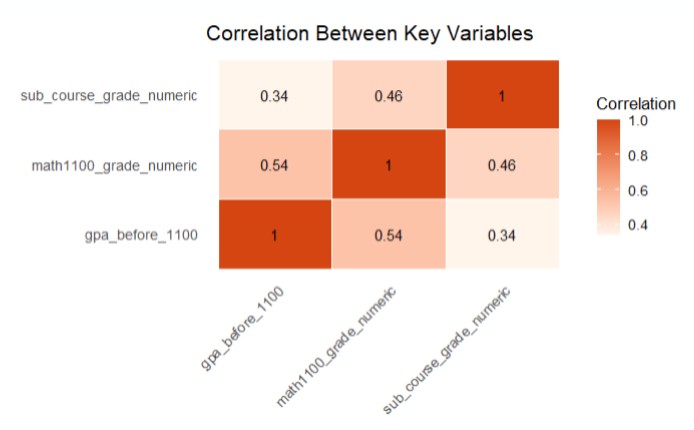
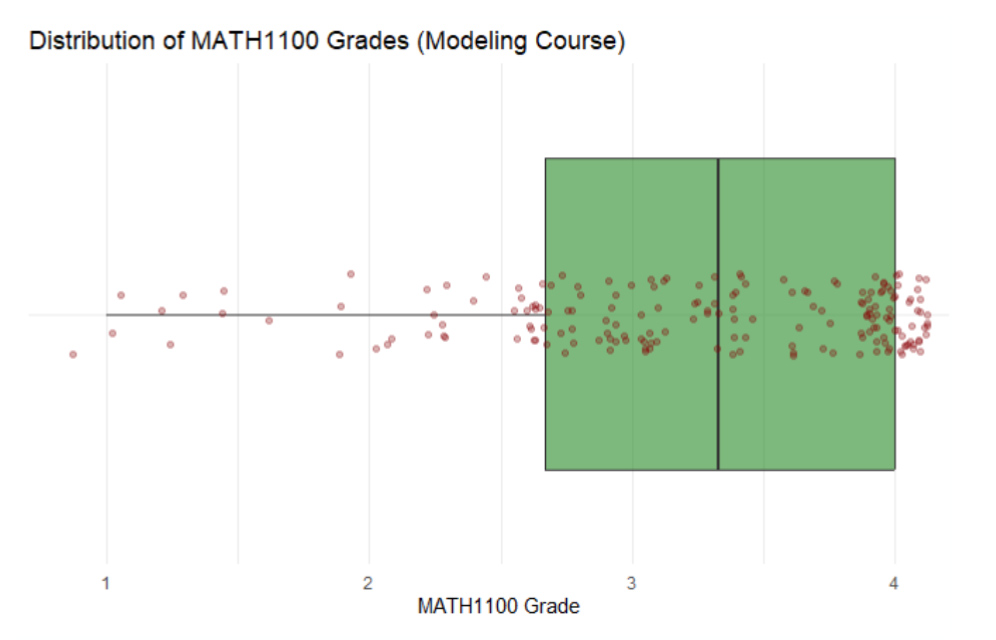
They were happy to see that a majority of students obtained an A or a B in the Modeling Life course (see Figure 1), but Nielson and her team were even more excited to see that those who took the course were more likely to do better in their future classes (see Figure 2). “A student’s performance in Modeling Life was moderately correlated with performance in subsequent courses,” Nielson said. “What was even more exciting was that this relationship is strong even after accounting for a student’s previous GPA. Their performance in [Modeling Life] was a better predictor of doing well in subsequent courses than their prior GPA.”
Nielson explained that while a student’s success in their subsequent courses could be impacted by many things, their data suggests that the course is doing what it is supposed to do. “Based on what we’re seeing, Modeling Life achieves or exceeds its aim to help students prepare for their future courses,” she said. “Hopefully it’s helping students do more than just get a high letter grade but also helping students prepare for future careers and better understand the world mathematically.”
About the Author
Nya Wynn
Associate editor, SIAM News
Nya Wynn is the associate editor of SIAM News.
Related Reading
Stay Up-to-Date with Email Alerts
Sign up for our monthly newsletter and emails about other topics of your choosing.