
Modeling Poor Sleep and Vaso-occlusive Crises in Sickle Cell Disease
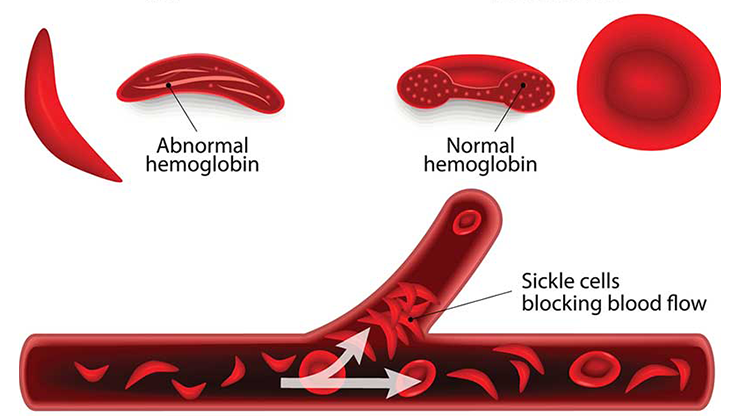
For patients with sickle cell disease (SCD), the most common reason for an emergency room visit is pain associated with a vaso-occlusive crisis (VOC) [2]. This extremely painful event occurs when sickled blood cells build up in a blood vessel and cause a blockage.
Milan Marsh and her advisor Rebecca Segal, both of Virginia Commonwealth University (VCU), wanted to explore different factors that impact the pain level of patients experiencing a VOC. “After talking with Dr. Cecilia Valrie at VCU and other biologists that study SCD, they made a point of telling us that if we were going to model sickle cell dynamics, we should incorporate a patient’s sleep quality as a factor that influences perceived pain by the patient,” Marsh said. “In fact, Dr. Valrie did a study with pediatric patients which found that poor subjective sleep quality was related to high pain severity the next day,” [3].
In her minisymposium presentation at the 2026 SIAM Conference on Life Sciences—collocated with the 2026 SIAM Annual Meeting and 2026 SIAM Conference on Applied Mathematics Education—Marsh presented a mechanistic model she developed to link underlying physiological processes, such as inflammation and cell adhesion dynamics, with patient sleep quality and perceived pain severity.
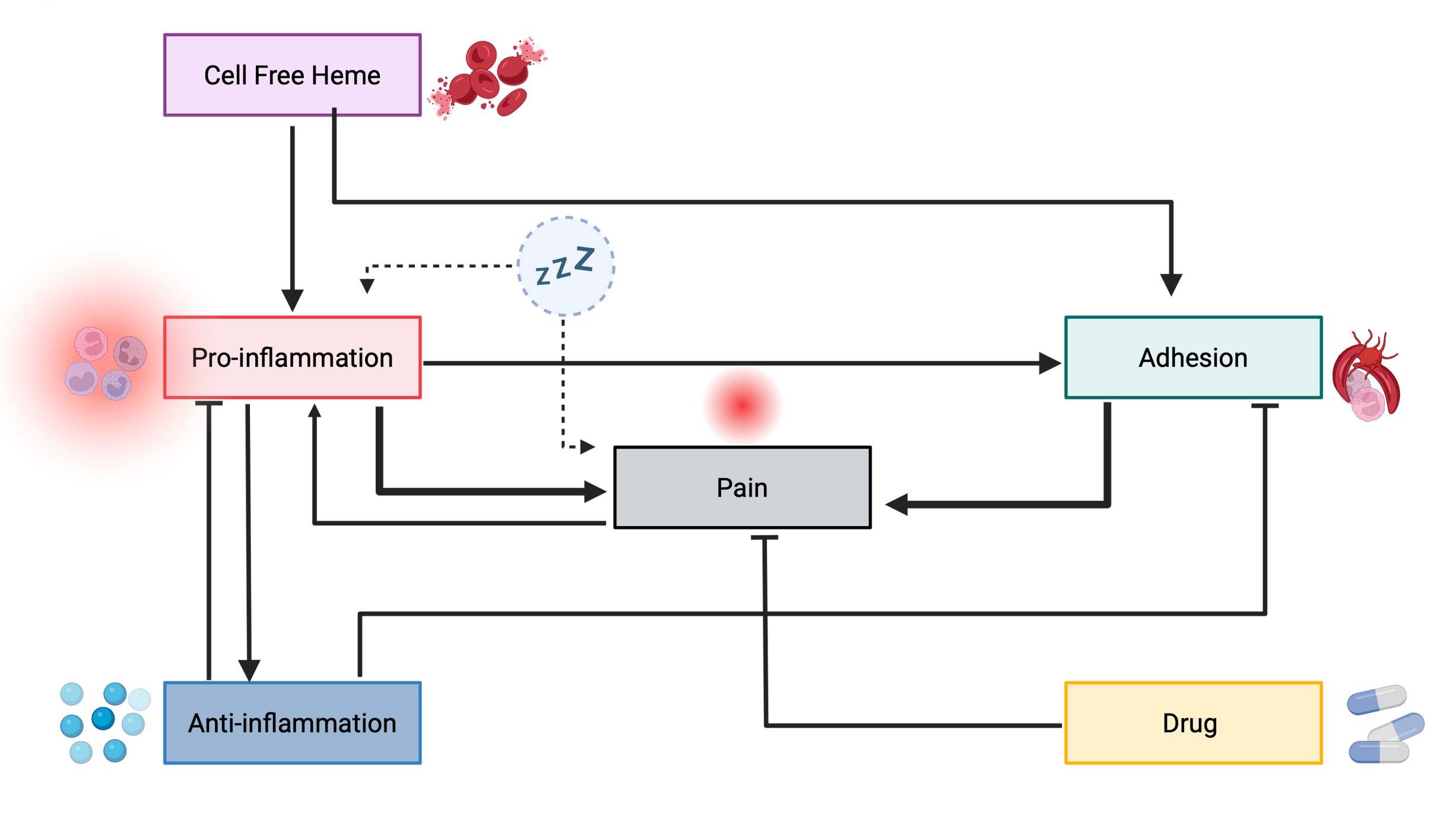
Marsh’s model employs a system of six ordinary differential equations to describe the interactions between a series of state variables (see Figure 1): pro-inflammation, anti-inflammation, cell adhesion, cell free heme, pain level, and drug treatment — for when pain becomes too extreme and medical intervention is required. Sleep quality acts as an external input in the model, impacting both pain and pro-inflammatory inputs.
Marsh explained that the pro- and anti-inflammatory response state variables in the model represent the total pro- or anti-inflammatory effects from cytokines or inflammatory cells such as neutrophils or macrophages. She also included a variable that represents cellular adhesion. “Sickled red blood cells interact with neutrophils, macrophages, and the vascular endothelium, causing cells to adhere to one another and to the walls of the blood vessel,” Marsh said.
Cell free heme levels were also taken into account, as levels of cell free heme in the bloodstream contribute to inflammation. “In addition to red blood cells becoming sickle-shaped in patients with SCD, the life span of red blood cells is reduced, which results in more hemolysis,” Marsh said. “In turn, cell free heme, the iron containing part of hemoglobin, is released into the environment, which directly activates the pro-inflammatory response.”
Then, Marsh looked at perceived pain level as another state variable. “Pain is very hard because pain severity is so subjective,” Marsh said. “But for the sake of the model, we utilized a scale from 0 to 10, where 10 is extreme levels of pain, that patients self-reported.”
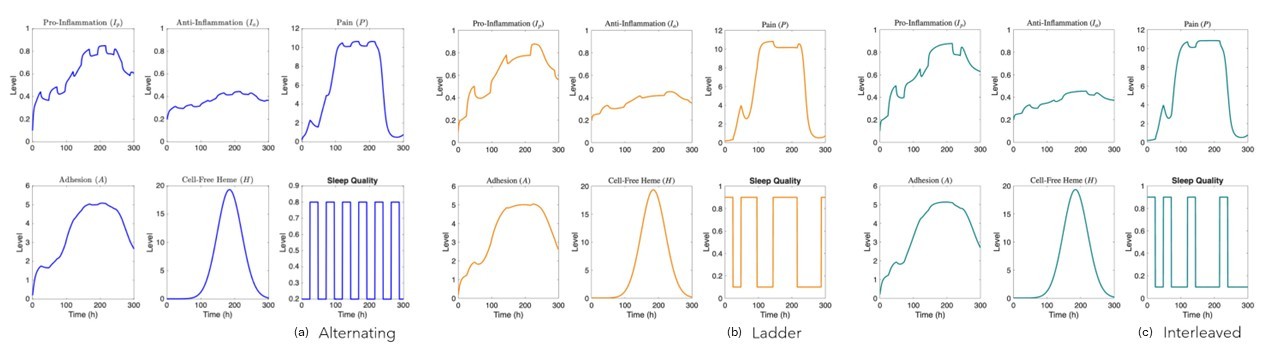
To analyze the impact of sleep on pain levels, Marsh considered three different sleep profiles (see Figure 2): alternating sleep, where a patient has a bad night of sleep followed by a good night of sleep; ladder sleep, where the number of consecutive good and bad nights gradually increases; and interleaved sleep, where one good night of sleep separates progressively longer stretches of poor sleep.
“Our goal is to understand how consecutive nights of poor sleep influence pain dynamics,” Marsh said. “For alternating sleep patterns, we noticed a small increase from what we might consider the baseline level. This is followed by a sharp increase toward maximum pain with some oscillations, and finally the pain resolves.” Marsh explained that the pain level profiles in the graphs corresponded with characteristic pain phases of VOC (phases shown in Figure 3).
This trend continued for the other sleep profiles but became increasingly more severe. “With the ladder sleep profile, once pain reaches its peak, there are fewer oscillations during the established phase of the VOC,” Marsh said. “The maximum pain level and pro-inflammatory variables are higher than in the alternating sleep profile. This suggests that consecutive nights of poor sleep may have a greater impact on pain and inflammation than poor sleep that is broken up by consecutive nights of good sleep.”
![<strong>Figure 3.</strong> The alternating sleep profile created the pain trajectory that most closely matched the canonical VOC pain curve (shown as the blue dotted line) that the model was fitted to; this was digitized pain data from [1]. The red curve shows the model curve generated before optimization (nominal model), and the yellow curve represents the model results after optimization. Both models, nominal and optimized, were able to generate pain curves close to the canonical VOC pain curve, with the optimized model better capturing the sharp increase in pain that occurs during the initial phase. Figure courtesy of Milan Marsh.](/media/4gljmhx5/figure3.jpg)
Marsh then aimed to optimize the model. Through a local sensitivity analysis, each parameter’s impact on the model output was quantified through a sensitivity matrix using finite difference approximation. Sensitive parameters were then put through an identifiability analysis using Strong Rank-Revealing QR factorization and then collinearity index. “A low collinearity index indicates that the parameters can be estimated independently, whereas a high collinearity index suggests that the parameters are too strongly correlated to estimate reliably,” Marsh said.
From these analyses, Marsh identified three candidate parameter subsets. “To choose the final subset, we compare their Akaike Information Criteria, where a lower value indicates a better balance between model fit and complexity,” Marsh said.
Both the original and optimized versions of Marsh’s model captured the VOC pain dynamics well, with the optimized model more accurately depicting the rapid increase in pain during the initial phase of VOC (see Figure 3). “Overall, the main takeaways that we saw were that poor sleep prolonged pain during simulated VOCs, and inflammation and adhesion were consistently identified as influential drivers of pain,” Marsh said. “Our model simulations capture key phases of VOC progression, and hopefully in the future we can obtain longitudinal patient data that would allow us to make this into a predictive tool for pain associated with VOC.”
Milan Marsh received funding to attend the SIAM Conference on the Life Sciences (LS26) through the Life Sciences and Dynamical Systems Travel Fund. To learn more about Student and Early Career Travel Awards and submit an application, visit the online page.
Acknowledgements: Milan Marsh acknowledged Cecilia Valrie and Rebecca Segal, both of Virginia Commonwealth University, and Reginald McGee of Haverford College for their collaboration on this project.
References
[1] Ballas, S.K. & Darbari, D.S. (2020). Review/overview of pain in sickle cell disease. Complement. Ther. Med., 49, No. 102327.
[2] Jang, T., Poplawska, M., Cimpeanu, E., Mo, G., Dutta, D., Lim, S.H. (2021). Vaso-occlusive crisis in sickle cell disease: a vicious cycle of secondary events. J. Transl. Med., 19(1), No. 397.
[3] Valrie, C.R., Kilpatrick, R.L., Alston, K., Trout, K., Redding-Lallinger, R., Sisler, I., & Fuh, B. (2019). Investigating the Sleep-Pain Relationship in Youth with Sickle Cell Utilizing mHealth Technology. J. Pediatr. Psychol., 44(3), 323–332.
About the Author
Nya Wynn
Associate editor, SIAM News
Nya Wynn is the associate editor of SIAM News.

Stay Up-to-Date with Email Alerts
Sign up for our monthly newsletter and emails about other topics of your choosing.