
Modeling the Effects of Urban Green Spaces on Crime Rates
If all of the vacant or abandoned lots in U.S. cities—which collectively comprise roughly 15 percent of America’s urban land—were combined, they would cover an area roughly the size of Switzerland. These spaces represent both untapped potential and active danger, as vacant lots in low-income communities often become sites for drug sales, drug use, and the storage of illegal goods — all of which can escalate to shootings and other violent crimes [1].
For decades, communities have attempted to mitigate these negative outcomes through “greening” — a process that transforms vacant lots by removing debris, planting grass and trees, installing fences, and/or creating parks and playgrounds (see Figure 1). Rather than responding to crime with increased law enforcement, greening seeks to proactively reshape the environment and make criminal activity less appealing. In Flint, Mich., for example, studies have shown that an increase in greening correlates with decreased levels of crime; in fact, well-maintained green spaces created “cold spots” with notably lower crime rates [4]. Since its inception in 1999, the Pennsylvania Horticultural Society’s LandCare program has greened more than 12,000 vacant lots in Philadelphia in pursuit of a similarly positive outcome.
![<strong>Figure 1. </strong>Example of the greening process for a vacant lot. Figure courtesy of [1] shared via the <a href="https://creativecommons.org/licenses/by-nc-nd/4.0/" target="_blank">Creative Commons Attribution-NonCommercial-NoDerivatives 4.0 International license</a>.](/media/5t3fm5uj/figure-1edited.jpg)
The effects of greening seem to align with two criminological phenomena: the broken windows theory and repeat and near-repeat crime patterns. The broken windows theory posits that visible disorder breeds crime [2], while repeated and near-repeated patterns of criminal activity at one location increase the likelihood of nearby crimes [6]. Although pioneering work in this domain dates back to 2008 [5], this early modeling effort treated the landscape as fixed and homogeneous. Our goal is to instead explore the use of models to better understand the active role of greening as a means of reducing crime. Will designed heterogeneity impact global patterns?
Model Approach
Rather than focus on a specific city, we developed general models of greening and assessed their ability to produce similar patterns to those that occur in real communities. Our modeling suite includes both ordinary differential equation (mean-field) models and agent-based simulations. The following three questions guided our investigation:
- Does greening decrease crime enticement in surrounding areas?
- Is there a minimum effective size for greened areas?
- Does the distribution of a fixed total greened area across multiple locations change its impact?
We employed agent-based models in NetLogo and adapted an existing framework [5] that uses the idea of attractiveness as a driver of crime likelihood at certain locations; in our study, we refer to this phenomenon as enticement. Within our model, each location on a lattice has an enticement value with two components: intrinsic and dynamic enticement. Intrinsic enticement serves as an unchanging baseline, while dynamic enticement responds to local criminal activity with a sharp rise and a more gradual decay back to baseline. The dynamic enticement level of one location can influence the enticement of neighboring locations. For instance, high enticement at one spot may negatively affect neighboring areas, capturing both the broken windows effect and near-repeat crime patterns.
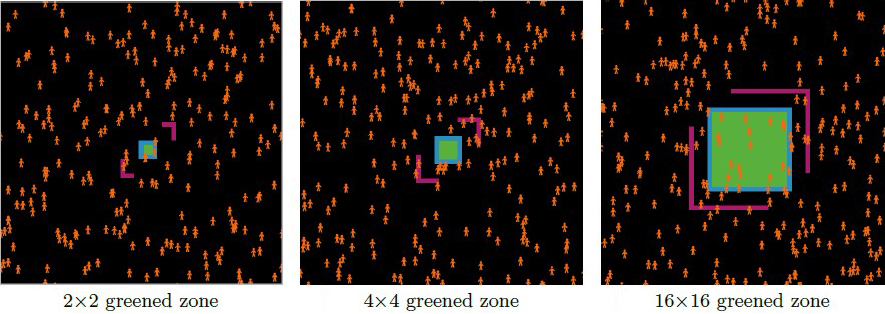
We introduced greened zones with lower intrinsic enticement levels and reduced their attractiveness to criminals, only making an active change to the environment within these greened areas. We defined several areas around each greened zone that were not altered and therefore allowed us to analyze greening’s impact: (i) a buffer zone that is immediately adjacent to the greened area, (ii) a pink zone of equal size to the buffer but not adjacent, and (iii) a black zone that represents the broader neighborhood (see Figure 2). Using extended simulations, we extracted long-term time average characteristics and averaged spatially across each analysis zone.
Does Size Matter?
We tested greened zones that ranged from \(1\times1\) square units (\(0.03\) percent of total area) to \(32\times32\) square units (\(27.52\) percent of total area). As designed, the results validated our approach in that greened zones showed lower enticement than the broader surrounding neighborhood. However, what was more interesting is the buffer zone effect.
As expected, the pink and black zones—which share all properties except location—exhibited comparable enticement levels. But the buffer zone, which is identical to the pink zone in all respects except its adjacency to greening, consistently displayed lower enticement. This spatial effect emerged purely from proximity to the greened area, thus supporting previous work that anecdotally affirms that greening’s benefits extend beyond the greened zone itself [3].
One Large Park or Several Small Ones?
Greening requires multiple resources—namely time, money, and available land—that are often scant in low-income areas. Given limited resources, should communities invest in one large greened area or distribute the effort among several smaller ones? We tested this question by comparing one \(10\times10\) zone against two \(5\times10\) zones and four \(5\times5\) zones, keeping the total greened area constant at \(100\) square units. Our simulations did not strongly favor one large zone over multiple smaller ones, which is good news for urban planners. Since many cities lack large contiguous vacant areas, this finding suggests that scattered greening can be equally effective — a practical insight for resource-constrained communities.
Modeling Urban Renewal
While our model cannot determine greening’s effectiveness in real cities—a question that requires empirical study—it demonstrates mathematical modeling’s ability to capture the complex spatial dynamics that are associated with communities. It also reproduces key patterns from the literature, affirming that greening reduces local enticement, its benefits extend to adjacent areas, and the distribution of greening efforts across multiple sites is indeed effective.
Ultimately, this work demonstrates the capacity of agent-based models to provide a theoretical framework that enhances our understanding of community interventions, complements empirical studies, and potentially helps cities optimize their greening strategies. As urban vacant land continues to challenge communities throughout the U.S., such models may help address an increasingly urgent conundrum: not whether to green, but how.
Alyssa Whiteley delivered a contributed presentation on this research at the Third Joint SIAM/CAIMS Annual Meetings, which took place last summer in Montréal, Québec, Canada.
Acknowledgments: Special thanks to Joseph Skufca of Clarkson University for assistance with editing.
References
[1] Branas, C.C., South, E., Kondo, M.C., Hohl, B.C., Bourgois, P., Weibe, D.J., & MacDonald, J.M. (2018). Citywide cluster randomized trial to restore blighted vacant land and its effects on violence, crime, and fear. Proc. Natl. Acad. Sci., 115(12), 2946-2951.
[2] Kelling, G.L., & Wilson, J.Q. (1982). Broken windows: The police and neighborhood safety. The Atlantic, 249(3), 29-38.
[3] Kondo, M., Hohl, B., Han, S., & Branas, C. (2016). Effects of greening and community reuse of vacant lots on crime. Urban Stud., 53(15), 3279-3295.
[4] Pizarro, J.M., Sadler, R.C., Goldstick, J., Turchan, B., McGarrell, E.F., Zimmerman, M.A. (2020). Community-driven disorder reduction: Crime prevention through a clean and green initiative in a legacy city. Urban Stud., 57(14), 2956-2972.
[5] Short, M.B., D’Orsogna, M.R., Pasour, V.B., Tita, G.E., Brantingham, P.J., Bertozzi, A.L., & Chayes, L.B. (2008). A statistical model of criminal behavior. Math. Models Methods Appl. Sci., 18, 1249-1267.
[6] Townsley, M., Homel, R., & Chaseling, J. (2003). Infectious burglaries. A test of the near repeat hypothesis. Brit. J. Criminol., 43(3), 615-633.
About the Author
Alissa Whiteley
Instructor, Oregon Institute of Technology
Alissa Whiteley is currently an instructor at Oregon Institute of Technology and a graduate student at Clarkson University researching mathematical modeling and its application to environmental modification and its impact on the spread of crime.

Stay Up-to-Date with Email Alerts
Sign up for our monthly newsletter and emails about other topics of your choosing.