
On the Clouds
While gazing out at the fresh snow, I began to wonder about the order of magnitude of the combined surface area of all the fallen snow crystals. A chain of associations gave rise to a few questions, some of which I mention here.
Question 1: A ball of water of radius \(\pmb{R=10\;cm}\) is pulverized into a cloud of droplets, each of \(\pmb{10\;{\mu}m}\) radius.1 What is the combined surface area of the droplets?
The combined area \(A\) of the droplets varies as the inverse power of their radii \(r:\)
\[A=3V\frac{1}{r}, \tag1\]
where \(V=\frac{4\pi}{3}R^3\) in the water volume. Indeed, the number \(n\) of droplets is in inverse proportion to the volume of an individual droplet, so that \(n={R^3}/{r^3}.\) Substituting this into \(A={n}{\cdot}{4}\pi{r^2}\) gives \((1).\)
With \(R=0.1\;\textrm{m}\) and \(r = 10^{-5}\;\textrm{m}\), we get
\[\boxed{A\approx{1,257}\;{\textrm{m}}^2}\]
— the area of a meter-wide strip over a kilometer long, created out of about a gallon of water.
Question 2: Water surface of area \(\pmb{A}\) stores potential energy \(\pmb{{\gamma}A,}\) where \(\pmb{\gamma}\) represents the surface tension; this is the work required to stretch the surface to its given area \(\pmb{A.}\) What is the combined energy \(\pmb{E}\) of the surface tension of all the droplets in the cloud made out of the ball of water?
\(E=\gamma{A}\) together with \((1)\) gives
\[E=3{\gamma}V\frac{1}{r}.\tag2\]
With \(\gamma = 0.072\;\textrm{N/m}\) (i.e., newtons per meter), we get \(E\approx{90}\;\textrm{J,}\) enough combined energy to lift our ball of water by about two meters. Alternatively, dropping the ball of water from such height releases enough energy to separate the water into these tiny droplets — assuming that this energy is not spent on anything else.
Question 3: Can \(\pmb{(2)}\) be used to estimate the size of water molecules?
This question is motivated by the similarity between pulverizing and evaporating: during both processes the water is split into smaller pieces.
Let \(E\) be the energy required to evaporate a given volume \(V\) of water; substituting this value into \((2)\) we can estimate \(r,\) the radius of a molecule. Of course, the resulting estimate is only as good as the similarity mentioned in the previous paragraph, and so should be taken with a grain of salt.
The energy to evaporate a unit mass of boiling water—the specific heat of evaporation—is well known: \(L = 2.5{\cdot}10^{6}\;\textrm{J}.\) For mass \(m\) of volume \(V\), we have \(E = mL= {\rho}VL, \) where \(\rho \) is the density of water.
Substituting the last expression into \((2),\) we get
\[\boxed{r=\frac{3\gamma}{{\rho}L},}\]
an estimate of the size of a water molecule. Substituting the numbers listed before gives \(r{\approx}10^{-10}\;\textrm{m.}\)
The actual2 size of a water molecule is about \(2.5{\cdot}10^{-10}\;\textrm{m,}\) and although our estimate is about three times less, the order of magnitude is right.
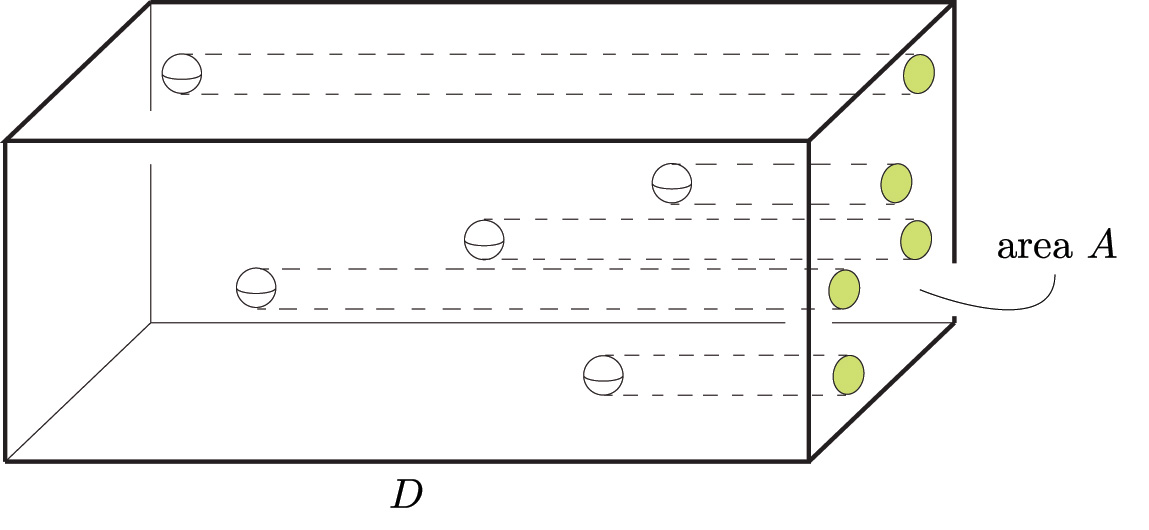
Question 4: How far can one see in a cloud of droplets given their radius \(\pmb{r}\) and the volume proportion \(\pmb{\lambda}\)?
Figure 1 shows projections of droplets along the line of sight onto the base of a box. Let us now continually increase the length of the box until these projections cover the base; the length \(D\) would then be the maximal visibility distance, since no ray of light of length \(>D\) will pass through without hitting a droplet. But covering the base with disks of radius \(r,\) assuming no excessive overlaps, implies
\[n{\cdot}{\pi}{r^2}{\sim}A, \tag3\]
where \(n\) is the number of droplets in our box. By the definition of \(\lambda\), we have
\[n{\cdot}\frac{4\pi}{3}r^3={\lambda}AD.\]
Combining this with \((3),\) we get
\[D\sim\frac{r}{\lambda}.\]
In particular, for a fixed proportion \(\lambda\) of water in the air, the smaller the droplets become, the worse the visibility is. This may not be surprising, as small drops don’t “waste” their thickness — small droplets have greater ratio \({\sim} 1/r\) of cross-sectional area to volume.
Question 5: What is the pressure inside a water droplet of \(\pmb{1}\) micron radius?
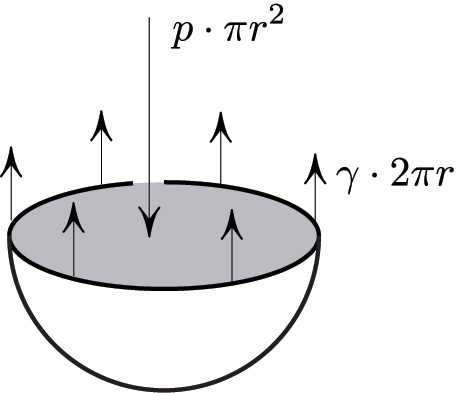
Consider the balance of forces acting on the half-ball of water droplet (see Figure 2). Surface tension pulls the hemispherical surface with force \(\gamma{\cdot}2{\pi}r;\) this force is balanced by the pressure on the equatorial disk (see Figure 2):
\[{\gamma}{\cdot}2{\pi}r=p{\cdot}{\pi}r^2, \]
so that
\[p=\frac{2{\gamma}}{r}.\]
Substituting \(r=10^{-6}\;\textrm{m}\) (one micron) and \({\gamma}=0.072\;\textrm{N/m}\) we discover that the pressure inside the drop is about \(1.4\; {\textrm{kg/cm}}^2\) over the atmospheric pressure — more than doubling it and making it approximately equal to being \(40\) feet underwater!
1 This is a typical size of droplets in clouds. \(1\;{\mu}\textrm{m}=10^{-6}\) Average thickness of a human hair is about \(70\;{\mu}\textrm{m}\)
2 Whatever “actual” means, given the quantum mechanical fuzziness.
The figures in this article were provided by the author.
About the Author
Mark Levi
Professor, Pennsylvania State University
Mark Levi ([email protected]) is a professor of mathematics at the Pennsylvania State University.
Related Reading
Stay Up-to-Date with Email Alerts
Sign up for our monthly newsletter and emails about other topics of your choosing.