
Powering Modern Cellular Networks: Stochastic Optimal Control Meets Green Communications
Modern society runs on wireless connectivity; from video calls and cloud computing to smart cities and autonomous systems, mobile data traffic continues to grow at an unprecedented pace, having reached one zettabyte in 2023 [4]. Yet behind every streamed video and downloaded file lies a hidden cost: energy consumption. The dense, “always-on” infrastructure of cellular base stations makes them among the largest energy users in telecommunications, using a reported 340 Terawatt-hour of energy in 2022 [2]. As operators continue to deploy 5G and next generation transmission technology, the resulting power demand threatens to increase both operational costs and carbon emissions — data transmission networks accounted for around 330 million metric tons of CO\(_2\)-equivalent emissions in 2022 [3].
A promising solution to this ever-growing problem is to power cellular networks with renewable energy sources, such as wind or solar energy. However, only nine percent of the energy consumed by cellular networks in 2021 came from renewables [2], as utilizing renewable energy for cellular networks comes with its own set of challenges. The main concern with using green energy is uncertainty: solar irradiance fluctuates with weather and time of day, wind generation is inherently uncertain, and wireless channels themselves vary randomly due to fading and interference. At the same time, network operators must maintain quality-of-service (QoS) guarantees, such as ensuring that a large fraction of users stay connected with high probability, despite uncertainties in the power supply.
A Mathematical View of a Base Station
We addressed this problem using tools from stochastic optimal control, numerical analysis, and uncertainty quantification in our recent study [5]. The core questions we addressed were simple: how should a cellular base station decide, in real time, how much power to buy from the grid, how much renewable energy to use, how much to store in a battery, and how much to transmit to users, all while minimizing operational costs and harmful emissions and providing probabilistic service reliability guarantees.
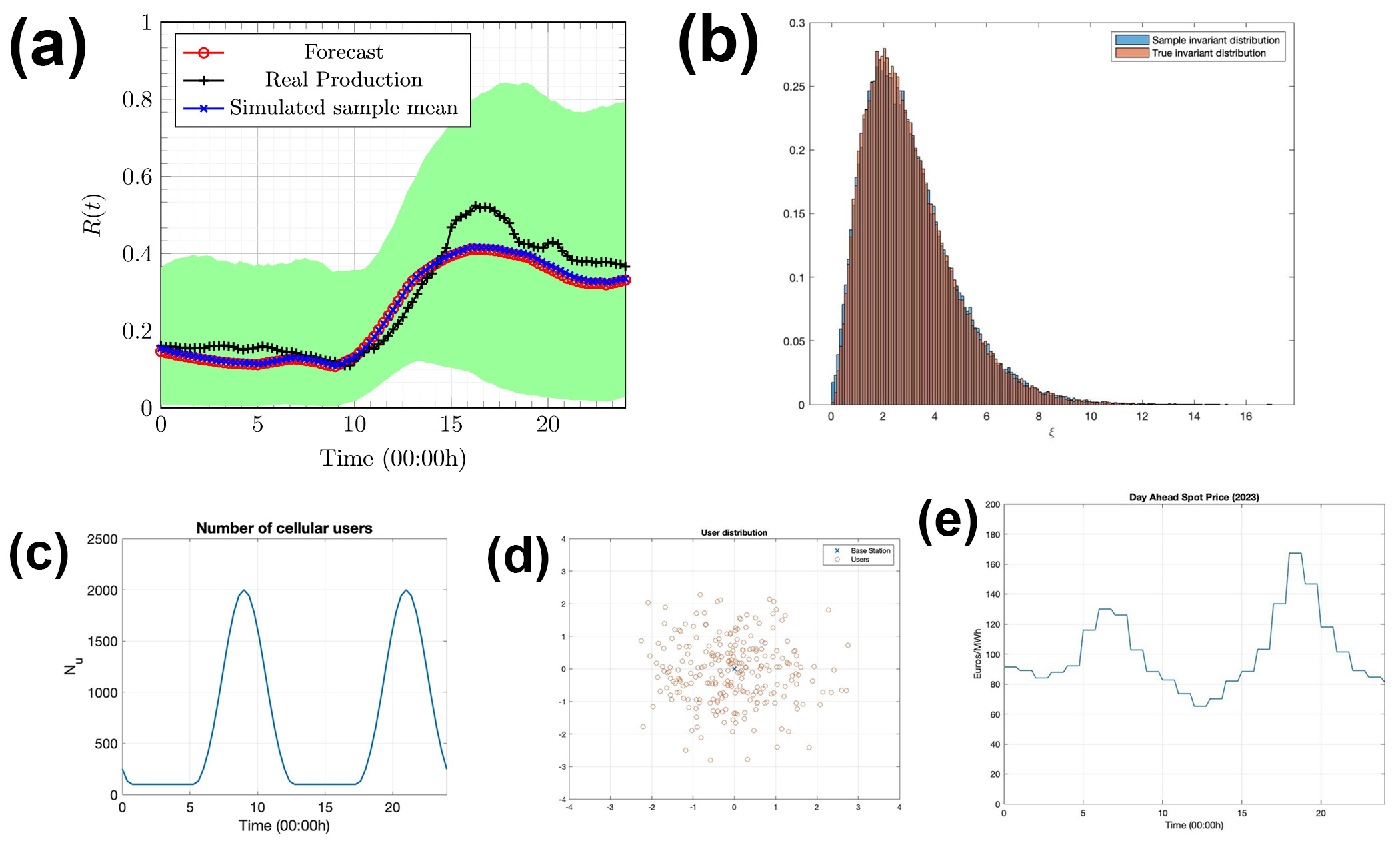
To answer this, we modeled a cellular base station as a coupled energy-and-communication system. The uncertainties in renewable power, battery charge, and wireless channel quality were modeled using stochastic differential equations, driven by data-powered trends (such as daily solar/wind forecasts) and random fluctuations (see Figure 1a).
The optimization objective balanced two competing goals: minimizing operating costs (including grid electricity purchases) and reducing environmental impact (modeled through emission-related penalty terms). Even further, a weighting parameter allowed operators to tune this trade-off in order to account for different regulatory or sustainability priorities.
Crucially, we imposed a chance constraint on QoS: the probability that a large portion of users experience poor signal quality must always remain below a prescribed risk threshold. This reflects how network operators manage reliability in practice — accepting small risks but avoiding frequent service failures. Unfortunately, such a probabilistic constraint breaks classical dynamic programming methods, which typically rely on state-based optimization. Overcoming this obstacle was one of the main mathematical challenges of the project.
From Theory to Computation
To handle the QoS requirement, we introduced a continuous-time Lagrangian relaxation. Instead of enforcing the chance constraint directly, we penalized its violation using a time-dependent Lagrange multiplier. This transformed the original constrained problem into a sequence of unconstrained stochastic optimal control problems that were more amenable to numerical treatment.
Each relaxed problem leads to a Hamilton–Jacobi–Bellman (HJB) partial differential equation (PDE) — a high-dimensional nonlinear PDE describing the optimal cost-to-go function. We developed an efficient, upwind finite-difference scheme to solve the HJB equation, providing a global view of optimal decisions across time and system states. We combined this solver with stochastic subgradient updates to iteratively refine the Lagrange multipliers, thus handling noisy gradient information that arose from Monte Carlo simulations of the stochastic state dynamics.
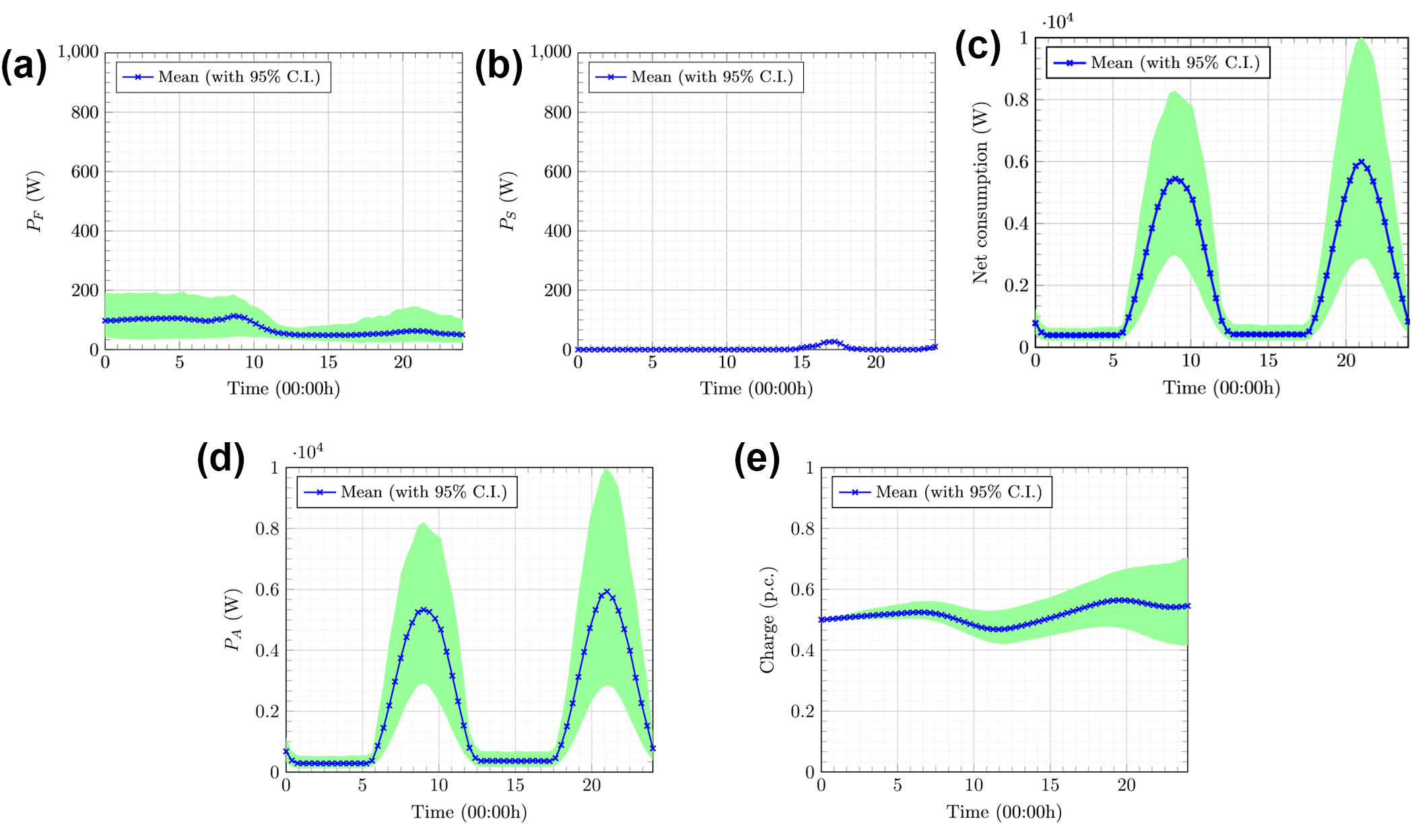
The result is a practical algorithm that computes near-optimal power procurement policies in realistic time frames — an essential requirement if such methods are to be used in operational planning tools (see Figure 2).
Putting the Algorithm to the Test
To demonstrate feasibility, we tested our framework using real-world-inspired data (see Figure 1). Renewable power uncertainty was calibrated using one year’s worth of German wind power forecasts and actual production data from the German energy operator 50Hertz [1]. This allowed us to produce sample trajectories of wind power for a given forecast in the future (see Figure 1a). Cellular traffic followed typical daily usage patterns, showcasing two peak hours in a day (morning and evening rush hours, see Figure 1c), and 2024 German electricity spot-price data [6] (see Figure 1e) and battery constraints were also incorporated to reflect realistic operating environments.
The numerical experiments showed several encouraging trends. By intelligently balancing grid purchases with renewable usage and battery management, the optimized policy reduced operating costs several-fold when compared to non-renewable strategies (see Figure 2). This was numerically confirmed by solving the same optimal control problem with zero incoming renewable energy sources, which revealed that the corresponding costs would increase by around 35 percent without renewables. Overall, penalizing fossil-based grid power purchases led to greener operation with lower emissions without sacrificing network reliability.
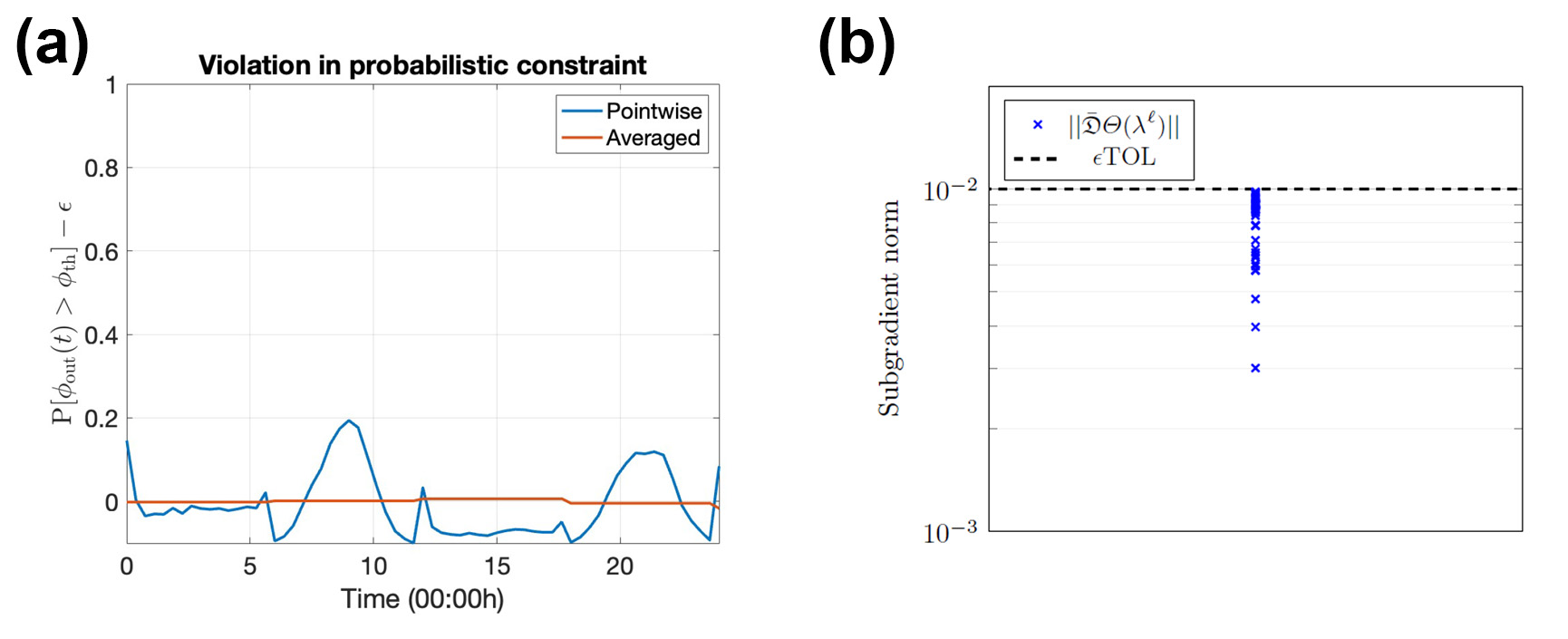
The chance constraint mechanism successfully limited QoS violations, ensuring that user outage probabilities stayed within the prescribed 90 percent risk tolerance (see Figure 3a). Moreover, we also found that enforcing probabilistic reliability constraints rather than “almost-sure” constraints—where one satisfies the constraint certainly (with 100 percent probability) rather than with only 90 percent probability—leads to significant cost reductions. This was numerically demonstrated by solving the optimal control problem satisfying the QoS constraint certainly (with 100 percent probability). The results demonstrated that the optimal cost using the almost-sure framework was almost four times as large as the optimal strategy with the QoS constraint satisfied with a 90 percent probability.
The algorithm also produced optimal solutions within practical runtimes (between two and six hours) despite the problem’s complexity. We performed scenario simulations over probability distributions of the various model parameters and confirmed that convergence was achieved in each case with no additional tuning between runs, demonstrating the computational efficiency and robustness of the proposed algorithm (see Figure 3). Our results also highlight the importance of uncertainty quantification: ignoring randomness in renewable generation or wireless channels can lead to overly conservative or fragile operational strategies.
Wireless Networks and Beyond
Although our motivating application was cellular communications, the methodology has potential to spread far beyond cellular networks and comes under the theme of chance-constrained stochastic optimal control. Many physical systems—from smart grids, autonomous energy hubs and transportation networks—face similar challenges: uncertain inputs, reliability constraints, and multiple objectives. By combining dynamic modelling, stochastic optimal control, and advanced numerical optimization, our work illustrates how mathematics can directly contribute to sustainability-driven engineering solutions. Our research also exposes new challenges and opportunities for the applied mathematics community:
- How can we leverage rare-event sampling to satisfy practically relevant (≤0.001 percent) risk tolerances in physical systems?
- How can we leverage machine learning surrogates to accelerate computation in high dimensional models (e.g., multiple base stations, multiple renewable sources, uncertain energy prices)?
- Can we improve our existing base station model through additional power-saving mechanisms (on-off switching) or user mobility (stochastic interacting dynamics)?
This work emphasizes the importance of increased collaboration between electrical engineers, mathematicians, and computer scientists if we wish to develop intelligent and sustainable energy management systems with robust uncertainty quantification. As wireless networks continue to expand, and sustainability goals become more urgent, mathematical optimization will play a central role in infrastructure design and operation. Ultimately, the vision is clear: reliable service, powered by intelligent, green energy management. With the right combination of modeling, computation, and collaboration, applied mathematics can help turn that vision into reality.
Shyam Mohan Subbiah Pillai delivered a minisymposium on this topic at the 2025 SIAM Conference on Computational Science and Engineering, which took place last year in Fort Worth, Texas.
References
[1] 50Hertz. (2025). Wind power production grid feed-in data. 2025. Retrieved from: https://www.50hertz.com/en/Transparency/GridData/Productiongridfeed-in.
[2] GSMA Intelligence. (February 2023). Going green: Benchmarking the energy efficiency of mobile networks. London, U.K.: GSM Association.
[3] International Energy Agency. (2023). Tracking clean energy progress 2023. Paris, France: International Energy Agency.
[4] International Telecommunication Union. (2024). Measuring digital development: Facts and figures 2024. Geneva, Switzerland: International Telecommunication Union Development Sector.
[5] Rached, N.B., Pillai, S.M.S., & Tempone, R. (2025). Optimal power procurement for green cellular wireless networks under uncertainty and chance constraints. Entropy, 27(3):308.
[6] SMARD. (2025). Market Data Download Center. Retrieved from: https://www.smard.de/en/downloadcenter/downloadmarket-data/.
About the Author
Shyam Mohan Subbiah Pillai
Research consultant, King Abdullah University of Science and Technology
Shyam Mohan Subbiah Pillai is a research consultant in the Stochastic Numerics Research Group in the Computer, Electrical and Mathematical Sciences and Engineering Division at King Abdullah University of Science and Technology (KAUST). His research explores numerical methods for stochastic optimal control in various applications.

Related Reading

Stay Up-to-Date with Email Alerts
Sign up for our monthly newsletter and emails about other topics of your choosing.