
Recent Book About Mathematical Greats Falls Short of Expectation
The Great Math War: How Three Brilliant Minds Fought for the Foundations of Mathematics. By Jason Socrates Bardi. Basic Books, New York, NY, November 2025. 416 pages, $32.00.
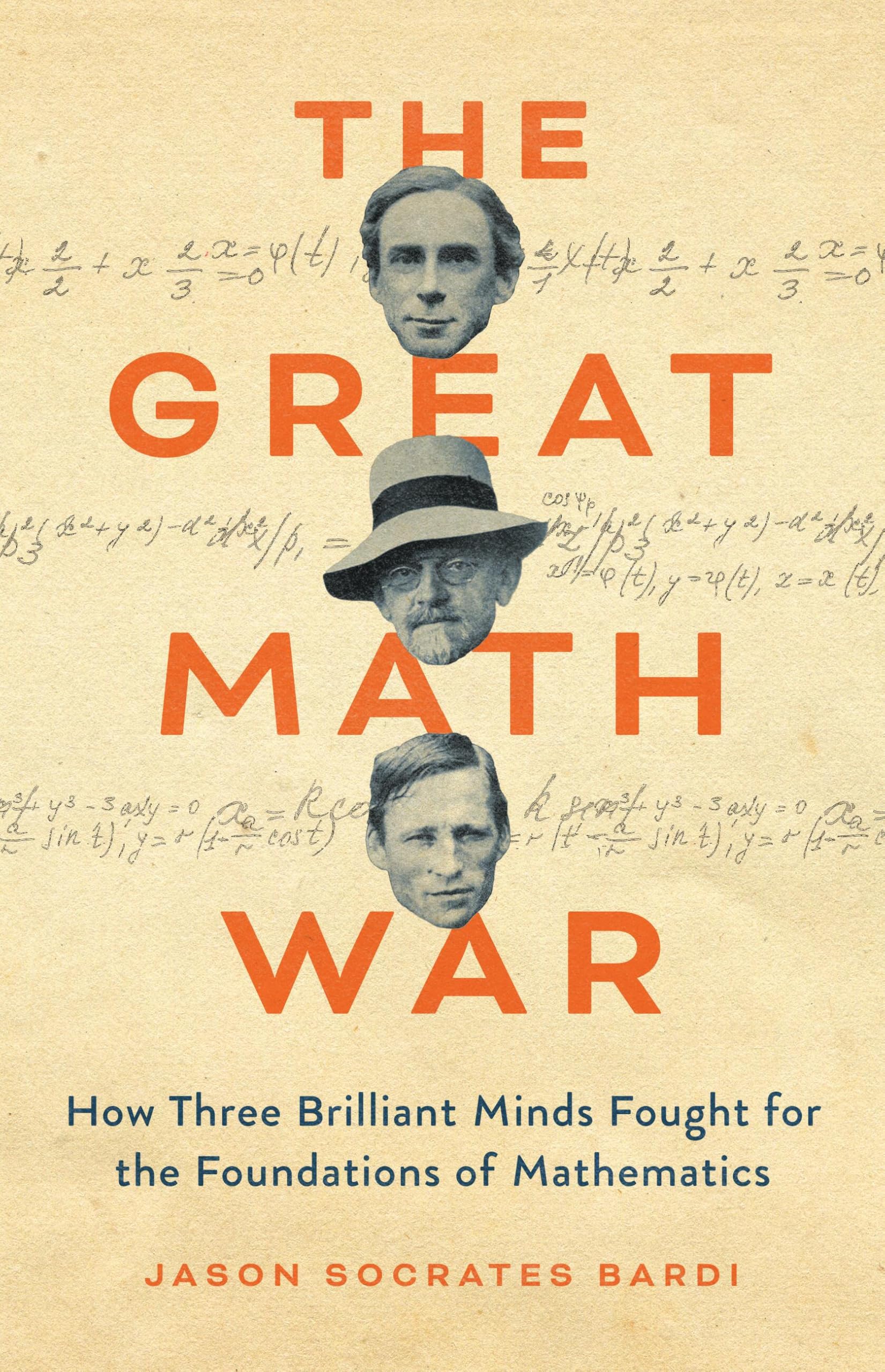
Jason Bardi’s connection to mathematician Bertrand Russell began before his birth. Bardi’s father was an enormous admirer of Russell’s politics and activism and wanted to name his unborn son “Bertrand Russell Bardi;” fortunately, Bardi’s mother stepped in to veto what would have likely become “Bertie Bardi.” Instead, they compromised and gave their son the middle name “Socrates.”
Bardi’s latest book, The Great Math War: How Three Brilliant Minds Fought for the Foundations of Mathematics, provides an account of the contentious development of the foundations of mathematics between 1870 to 1930. This evolution culminates in a nasty squabble during the 1920s—the “war” in the title book’s title—between David Hilbert and L.E.J. Brouwer about the legitimacy of non-constructive mathematical proofs. Beyond this bitter altercation, the book also contains extended commentary on the lives and works of Georg Cantor and Hermann Weyl, with shorter accounts of Leopold Kronecker, Giuseppe Peano, Ernst Zermelo, Ludwig Wittgenstein, Kurt Gödel, Richard Courant, and other notable players.
The Great Math War was clearly a labor of love for Bardi. He emotionally describes his father’s love for Russell as inspiration for the book and admits that he worked on the text for over a half a decade. Bardi provides the reader with a dramatis personae of 55 individuals; an overview of “Queen Math;” and commentary about 19 axioms, fallacies, hypotheses, paradoxes, and myths. He also includes an annotated bibliography with a 12-page guide to the literature and more than 600 references; very regrettably, there are no footnotes.
Despite this extensive effort, I am sorry to say that the book is flawed in multiple ways.
Errors of Fact
Bardi gets some important things wrong, particularly when it comes to the mathematics. He correctly states the continuum hypothesis in the dramatis personae but misrepresents it several times in the text by writing that “All infinite sets … come in two and only two sizes: aleph-naught and aleph-one … The continuum hypothesis says all infinite sets fall into one bucket or another and never in between the two.” He also misstates Gödel’s theorem that the consistency of arithmetic is unprovable in this bewildering formulation: “If a system is inconsistent, it cannot be proven consistent using its own inconsistent means.”
Additionally, Bardi claims that “In 1924, with his new intuitionist constructive methods, [Brouwer] pushes ahead, proving thorny theorems where classical methods have failed.” This claim would be fascinating if it were true, but as far as I can determine, it is not. In and around 1924, Brouwer indeed had some remarkable successes in using constructive methods to establish results about the continuum; however, these victories were not “theorems where classical methods had failed.” Since Bardi’s book has no footnotes, it is hard to know what he had in mind.
Bardi makes mistakes in the non-mathematical parts of his narrative as well. When Russell visited the U.S. in 1914, he met T.S. Eliot, who was a Harvard philosophy student at the time. Bardi writes that “Bertie loves T.S., but more than that, he loves T.S.’s wife, with whom he would later have an affair.” However, Eliot was unmarried in 1914 and had not yet met his first wife, Vivienne Haigh-Wood, who spent all her life in England. Furthermore—based on what I can tell from biographies of Russell and Eliot—the claim that Russell loved Eliot is baseless hyperbole. Russell’s description in his autobiography was as follows [1]: “The students … were admirable. I had a post-graduate class of twelve, who used to come to tea with me once a week. One of them was T.S. Eliot … He was extraordinarily silent and only once made a remark which struck me. I was praising Heraclitus, and he observed, ‘Yes, he always reminds me of Villon.’ I thought this remark was so good that I always wished he would make another.”
Bardi makes another faux pas when he writes that “The other places comparable [to Göttingen] in terms of prestige are all located in major cities — Paris, Berlin, London, Zürich, Moscow.” Apparently Cambridge and Oxford slipped his mind. He also consistently misspells Paul Gordan’s last name, though many people have made that error.
Significant Omissions
While some of Bardi’s omissions are admittedly matters of judgment and taste, a few examples were particularly striking. The Great Math War includes an extended discussion of Russell’s paradox and a short discussion of the Zermelo-Fraenkel axiomatization of set theory, but it does not explain the clever way in which the axiomatization sidesteps the paradox. When addressing the ZFC axiomatization of set theory, Bardi explains that “Z” stands for “Zermelo” and “C” stands for “choice,” but there is no mention of Abraham Fraenkel, who was the “F.” And while the text addresses the continuum hypothesis at length (albeit inaccurately), it does not mention Gödel’s 1938 proof that the hypothesis is consistent with ZFC, or Paul Cohen’s 1964 proof that its negation is likewise consistent with ZFC.
Bardi offers detailed accounts of Russell’s work on logic and math, which culminated in Principia Mathematica (coauthored with Alfred North Whitehead); his political activism in World War I and beyond; and his personal life up to and during the war. However, Russell’s later great philosophical works—technical books such as An Inquiry Into Meaning and Truth and Human Knowledge: Its Scope and Limits, as well as popular titles like Sceptical Essays, Unpopular Essays, and A History of Western Philosophy—remain entirely unmentioned; Bardi does not even note them in the bibliography.
Additionally, Bardi twice apologizes for not including a longer account of Zermelo due to lack of space. In my opinion, more content about figures like Zermelo and less information on Lady Ottoline Morrell and the Boer War—two largely irrelevant topics that each get a chapter—would have improved the book.
Unwarranted Hostility
Bardi’s writing exhibits over-the-top aggression at several points, the most conspicuous of which is his account of Wittgenstein. There is no denying that Wittgenstein was somewhere between difficult and impossible in his personal relations, and legitimate differences of opinions exist as to the value of his philosophies. However, passages like the following seem entirely unfair:
[Wittgenstein] is a compositional lazybones, to begin with. With the possible exception of E.E. Cummings, never has any writer in history become more famous with fewer words. Some would apologize for this by insisting that Wittgenstein is a perfectionist. But I say, hooey. With Wittgenstein, the perfect is not just the enemy of the good. The perfect is a psychopath who grabs the good by the throat, throttles the good into silence, and slowly chokes the good’s life away while laughing and eating good’s dinner. Wittgenstein and Russell are fundamentally different in this regard. Russell is a verbal fire hose of helpful tonic. Wittgenstein is a fickle trickle of foul poison. His work is confusing, difficult, unapproachable, and reminiscent of Thomas Hobbes’ view of humanity — nasty, brutish, and short.
This sentiment is not only defamatory toward Wittgenstein but entirely unfair to Cummings, whose collected poems form a volume of more than 1,000 pages. It also misrepresents the subject of Hobbes’ famous quotation.
Writing Style
While personal tastes may differ, I am not a fan of Bardi’s writing style. He writes almost entirely in the historical present, with a lot of “chatty” verbiage, quasi-poetical wordings, extended metaphors, and corny plays on words. The aforementioned quote about Wittgenstein is one example, as is the following passage:
For Brouwer, finding a new mathematical proof should be like feeling your way through an unfamiliar landscape in the dark. You stumble here. You touch the squishy ground there. You find a place where the mud hides a sunken plank, like those mucky duckwalks in the trenches on the Western Front. You walk. Stay low. Have no idea where to go but keep going. See where the path leads you. Step by step. Squish by squish. Across the gooey mess.
When Bardi occasionally stops this literary posturing and writes simple narrative prose in the past tense, it comes as a huge relief:
My father had just started graduate school in Ohio then [in 1969]. Vietnam protests were in full swing, and like so many in their generation, my parents were part of the antiwar movement. My father had stirred controversy on his undergrad campus some months before by writing an antiwar editorial as editor-in-chief of his college paper. A number of students on campus objected to his essay and organized a protest calling for him to step down. My dad defied the call and attended his own protest.
Final Thoughts
All that said, I did find some value in The Great Math War. In particular, it provided me with a much clearer idea of Brouwer and Weyl and their interactions with Hilbert. Unfortunately, in light of the many errors in Bardi’s book and its slanted viewpoints, I can’t be confident that I have the correct idea — either in general terms or of specific facts.
Ultimately, I would not recommend The Great Math War for the general lay reader. Someone who has a basic knowledge of the development of mathematical foundations and wishes to delve more deeply into the corresponding debates and fights may find it useful; however, they should be very cautious of accepting Bardi’s viewpoint and should carefully check any fact before disseminating it further.
References
[1] Russell, B. (1967). Bertrand Russell: Autobiography. London, U.K.: George Allen & Unwin.
About the Author
Ernest Davis
Professor, New York University
Ernest Davis is a professor of computer science at New York University's Courant Institute of Mathematical Sciences.
Related Reading

Stay Up-to-Date with Email Alerts
Sign up for our monthly newsletter and emails about other topics of your choosing.