
Reflections on the Graduate Research Assistantships in Developing Countries Program: A Journey of Two Doctoral Awardees
The continued advancement of mathematics plays a fundamental role in supporting technological innovation, intelligent systems, and sustainable development across the globe. Recognizing the importance of such advancement, the International Mathematical Union (IMU) strengthens mathematical capacity worldwide by providing targeted funding programs that support graduate students, early-career researchers, and institutions to ultimately foster strong, sustainable mathematical communities.
The Commission for Countries (CDC) at the IMU specifically aims to provide financial support for research in developing and middle-income countries. One of the CDC’s flagship initiatives is the Graduate Research Assistantships in Developing Countries (GRAID) Program. Established in 2017, the GRAID Program offers modest but strategic financial support to emerging research groups in countries that are classified under Priority 1 or 2 according to the IMU’s “Definition of Developing Countries.” The initiative allows talented master’s and Ph.D. students to pursue their studies on a full-time basis as graduate research assistants in mathematics while simultaneously participating in an active research environment with a local principal investigator (PI) and an international partner (IP).
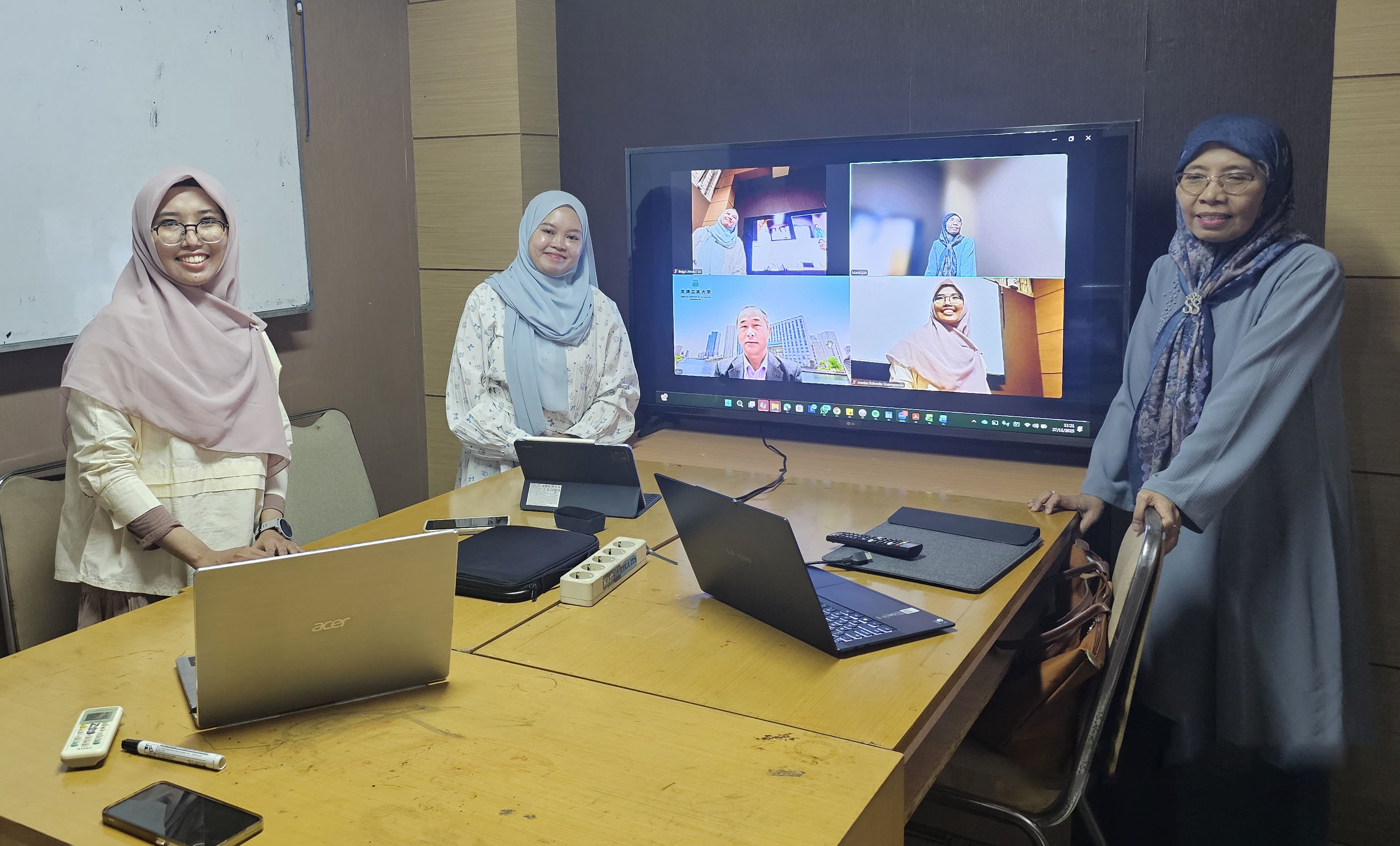
In 2025, a total of five doctoral students in three research groups received the prestigious GRAID scholarship. We, Belgis Ainatul Iza and Annisa Rahmita Soemarsono, are honored to be the first students from Sepuluh Nopember Institute of Technology (ITS) in Indonesia to receive financial support from SIAM through the GRAID Program. Through this opportunity we were able to work under the direction of PI Mardlijah Mardlijah of ITS and IP Zhai Guisheng of Shibaura Institute of Technology in Japan. Not only are we honored to receive financial support, we feel that programs such as these represent the collective strengthening of applied mathematics research capacity in Indonesia through international collaboration.
Belgis Ainatul Iza
My research lies at the intersection of applied mathematics and control systems, investigating the development of intelligent control algorithms based on fuzzy logic and extended Kalman filters (EKFs) for unmanned aerial vehicle delivery systems. My doctoral dissertation, titled “Designing Fuzzy-PID Control With Robust EKF and Measurement Compensation for Delivery Quadcopters,” is highly relevant to Indonesia’s national research agenda, particularly in the fields of intelligent transportation systems, autonomous vehicles, and smart logistics.
Annisa Rahmita Soemarsono
In contrast to Iza’s research, I study the application of fuzzy optimal control methods for robotic manipulator systems with two degrees of freedom; my dissertation is titled “Fuzzy Optimal Control Problem in Fuzzification and Defuzzification Processes (Case Study: Manipulator System on a Sea Ship).” This work has strong potential applications in marine mechatronics and ship-based robotic systems for surveillance and maritime defense, which is an area of strategic importance for an archipelagic country like Indonesia.
Financial Challenges of Doctoral Research
Despite having strong academic backgrounds, we both faced significant financial constraints prior to receiving the GRAID funding that affected our ability to focus fully on doctoral research. Although we both received some scholarships from outside agencies—Iza from a Fresh Graduate Scholarship at ITS and Soemarsono from the National Research and Innovation Agency—these funds only covered tuition fees and did not include support for living expenses or research activities. This meant taking on teaching and tutoring responsibilities to support our studies, which significantly reduced the time and energy that we could devote to research.
At the time of our GRAID application, neither of us received financial support from private foundations, industrial institutions, or other international programs. The GRAID scholarship thus played a vital role in easing financial pressure and enabling us to pursue research in a full-time capacity.

A Strong Foundation in Mentoring, Leadership, and International Collaboration
We first learned about GRAID through the coordinator of the doctoral study program at ITS, who recognized the alignment between GRAID’s objectives and the needs of doctoral researchers such as ourselves. We submitted our application as a collaborative proposal with a strong supervisory structure and an established international partnership.
The involvement of Mardlijah as PI and Guisheng as IP reflect the GRAID philosophy of strengthening local research ecosystems through sustained international engagement. Mardlijah is a senior lecturer at ITS who leads the Laboratory of Mathematical Modeling and System Simulation. She has more than 30 years of experience supervising students across the undergraduate, master, and doctoral levels, many of whom have become lecturers and researchers at leading universities across Indonesia or applied their expertise in industry.
Mardlijah’s mentoring philosophy emphasizes not only academic excellence but also research productivity and long-term scholarly development. Students under her supervision are actively involved in scientific writing, conference presentations, international networking, and collaborative research in areas like autonomous system control, intelligence control, fuzzy logic modeling, estimation theory, and renewable energy — fields that are increasingly relevant to modern engineering and technological challenges.
Beyond allowing us to work with such a supportive PI, a key strength of the GRAID Program lies in its inclusion of a qualified IP to fortify each project’s global reach. Guisheng, who previously served as an adjunct professor at ITS, is a leading expert in control theory whose expertise is especially relevant to our specific dissertation topics. Iza’s work on EKF-based fuzzy-proportional-integral-derivative control for quadcopters closely aligns with Guisheng’s research in decentralized control, H-infinity control, and the stabilization of dynamic systems. Similarly, Soemarsono’s exploration of fuzzy optimal control for manipulator systems overlaps with Guisheng’s contributions to adaptive control algorithms and optimization-based control systems in robotics and mechatronics.
Guisheng has expressed his intention to continue to mentor us both through our doctoral journeys. Support from the GRAID Program will augment this collaboration, providing access to an international research ecosystem; significantly enhancing the quality and impact of our research outputs; and improving research capacity, knowledge exchange, and international visibility in Indonesia and beyond.
Global Networking and Capacity Building
In addition to providing financial support, GRAID fosters global networking opportunities among awardees and researchers. The annual CDC Webinar 2025, is one such example. The event focused on the Volunteer Lecturer Program and allowed host institutions and international lecturers to share their experiences. It also introduced CDC activities that correspond with the upcoming 2026 International Congress of Mathematicians, which will take place in Philadelphia, Pa., in late July and offer further opportunities for global engagement.
Participation in the webinar and other like-minded activities allows us and other GRAID awardees to connect with mathematicians around the world, exchange ideas, and establish collaborations beyond their immediate research groups.
Looking Ahead
Taking part in the GRAID Program marked a turning point in our doctoral journeys. The support enabled us to completely devote our time to research, contribute to the advancement of applied mathematics with both national and global relevance, and pursue international collaborations that would otherwise be inaccessible.
More broadly, GRAID signifies the importance of sustained international support when building research capacity in developing countries. Through funding initiatives like GRAID, the IMU and SIAM continue to play a strategic role in nurturing future leaders in mathematics and ensuring that mathematical research contributes meaningfully to global scientific progress.
About the Authors
Belgis Ainatul Iza
Ph.D. candidate, Sepuluh Nopember Institute of Technology
Belgis Ainatul Iza is a mathematics Ph.D. candidate at Sepuluh Nopember Institute of Technology (ITS) specializing in mathematical modelling, control systems, and state estimation for high-dimensional dynamic systems. Her research advances autonomous aerial system control through the development of robust and intelligent estimation–control frameworks, integrating adaptive filtering and data-driven approaches, while her teaching in Data Science bridges rigorous mathematical theory with real-world applications.
Annisa Rahmita Soemarsono
Ph.D. candidate, Sepuluh Nopember Institute of Technology
Annisa Rahmita Soemarsono is a mathematics Ph.D. candidate at Sepuluh Nopember Institute of Technology specializing in systems and control, particularly optimal control theory and fuzzy concepts, and her research contributes to the theoretical development of fuzzy optimal control problems and their implementation in real-world plants. Her teaching in Applied Mathematics focuses on fundamental mathematical concepts, such as calculus and differential equations, and their applications across various practical contexts.


Stay Up-to-Date with Email Alerts
Sign up for our monthly newsletter and emails about other topics of your choosing.