
The Cognitive Science Revolution
The Laws of Thought: The Quest for a Mathematical Theory of the Mind. By Tom Griffiths. Henry Holt and Co., New York, NY, February 2026. 400 pages, $31.99.
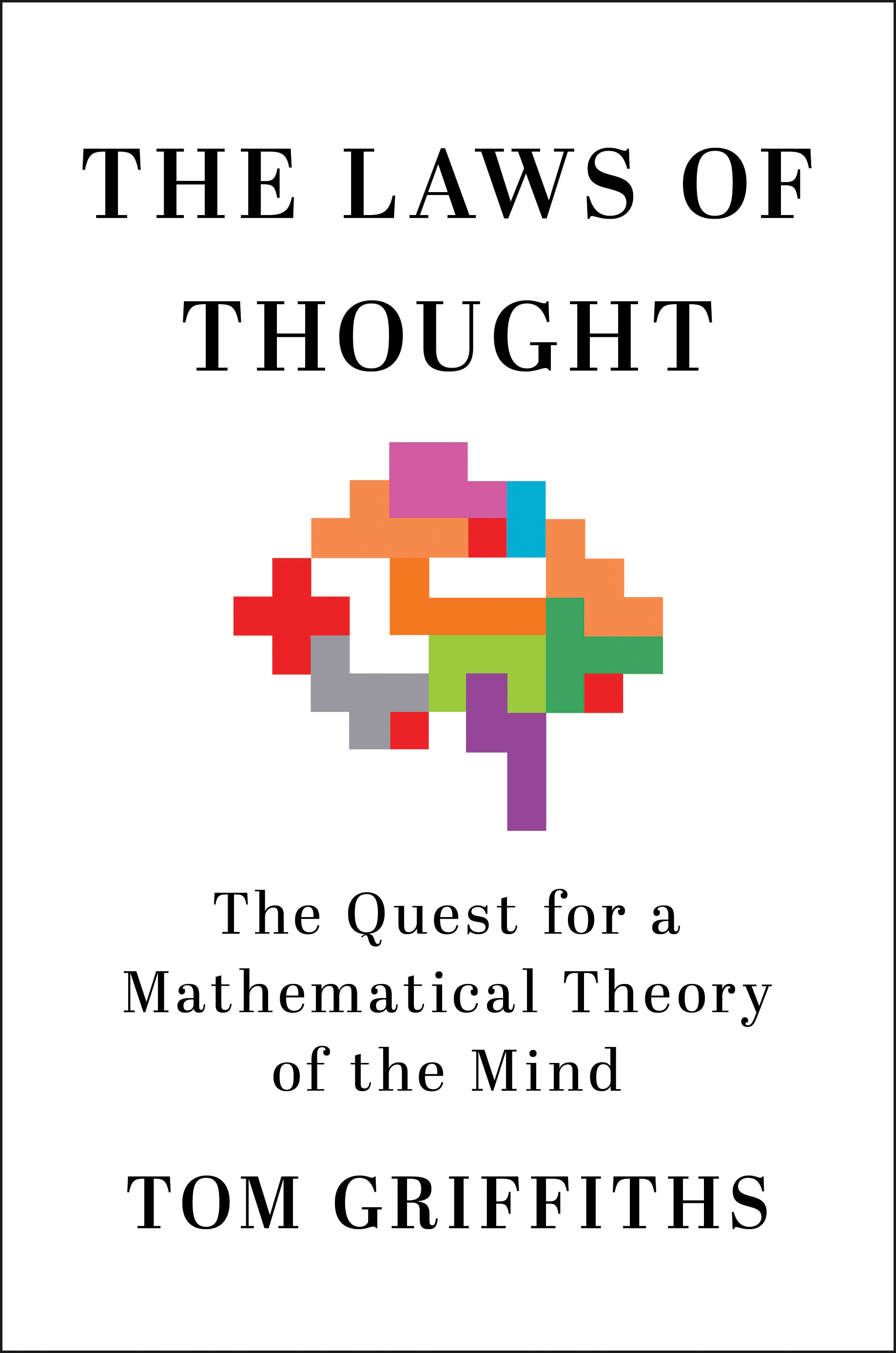
While the world is transfixed with the artificial intelligence (AI) revolution—most recently with the development of Claude and ChatGPT, the large language model (LLM) products of the companies Anthropic and OpenAI respectively—the field of cognitive science is simultaneously having its own revolution. The Laws of Thought: The Quest for a Mathematical Theory of the Mind gives a panoramic overview of this revolution, from the viewpoint of an active participant at the epicenter of this new wave: cognitive scientist Tom Griffiths of Princeton University. The book describes, in a lucid and accessible way, key ideas in the discipline, from ancient history to the present state of the art, and paints short biographical sketches of the most important figures in the revolution.
Griffiths highlights the three main pillars of the cognitive science revolution: logic, neural networks (and other computational models), and probability—listed roughly in historical order of their contribution.
Logic dates back to Aristotle and the syllogisms he designed to explain the formation of arguments and inferences. The great polymath genius Gottfried Wilhelm Leibniz later attempted to reduce all human thought to mathematical calculation: “Let us calculate, without further ado, to see who is right,” he declared. In 1879, workmen fixing a leaky roof discovered a mysterious machine discarded in the corner in an attic at the University of Göttingen; with its cylinders of polished brass and oaken handles, the artifact was identified as one of several early mechanical calculating devices that Leibniz invented in the late 17th century. Leibniz in turn was influenced by Ramon Llull—a Majorcan philosopher, logician, and mystical thinker—and his work Ars magna (or “ultimate general art”) from 1308. The modern foundations of logic, though, were laid by the English autodidact George Boole who invented the system known today as Boolean algebra in his great work An Investigation into the Laws of Thought, which inspired the title of Griffith’s book. The logic tradition led eventually to the birth of modern computer science via the foundational insights of Alan Turing in his solution to David Hilbert’s famous Entscheidungsproblem from 1928.
The second pillar is connectionism, or the tradition of using neural networks to model cognition by drawing inspiration from the brain. Griffiths cites the early origins of connectionism in Frank Rosenblatt’s Perceptron and the first model of neural networks by Warren McCulloch and Walter Pitts. This area of cognitive science suffered a temporary setback but was revived again by scientists like David Rummelhart and Jay McClelland with their influential book Parallel Distributed Processing, published in 1987. Connectionism has reached its apogee today following the deep learning revolution that lies at the heart of modern AI, for which Geoff Hinton received both the 2024 Nobel Prize in physics and the 2018 Turing Award. Modern neural networks lie behind the major successes of modern deep learning both in perception systems based on vision models and language modelling based on LLMs. These systems demonstrate amazing capabilities for logic and reasoning, most recently achieving a gold-medal-worthy performance in the International Mathematics Olympiad and also solving or assisting in high-level mathematics.
The third pillar, probability, supplies the fundamental concepts and toolkit to deal with uncertainty within how cognitive systems understand the world around us. Griffiths effectively shows how probabilistic reasoning extends logical reasoning to handle uncertanties. Perhaps the single most important concept here is the simple principle called the Bayes Rule, a concept introduced by Reverand Thomas Bayes in 1763 that lays the foundations for a systematic approach to updating beliefs when new evidence is presented. Today, Bayesian statistics is an active field of research that provides sophisticated, data-driven computational techniques to implement such belief-updating schemes. Bayesian thinking also provides a fruitful approach to addressing the vexed problem of causation as opposed to mere correlations between events: discovering cause and effect relationships between events is central to cognition. Judea Pearl, engineer and computer scientist, received the Turing Award in 2011 for creating a calculus of probabilistic rules to deduce cause and effect relationships from observational data. Griffiths explains how these principles can be used by many cognitive scientists—such as deep thinkers like Roger Shepard and Amos Tversky—to uncover the principles of cognition. Readers with computer science backgrounds such as myself may have some familiarity with the topics and figures discussed in this book, but this aspect of cognitive science research offered many new insights.
Griffiths also explores the value of language; language occupies a very special and central position in cognitive science and is one of the defining properties of human cognition that separates us from other animal species. At the start, language was studied in the symbolic tradition, with Noam Chomsky’s seminal Syntactic Structures as the fountainhead for the study of language via grammar. Later, pioneering explorations of the Soviet mathematicians Andrey Andreyevich Markov and Cluade Shannon introduced probabilistic approaches to studying language. This avenue was pursued at IBM Research, where manager and director Fred Jelenik quipped: “Every time I fire a linguist, the performance of the system goes up.” IBM was eventually displaced by Google, and the statistical approach reached its peak with Google Translate around 2006. This approach itself was overtaken by the neural approach using modern deep neural networks, which lies behind the current version of the application. Finally, the ongoing development of LLMs and their innovative properties is based heavily on large neural networks, such as Transformer architecture, which allows AI tools to use self-attention mechanisms to ingest heaps of data from the internet.
The debate over whether LLMs can truly “understand language’’ or are merely “stochastic parrots’’ that reproduce statistical patterns in their training data is still ongoing. Even further, the question of if LLMs can pave the way to fully-fledged artificial general intelligence (AGI) with the potential to overcome human capabilities remains. Griffiths doesn’t pronounce a definitive verdict on this, but gives clear hints that he does not believe LLMs are the final word. In a recent paper [1], his group countered the claims of a Microsoft group that LLMs are showing “sparks of AGI’’ by arguing that they actually betray the “embers of prediction problems” they are trained on. Griffiths argues instead for a new approach that brings the probabilistic approach to bear on neural networks using modern Bayesian techniques, writing that “hundreds of years after the death of the Reverend Thomas Bayes, thinking in terms of probabilities is still useful for understanding intelligent systems." Indeed, the future of both AI and cognitive science lies in "neuro-symbolic" systems that create “world models” that can bring together all three pillars of the cognitive science revolution, or the Laws of Thought that govern all intelligent systems.
References
[1] McCoy, R.T., Yao, S., Friedman, D., Hardy, M.D., & Griffiths, T.L. (2024). Embers of autoregression show how large language models are shaped by the problem they are trained to solve. Proc. Natl. Acad. Sci., 121(41):e2322420121.
About the Author
Devdatt Dubhashi
Professor, Chalmers University of Technology
Devdatt Dubhashi is a professor in the Data Science and AI Division at Chalmers University of Technology in Sweden. He earned his Ph.D. in computer science from Cornell University and has held positions at the Max Planck Institute for Computer Science in Germany and the Indian Institute of Technology Delhi.

Related Reading

Stay Up-to-Date with Email Alerts
Sign up for our monthly newsletter and emails about other topics of your choosing.