
The inControl Podcast: Building a Global Audience for Control Theory
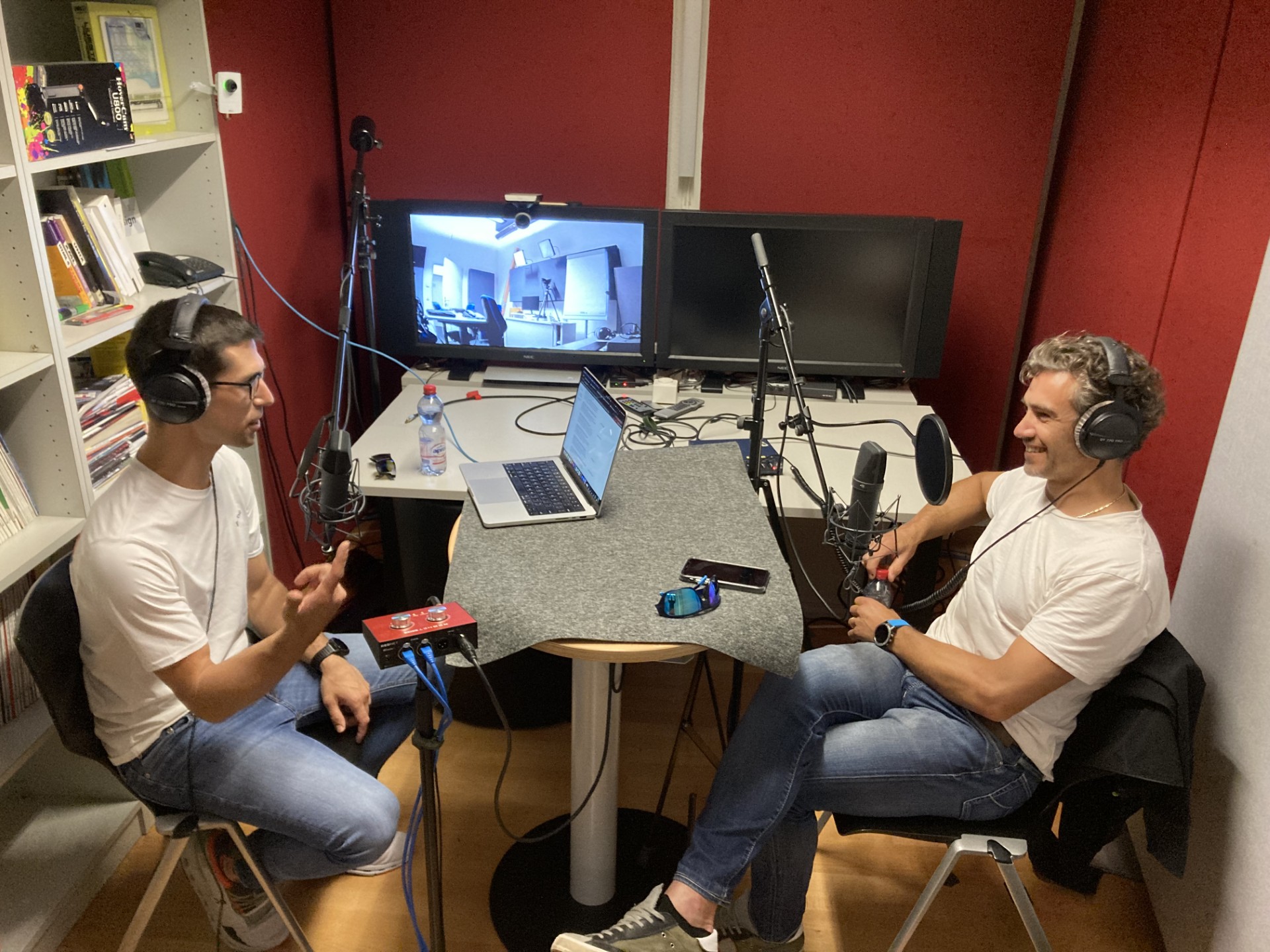
Alberto Padoan is an assistant professor in the Department of Electrical and Computer Engineering at the University of British Columbia and the creator of inControl, the first podcast dedicated to control theory. Since its launch in 2022, the show has grown into a global platform reaching over 150,000 listeners across more than 150 countries.
Dante Kalise recently spoke with Alberto Padoan to discuss how he built his platform and what four seasons of storytelling have taught him about research, creativity, and the future of science communication in control theory. Here they share their conversation with SIAM News.
Dante Kalise: inControl describes itself as “the first podcast on control theory.” What prompted you to start it in 2022?
Alberto Padoan: The origin story is disarmingly simple. The podcast idea started with the simple observation that every technical field I admired had found its way into podcasting—physics, neuroscience, machine learning—except ours. During my postdoctoral appointment at the University of Cambridge in 2018, I first floated the idea while walking to lunch with colleagues. One of them replied: “Who do you think would ever listen to you?” A fair challenge, honestly. But the question wouldn’t go away. For quite some time, I kept waiting for someone better positioned, more media-savvy, and simply less shy, to launch it. Time went by, but the podcast did not materialize. Eventually, I realized that waiting was its own kind of answer — if the podcast was going to exist, it would have to start with someone willing to just begin. The pandemic created a strange window for slow-burning ideas, and with the encouragement of my supervisors at ETH Zürich and the backing of the National Centres of Competence in Research (NCCR) Automation, inControl went from a passing remark on Trumpington Street to a real project.
One thing that genuinely motivated me from the start was the promise of a legitimate reason to sit with people I deeply admired and ask the kinds of questions that never quite fit into a conference panel Q&A.
DK: Your episodes range from historical portraits to interviews with leading researchers. How do you decide what an episode should be, and who are you aiming to reach?
AP: Our field has no shortage of remarkable stories; I could record for years and barely scratch the surface. My guiding principle is to follow my own curiosity. I tend to pursue questions that genuinely fascinate me, and more often than not, that personal investment seems to resonate with others.
As for the audience, that is the easy one: inControl is meant to serve as a global channel for anyone drawn to systems and control, from researchers and students to control aficionados and the genuinely curious from adjacent fields.
DK: Control theory sits somewhat in the background compared to, say, machine learning in public scientific discourse. Do you see inControl as a corrective to that?
AP: I wouldn’t call it corrective, more of a complement. Machine learning deserves enormous credit for the way it communicates its impact; those advances are real and tangible. But I do think control has historically underplayed its hand. We are behind some of the most extraordinary engineering achievements of our time, from reusable rockets to robots performing acrobatic feats, and, somewhat ironically, the semiconductor fabrication processes that make modern artificial intelligence (AI) physically possible. Control is also behind the quieter but equally profound advances in quantum technologies and systems biology. There is absolutely no reason for an inferiority complex. What I hope inControl demonstrates is that when you give these stories the space and narrative they deserve, people pay attention. The appetite is there, we just need to meet it with the same confidence and craft that other fields have brought to their public presence.
DK: After 42 episodes and four seasons, has any episode surprised you in terms of the response it got or something that you learned while making it?
AP: Constantly. The biggest surprise was the appetite for depth. The most listened-to episode isn’t a conversation with a prominent guest, it’s usually a deep dive into a given topic, say the prehistory of control. That tells me something important: people aren’t just looking for names or news; they want narrative, context, and the longer arc of how ideas came to be.
On a more personal level, hosting the show has sharpened my thinking about what shapes a successful research career. I’ve become increasingly convinced that luck plays a larger role than we typically admit; perhaps half the story is being in the right place when the right question appears, but the other half seems to be preparation and a broad, genuine curiosity that lets you recognize and respond to those moments when they arrive. Creativity seems to live at that intersection, where deep expertise in some areas meets wide-ranging intellectual restlessness.
DK: Who listens? Have you had feedback from students, practitioners, people outside the field entirely?
AP: The reach has genuinely astonished me. inControl is accessed by over 150,000 listeners across more than 150 countries and territories, numbers I never imagined when I recorded that first episode. The core audience is in Europe and North America, but there’s meaningful and growing engagement from Asia, Africa, Oceania, and South America. What moves me most is the breadth: I hear from Ph.D. students looking for perspective, senior researchers reconnecting with the broader motivations behind their work, and people from entirely different fields who simply stumbled in and stayed. The project started as an attempt to build the kind of conversation I wished had existed when I was a student. Discovering that so many others felt the same need has been one of the most rewarding surprises of my career.
DK: What’s next for inControl?
AP: If bandwidth were unlimited, the list would be long: short-form research explainers, collaborative annotation platforms in the spirit of Fermat’s Library, and deeper integration with the emerging AI tools that are reshaping how we communicate research. The landscape for science outreach is evolving rapidly, and I find that genuinely exciting.
In practice, with two young children at home and a new position that comes with its own set of responsibilities, I have to be a bit more deliberate about where the energy goes. But the core motivation hasn’t changed since that walk to lunch in Cambridge: control deserves a voice that matches the scale of its impact. The audience is there, the task now is simply to keep building.
About the Author
Dante Kalise
Associate professor, Imperial College London
Dante Kalise is an associate professor in computational optimization and control at Imperial College London. He also serves as the program director and SIAM News activity group liaison for the SIAM Activity Group on Control and Systems Theory.
Related Reading
Stay Up-to-Date with Email Alerts
Sign up for our monthly newsletter and emails about other topics of your choosing.