
The Meanings of Foucault’s Pendulum
Seeing Foucault’s Pendulum: Between Science, Politics, and Art. By Michael Hagner. Translated by Robert Savage. Zone Books, New York, NY, September 2025. 320 pages, $38.00.
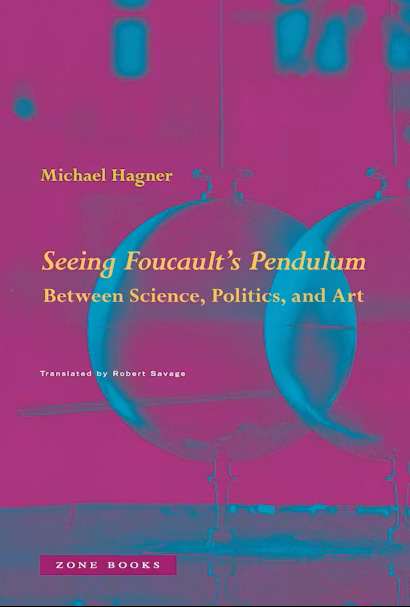
In 2018, the eminent German artist Gerhard Richter designed a permanent installation for the Dominican Church in Münster titled “Two Grey Double Mirrors for a Pendulum” (“Zwei Graue Doppelspiegel für ein Pendel”). Quoting from Seeing Foucault’s Pendulum,
The work consists of a Foucault pendulum with a 28.75-meter-long steel cable and a 48-kilogram metal ball swinging over a circular disk made of graywacke, an ancient sedimentary rock. An electromagnetic drive ensures a constant amplitude of oscillation. The stone plate has a circumference of 5.6 m and is engraved on its outer rim with a 360-degree scale in 12-degree increments. The gray of the sandstone is picked up in four 6-meter-high, 1.34-meter-wide glass panels. These are mounted in pairs on the transept walls ... The backs of the panels are covered in gray enamel.
Michael Hagner, a distinguished historian of science at ETH Zürich, was invited to write a brief historical essay contextualizing this artwork. His essay turned into Seeing Foucault’s Pendulum: Between Science, Politics, and Art, a 300-page book originally published in German in 2021 but later translated by Robert Savage and published in English in 2025. Despite the book’s subtitle, however, there is not much about politics in the narrow sense, and even less about science. In particular, there is no explanation of the fact that the rotational period of the pendulum is 24 hours divided by the sine of its latitude. Likewise, descriptions and explanations of devices similar to Foucault’s pendulum are often left frustratingly unclear. Overall, however, the book is remarkable and mind-expanding, combining the histories of science, culture, and iconography.
The early chapters of Seeing Foucault’s Pendulum are primarily a historical recounting of the effort to find purely terrestrial evidence of the rotation of the Earth. It turns out that the rotation of the pendulum path was observed as early as about 1661. The posthumous papers of Vincenzo Viviani (1622-1703), a student and assistant of Galileo, contain the following observation, “We have observed that all pendulums suspended by a single thread deviate from their vertical plane ... from right to left in the front part.” However, Viviani and his associates failed to connect this to the rotation of the Earth, in part because Galileo had asserted that no terrestrial experiment could ever demonstrate the Earth’s rotation. Ironically, Galileo’s successors prioritized his dogma over their own experimental results.
Many people, from Robert Hooke in 1680 to Johann Friedrich Benzenberg in the early 19th century, attempted to experimentally demonstrate the impact that the Earth’s rotation imposes onto a falling object. Though there was some evidence of the predicted drift eastward and southward, it proved to be difficult to shield the falling objects from perturbations sufficiently and thus obtain a reliable and convincing result.
The book next provided a biographical sketch of Léon Foucault. By 1851, Foucault had achieved a considerable reputation as an inventor and experimental physicist. Working with bacteriologist Alfred Donné, he had made important innovations in photomicrography. Working with his longtime mentor, astronomer François Arago, he produced the first daguerreotype of the sun. In 1849 he created a stage effect for Giacomo Meyerbeer’s opera La Prophéte, producing the effect of a sunrise by shining a huge spotlight powered by an arc lamp directly at the audience — a wonderous feat at the time. In 1850, he demonstrated that the speed of light in water is slower than in air, establishing (so it was thought at the time) the truth of the wave theory of light.
Also in 1850, Foucault conceived the design of his pendulum by extrapolating from a well-known phenomenon:
The pendulum experiment ... emerged not from a cosmological research tradition, but from a locally rooted technoscientific practice ... For example, attach a flexible steel rod to a lathe and set it in motion. If you then rotate the entire lathe in any given direction, the swinging rod does not follow its rotational movement but maintains its plane of oscillation.
Foucault realized that the same thing could happen with the rotation of the Earth; the pendulum would continue swinging in the same plane (more precisely, in as close to the same plane as possible) while the Earth rotates beneath it. From the perspective of the Earth-bound observer, the path of the pendulum slowly rotates clockwise (in the Northern Hemisphere). In January 1851, he successfully performed the experiment using a five-kilogram pendulum on a two-meter steel cable. In March, with the permission of Louis-Napoleon Bonaparte, then president of the French Republic, he installed a pendulum consisting of a 28-kilogram bob attached to a 67-meter wire in the Panthéon in Paris. It swung with an oscillation period of 16 seconds over an octagonal marked with a 360-degree scale. To make the effect of the rotation of the pendulum’s path even more visually dramatic, Foucault placed a pile of sand in the pendulum’s path which was gradually furrowed by a stylus attached to the bottom of the bob.
The demonstration was astonishingly successful. Crowds of people came to the Pantheon to gaze with awe at the pendulum’s mysterious motion. Foucault himself described it as follows:
The phenomenon unfolds calmly, inevitably, irresistibly, like the higher cause through which it is summoned. One feels, in seeing it born and growing, that it is not in the power of the experimenter either to accelerate or retard its manifestation. Everyone who witnesses this event, regardless of whether they have been converted to the conventional view [regarding the Earth’s rotation], tarries for some moments in silent contemplation and generally draws away with a keener and livelier sense of our incessant mobility in space.
In the following years, further demonstrations of the Earth’s rotations were developed. In 1852, Foucault himself designed a powerful gyroscope (a term he coined) that maintained its absolute orientation in space long enough for its rotation to be observed. Another remarkable demonstration, involving no moving parts, was described in 1855:
In a secluded, shock-resistant location, a large glass bowl was filled almost to the brim with water. Once the surface had become completely still, a thin layer of water-repellent horsetail seeds was scattered evenly over the surface. Next, a thin line of coal powder was sprinkled centrally over the horsetail layer and a mark made on the edge of the bowl in the direction of the line. Over time, the black line appeared to move clockwise, like the pendulum, even though in reality the earth, along with the glass bowl, was moving from west to east around the motionless water.
![Appareil construit par M. Leon Foucault au Panthéon. Figure from [1].](/media/ucxoukn5/figure-1.jpg)
Hagner’s book next recounts the long history of installations of Foucault’s pendulum and addresses the central questions of the book: Why did the pendulum have such an impact? What did it mean to the people who installed it and the audiences that viewed it? There are over 350 installations of Foucault’s pendulum, with one in every continent including Antarctica (at the South Pole), in 51 countries, and in 43 U.S. states in addition to Washington, D.C. What is the secret of its universal appeal?
The book includes particularly detailed accounts of the installations of Foucault’s pendulum in St. Isaac’s Cathedral in Leningrad in 1931, in the main headquarters of United Nations (UN) in 1955, and in the Smithsonian National Museum of Science and Technology in 1964, as well as the original 1851 installation in the Paris Panthéon. Analyzing both the writings and the images that were published about each of these at the time, Hagner endeavors to discover how the meaning of the pendulum connects to the political, social, and educational purposes of their creators. He also ponders the question, for which there is much less documentation, of why each of these exhibits—apart from the one at the UN—was taken down only a few decades after being installed.
The last part of the book deals with the ways in which modern artists and writers—especially Richter and novelist/semiotician Umberto Eco, but also others—have used the Foucault pendulum. Here, Hagner’s analysis turns to art criticism. For instance, he writes of Richter’s installation:
Entering the church through the portal, the visitor is as much struck by the interplay of the gray on the transept walls and the gray stone plate on the ground directly beneath the dome as by the oscillating pendulum itself. Only upon drawing closer are these visual impressions multiplied by the huge mirrors. One can focus on the pendulum, but in turning to face the walls, the church interior, pendulum, and observer are reflected to varying degrees as they combine with the different shades of gray. The burnished, flawless surfaces of the mirrors offer an apparently objective duplication of the scenery. Yet the ambiguity of the image they present, which reflects the surroundings while bleaching out the colors in the mirrored gray, generates an element of illusion that challenges the visitor to reexamine their own perceptions. Which brings us back to the fundamental questions: Who is doing the seeing here? And what do they see when they see?
As befits a book that deals in depth with the meaning of spectacles and images, Seeing Foucault’s Pendulum is extensively illustrated with 19 color plates on glossy paper and 82 grayscale or line-drawing figures. It is a beautiful book.
The Foucault pendulum is and has always been a demonstration rather than a scientific experiment, discovery, or a means of measurement. It demonstrated that the Earth rotates around its axis despite the fact that most educated people in 1851 already believed that to be true. Traditionally, the history and philosophy of science measure the importance of an experiment or observation in terms of its impact on scientific theory; an important experiment is one that confutes an accepted theory or suggests a new one. The Foucault pendulum barely registers on that scale. Perhaps its ultimate importance is as a metalevel demonstration that that framework is inadequate. Perhaps the purview of those disciplines should be extended to include the kinds of questions raised in Seeing Foucault’s Pendulum.
References
[1] L’illustration: Journal universel (Vol. 17). (1851). HathiTrust. Retrieved from https://babel.hathitrust.org/cgi/pt?id=uc1.c008845598&seq=8.
About the Author
Ernest Davis
Professor, New York University
Ernest Davis is a professor of computer science at New York University's Courant Institute of Mathematical Sciences.
Related Reading
Stay Up-to-Date with Email Alerts
Sign up for our monthly newsletter and emails about other topics of your choosing.