
The Role of Quantization in Quantum Computing
The use of topological data analysis for quantum computing has gained momentum within the applied mathematics community [2, 4]. This has opened doors for the creation of novel hybrid methods that employ several branches of mathematics for processing and digesting the very large, ever-increasing data sets that many mathematicians work with daily.
Quantum computing allows mathematicians to process this high-dimensional, complex data through either qubits or quantum bits. These qubits consist of two states: two polarizations of a photon or two spin positions of an electron [6]. Practically, the state of a qubit is still at a model stage due to (i) the several uncertainties in defining atomic structure, and (ii) the fact that the measurement of a qubit follows a probability approach.
Recent demonstration of the supremacy of quantum computing in laboratory-level experiments shows promise [1]; however, these experiments were not based on direct comparison with classical computing algorithms, and instead compared partial patterns using random pattern circuits for benchmarking. Suppose \(F(x_i)\) is the cross-entropy benchmarking fidelity [5] of a measurable bitstring, say, \(x_i\); then
\[F(x_i)=2^nP(x_i)-1\tag1\]
where \(P(x_i)\) is the probability of detecting a bitstring \(x_i.\) When \(P(x_i)\) follows a uniform sampling distribution, \(F(x_i)\rightarrow 0\) (since \(P(x_i)\rightarrow 1/2^n\)).
These experiments of benchmarking might see real-world, implementable quantum computing hardware and software in the future, but the technicalities of quantization [3] could instead be used to process massive, real-world data sets.
Quantization Hypothesis
We propose a quantization method that could aid in processing massive data sets at the atomic level by imagining a flexible topological space of the data, followed by functional mapping onto a space in the atom. These techniques potentially offer better analysis of complex data sets, but were left unexplored in previous experiments that used one- and two-qubit proof of concepts.
Flexible Topological Space
The massive data sets created from individual and societal metrics are continuous and unavoidable, thus the ability to optimally process such data sets is of high value. This is where the quantum computing framework could assist. Quantization can break down data at large scales, allowing it to be conceptualized as a topological space containing hidden or visible multilevel information. This breakdown of smaller spaces need not be unique; they depend on the requirements of a given study design and the goals of an experiment.
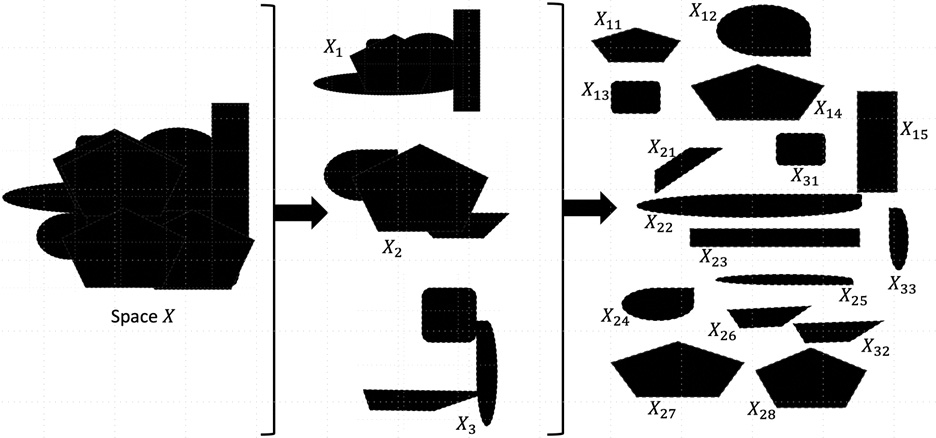
Given a topological space \(X\) that represents a massive data set, one can partition \(X\) into smaller subspaces that can be processed more efficiently by a quantum machine (see Figure 1).
Functional Mapping of Quantized Spaces
Once data is decomposed into smaller subspaces, it can be used to model the phenomenon of interest. Different quantized subspaces can lead to different forms of individual model equations, allowing for effective analysis of the original massive dataset. By reducing the data space through quantization, computations are significantly quicker.
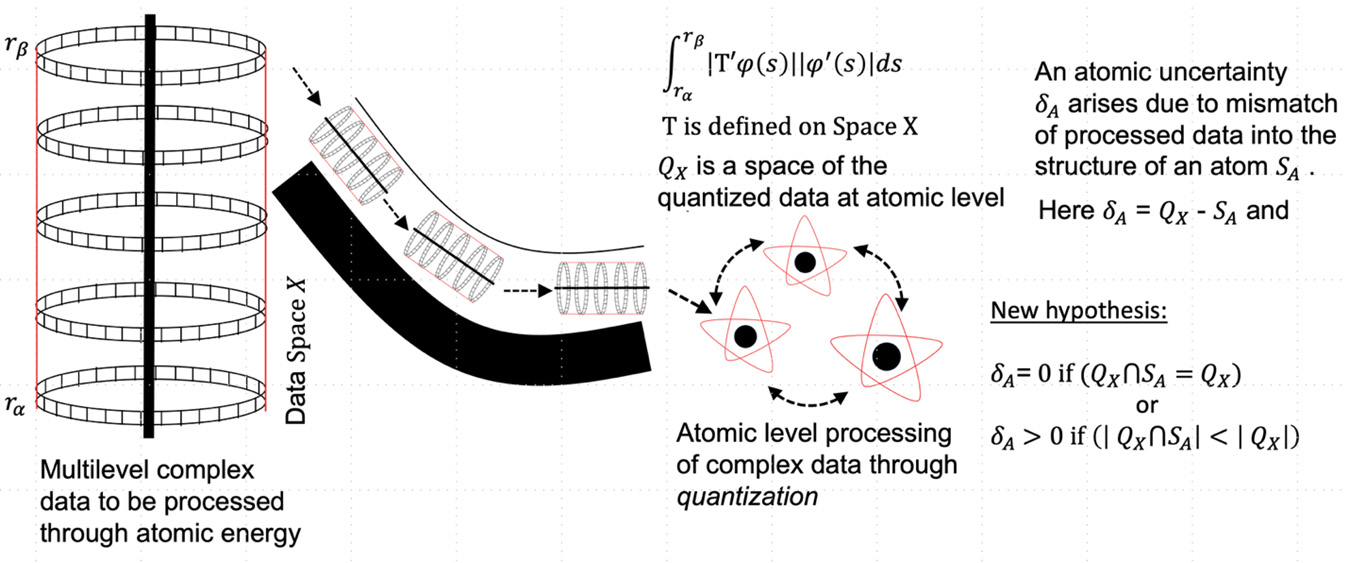
Given current computational capabilities, and the existing cloud computing facilities for any time-sensitive research objectives and goals, collecting and analyzing complex data sets from various sources is a challenging endeavor. Every organism on the planet continuously leaves massive data footprints, ranging from health-related and scientific information to climate and food-related global information. This complex multilevel data varies by individual, region, and several other factors. The topology of quantum data can be thought of as wired deformations of multilevel data, where each wire can be imagined representing a space of the quantized data at the atomic level. Such deformations are precisely needed for understanding if atomic uncertainty exists.
Atomic Uncertainty
Let us denote by \(X\) the space of massive complex multilevel data. Here \(X\) could be dynamic over time, and we express it here as
\[X = \underset{i{\in}A}{\bigcup}\;\underset{i}{\int}X_i\;di,\tag2\]
where \(X_i{\subset}X\) and \(A\) is the set of different components of data in \(X\) that needs quantization while processing them through an atom. We expressed \(X\) in (2) as an integral to give the impression that the \(X_i\)’s are continuous pieces of the total space \(X.\) For example, when only three components of the data, say \(i, j, \textrm{and} k,\) are present in \(X,\) then it can be expressed as
\[X=\;\underset{i}{\int}{X_i}\;di\cup\;\underset{j}{\int}{X_j}\;dj\cup\;\underset{k}{\int}{X_k}\;dk. \tag3\]
Carlsson’s methods of data transformation [1] could help us to write \(X\) in smaller quantities, then the data can be processed into normal or traditional computing machines (non-quantum type). The continuous data flux can be broken into smaller continuous fluxes of bits of data. Suppose \(Q_X\) is a space of the quantized data at the atomic level, then it is rather difficult to establish a one-to-one correspondence: \(Q_X{\sim}X, \) because the atomic structure is yet to be clear to scientists.
If we let the atomic structure be denoted by \(S_A.\) We propose a new hypothesis:
\[\begin{array}{c}{\delta}_A=0 \textrm{ if } (Q_X\;{\cap}\;S_A=Q_X)\\ \textrm{ Or }\tag4 \\{\delta}_A>\textrm{ if }(|Q_X\;{\cap}\;S_A|<|Q_X|),\end{array} \]
where \(\delta_A=Q_X-S_A, \) a quantity representing atomic uncertainty. The norm \(|Q_X\;{\cap}\;S_A|\) indicates the level of matching quantized data with the atomic structure.
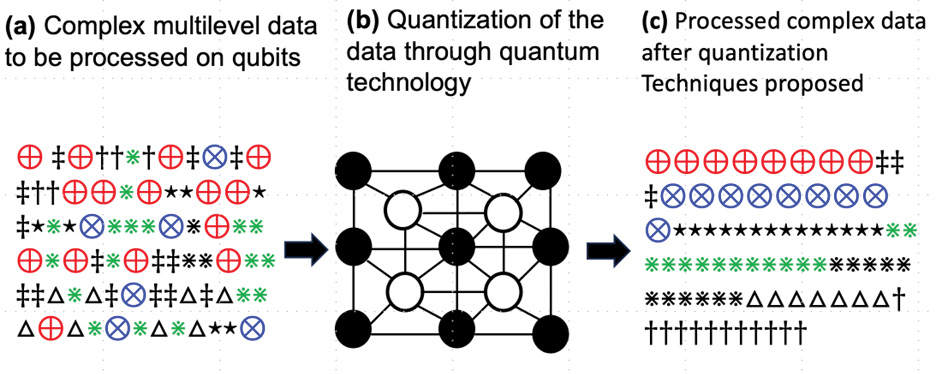
Even though quantization techniques can provide bits of continuous data flux, the uncertainty in the atomic structure makes quantum computing prone to error. This is especially true when working with massive data inputs, as the errors of quantum computing (until we have clarity on atomic structure) could generate large-scale errors. Even so, the random pattern bitstring benchmarking that typically assists in small-scale proof of concepts can be used to measure uncertainty. The quantization techniques proposed, combined with circuits, can help break down complex multilevel data into single-layer data in a faster way (see Figure 3).
A Basic Example
Let us try to understand the computation of atomic uncertainty in a disease modeling framework within a population. Let the multilevel data \(X\) be formed out of four layers of distinct information, say \(X_1,\) \(X_2,\) \(X_3,\) and \(X_4,\) where:
- \(X_1\) is basic demographic information of the population (e.g., population density by age or gender)
- \(X_2\) is socioeconomic status of individuals (e.g., proportions of low-income versus high-income, etc.)
- \(X_3\) is the infection status of each individual in the population (e.g., susceptible, infected, or recovered)
- \(X_4\) is living conditions of work and house (e.g., living in a condo opposed to an individual house, etc.).
For the sake of illustration, let us assume:
\[\begin{array}{l} X_1=[0.35,0.45,0.15],\\ X_2 =[0.15,0.25,0.11,0,28,0.16,0.21],\\ X_3=[0.23,0.67,0.10],\\ X_4=[0.13,0.42,0.15,0.16,0.25]. \end{array}\]
The space of \(X\) is then given by \(X={\bigcup}_{i=1}^4X_i=[0.10, 0.11, 0.13, 0.15, 0.16, 0.21, 0.23, 0.25, 0.28, 0.35, 0.42, 0.45, 0.67].\)
Let us obtain \(Q_X\) values by quantization to one decimal place of the \(X\) values above (i.e. rounding to nearest \(0.1\)). This gives us
\[\begin{array}{l} Q_{X_1}=[0.4, 0.5, 0.2], \\ Q_{X_2}=[0.2, 0.3, 0.1, 0.3, 0.2, 0.2], \\ Q_{X_3}=[0.2, 0.7, 0.1], \\ Q_{X_4}=[0.1, 0.4, 0.2, 0.2, 0.3].\end{array}\]
We thus obtain \(Q_X={\bigcup}_1^4Q_{X_i}=[0.4, 0.5, 0.2, 0.2, 0.3, 0.1, 0.3, 0.2, 0.2, 0.2, 0.7, 0.1, 0.1, 0.4, 0.2, 0.2, 0.3].\)
Hence \(Q_X=[0.1, 0.2, 0.3, 0.4, 0.5, 0.7].\)
Let us assume the atomic structure \(S_A=[0.05, 0.1, 0.13, 0.35, 0.4, 0.45, 0.6, 0.7].\)
The atomic uncertainty \(\delta_A\) is computed by \(Q_X-S_A=[0.2, 0.3, 0.5]\neq0.\) Since the atomic uncertainty is present, the computation errors are present in understanding the disease spread.
Conclusion
Quantization techniques could offer great assistance in processing complex data that would not otherwise be processable through a classical computing approach in a standard bit; however, the potential for atomic uncertainty due to the random structures and patterns involved remains. The quantum computing world is still in a proof-of-concept stage and raises speculation of various kinds of data manipulation at the atomic level, but the possible applications of quantum computing are considerable if the hardware eventually becomes available. However complex, the patterns within a data set and their complexities need to be precisely understood in order to map data into the structure of a multi-partite quantum system. The role of quantization would reduce the gap in decoding the patterns in the data and preparing it to be processed into a qubit.
For more information, a complete list of references, and an expanded introduction, please visit our website.
Acknowledgements: The previous draft of this article benefited from the comments by Ravi Chandra, Angel R. Plastino, Andrei Stepanenko, Ari Stern, and Victor Wickerhauser. We are grateful for them. We are also grateful to Hans Kaper, the editor-in-chief for SIAM News, for his comments that improved the presentation of our ideas. Finally, we extend our sincere thanks to Nya Wynn of SIAM News for her copyediting.
References
[1] Arute, F., Arya, K., Babbush, R., Bacon, D., Bardin, J.C., Barends, R., … Martinis. J.M. (2019). Quantum supremacy using a programmable superconducting processor. Nature, 574, 505-510.
[2] Carlsson, G. (2009). Topology and data. Bull. Amer. Math. Soc., 46(2), 255-308.
[3] Graf, S., & Luschgy, H. (2000). Foundations of quantization for probability distributions. New York, NY: Springer Science & Business Media.
[4] He, Y.H., Heyes, E., & Hirst, E. (2023). Machine learning in physics and geometry. In S.G. Krantz, Arni S.R. Srinivasa Rao, & C.R. Rao (Eds.), Artificial intelligence: Handbook of statistics (Vol. 49) (pp. 47-81). Amsterdam, Netherlands: Elsevier.
[5] Parthasarathy, K.R. (2005). Mathematical foundation of quantum mechanics (Vol. 35). New York, NY: Springer.
[6] Schumacher, B. (1995). Quantum coding. Phys. Rev. A, 51(4), 2738-2747.
About the Authors
Arni S.R. Srinivasa Rao
Professor, Augusta University
Arni S.R. Srinivasa Rao is currently a professor and director of the Laboratory for Theory and Mathematical Modeling in the Division of Infectious Diseases, with a joint appointment in the Department of Artificial Intelligence (AI) & Health at the Medical College of Georgia, Augusta University. His research work focuses on AI, real-world applications of mathematics, stochastic processes, and pure mathematics.
Steven G. Krantz
Professor, Washington University
Steven G. Krantz received his Ph.D. from Princeton University in 1974. He has had 20 Ph.D. students and nine master’s students. His current affiliation is Washington University in St. Louis.
Related Reading

Stay Up-to-Date with Email Alerts
Sign up for our monthly newsletter and emails about other topics of your choosing.