
Why Does Wildfire Smoke Circulate in One Direction?
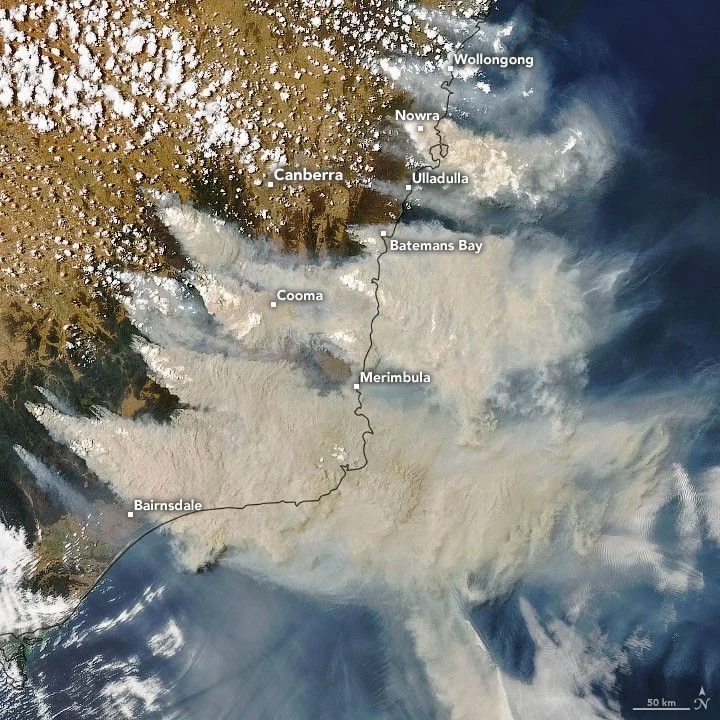
The increased frequency and intensity of wildfires are disastrous consequences of climate change, with effects reaching far beyond the immediate geographical area where they occur. Scientists uncovered an unexpected side-effect of wildfires from the satellite observation of smoke vortices in the stratosphere 35 kilometers above Earth’s surface from 2019-2020 Australian wildfires (see Figure 1). Swirls of particles can be a thousand kilometers across—much wider than the wildfires that produced them—and persist for weeks, altering the chemistry of the stratosphere by trapping ozone, carbon monoxide, and water vapor.
The circulation of the smoke particles was not a surprise, but their swirling pattern was: the entire collection of particles rotated in one direction. This defied what typically occurs with other atmospheric vortices, where the top of the vortex rotates in one direction while the bottom rotates the opposite way. To understand this phenomenon, researchers modeled the way smoke rises and circulates.
“The new idea is the participation of the smoke in its own dynamics,” Kasturi Shah, an applied mathematician at the University of Cambridge, said. In other words, the vortices observed by satellites are a nonlinear process whereby the smoke particles themselves are partial drivers behind swirling patterns rather than simply passive participants. “The smoke is absorbing sunlight, so it’s actually contributing to heating. That heating is setting up the winds and the circulation.”
In a paper with Peter Haynes of the Massachusetts Institute of Technology [2], Shah developed simplified dynamical models that reproduce the observed consequences of wildfires: the rising of the smoke and the formation of vortices that rotate in a single direction. She noted that both better data and more detailed simulations are needed, but their theoretical model agrees with work performed independently by other researchers [1].
You Spin Me Round
Scientists have studied vortices in a variety of contexts for a long time, as they are of interest in everything from meteorology to plasma physics. The rotation of Earth, for instance, produces large-scale swirls in the atmosphere and water known as the Coriolis effect. Meteorological vortices are further classified as cyclonic or anticyclonic, based on their direction of rotation: in the Northern Hemisphere, cyclones rotate counterclockwise in accordance with the Coriolis effect, while in the Southern Hemisphere they spin clockwise. Anticyclones spin in opposite directions in each hemisphere, due to different atmospheric conditions; Jupiter’s Great Red Spot is an anticyclone wider than Earth that has been observed for centuries.
Earth-observation satellites identified large anticyclones in the stratosphere containing carbon-rich particles from the 2017 Canadian wildfires, the 2019-2020 Australian fires, and the 2019 eruption of the island volcano Raikoke in the Pacific Ocean between Japan and the Kamchatka Peninsula. These anticyclones were flat ellipsoids in shape, extending 500 to 1000 kilometers horizontally—much larger in extent than the wildfires or volcano that produced them—but only about five kilometers thick. Each of these vortices persisted for several weeks.
Researchers that attempted to model this anticyclonic phenomenon encountered a major difficulty. If smoke particles were governed by ordinary atmospheric dynamics, the vortices should be anticyclonic at higher elevations and cyclonic at lower heights—otherwise known as a dipole vortex—rather than the monopole single-direction rotation that they observed. However, as Shah, Haynes, and others realized, the simplest models assumed that smoke particles were just along for the ride, at the mercy of atmospheric dynamics. Instead, they found that because the smoke particles are larger and heavier than typical atmospheric molecules, and dark in color, they absorb a disproportionate amount of sunlight and heat up.
“What goes into [our] model [is] the heating provided by the smoke itself and the dynamics of a rotating atmosphere,” Shah said. Those warm particles rising into the stratosphere change the dynamics that govern them, leading to a kind of feedback effect. “You end up with a slightly asymmetric pattern where the contours of the smoke, and therefore the heating, are bunched at the top [of the vortex].”
The higher density of warm smoke particles suppresses the counter-rotation, leaving a monopole vortex like those seen in satellite observations.
Turn Turn Turn
To simplify the physics, Shah and Haynes ignored the ellipsoidal character of the smoke vortices, instead assuming a cylindrical axisymmetric geometry. That reduced the model to two dimensions: radial and vertical \((r,z)\), with rotational symmetry around the center of the vortex. Since the smoke vortices are geographically large, the Coriolis effect dominates over small-scale inertial forces, which allowed them to apply further simplifications to the physical model.
With these approximations, the governing equations for the system become:
\[\frac{{\partial}{v}}{{\partial}{t}}+fu=0\]
\[f\frac{{\partial}{v}}{{\partial}{z}}=\frac{R}{H_0}\frac{{\partial}{T}}{{\partial}r}\]
\[\frac{1}{r}\frac{{\partial}}{{\partial}{r}}(ru)+ \frac{1}{\rho_0}\frac{{\partial}}{{\partial}{z}} (\rho_0w)=0\]
\[\frac{{\partial}{T}}{{\partial}{t}}+w(\frac{{\partial}T_B}{{\partial}z}+\frac{{\partial}T_B}{7H_0})=Q_S-{\alpha}T\]
where \((u, v, w)\) are the radial, azimuthal, and vertical components of the air velocity. The temperature is divided into a background component \(T_B(z)\) and a horizontally varying component \(T(r,z)\), \(R\) is the ideal gas constant, and \(f\) is the Coriolis frequency. The air density \(\rho_0(z)\) decreases exponentially with height, while the parameters \(H_0\) and \(\alpha\) describe atmospheric stratification and the rate of cooling, respectively. Finally, \(Q_S\;(r, z, t)\) is a heating function directly proportional to the concentration of smoke particles.
The numerical solutions to these coupled nonlinear equations showed that the strength of the heating makes a profound difference to the vortices, particularly in the presence of wind shear in the stratosphere.
“When the heating is weak, this vortex structure is quite weak,” Shah explained, which means wind shear simply destroys it. “If smoke gets injected into the stratosphere, there needs to be enough black and brown carbon to absorb enough sunlight such that it’s strong enough to resist the shear.”
Where There’s Smoke
The next steps, which are already underway, are to create three-dimensional simulations to understand how ellipsoidal vortices form and persist. These models do more than simply explain why vortices are monopole in character, they could provide help for modeling changes in stratospheric chemistry.
“Understanding where these solid particles end up is quite important,” Shah said. “Wildfire smoke particles provide surfaces on which chemical reactions take place that affect stratospheric ozone.”
In other words, fires that cover a relatively small area on Earth’s surface could have detrimental effects high above ground. Shah argued that this means we need to collect higher quality satellite data more frequently to better understand these effects and guide modeling techniques. Since there are only a relatively small number of events studied so far, it is quite probable that with the increase in wildfire occurrence and severity due to climate change, more smoke anticyclones have happened but went unidentified.
Shah also noted that the wildfires that produced these vortices happened in the summer in the hemisphere where they occurred, which is important for several reasons. First, wildfires are simply more likely in summertime, when conditions tend to be drier — though that’s changing with global warming. Second, the stratosphere is more turbulent in wintertime, which might make smoke vortices more unstable. However, with large-scale alterations in the atmosphere as the result of climate change, combined with increased risk of fire throughout the year, all those conditions might not hold forever.
“One extremely challenging thing is to identify where the wildfire smoke has been injected into the stratosphere,” Shah said. “That can be on sometimes quite small scales. Once the smoke has coalesced on a scale that is resolved by the satellites, that’s when you detect it, [which is] an observational challenge.”
References
[1] Podglajen, A., Legras, B., Lapeyre, G., Plougonven, R., Zeitlin, V., Brémaud, V., … Sellitto, P. (2025). Dynamics of diabatically forced anticyclonic plumes in the stratosphere. Q.J.R. Meteorol. Soc., 150(760), 1538-1565.
[2] Shah, K., & Haynes, P.H. (2024). How heating tracers drive self-lofting long-lived stratospheric anticyclones: Simple dynamical models. Weather Clim. Dynam. 5(2), 559-585.
About the Author
Matthew R. Francis
Science writer
Matthew R. Francis is a physicist, science writer, public speaker, educator, and frequent wearer of jaunty hats. His website is https://bowlerhatscience.org.
Stay Up-to-Date with Email Alerts
Sign up for our monthly newsletter and emails about other topics of your choosing.