Atmospheric Turbulence in a Jar
Atmospheric models of the Earth are essential, informing a wide range of work in climate models, weather prediction, and atmospheric modeling of other planets in our solar system and beyond. However, attempting to model the Earth’s atmosphere presents many challenges for researchers, particularly at length scales where tropical cyclones, polar vortices, and other major weather-driving phenomena form. The heart of the problem is the spectrum of energy transfer, driven by solar heating in warmer latitudes and the rotation of the planet, which leads to various types of atmospheric waves and turbulence. This challenge has attracted scientists from many overlapping disciplines offering a wide variety of solutions.
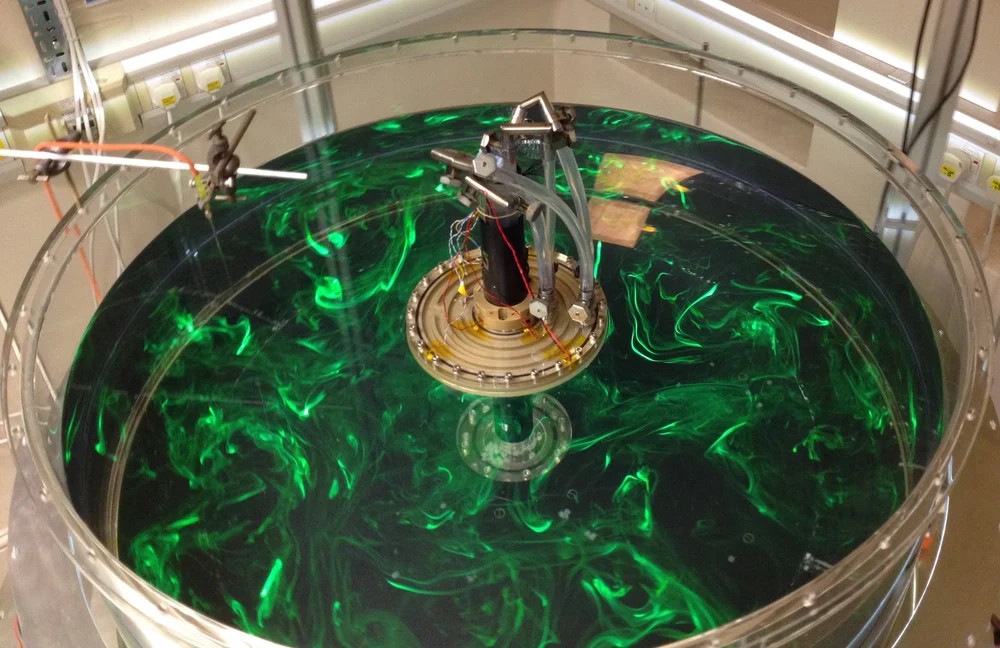
Basic fluid dynamics models predict very different energy spectra than what is measured by aircraft, as well as the results of numerical simulations. To resolve the discrepancy, researchers constructed an atmospheric analog in the lab that involves a rotating fluid in a cylindrical container with a strong heating gradient to simulate the flow of energy from the equator to the pole (see Figure 1). The results and mathematical analysis provide a guide for theoretical and numerical models to come.
“With this kind of setup, we have all the fundamental physics in the atmosphere,” Shanshan Ding, an atmospheric researcher at the University of Oxford, said. In a recent study published in Physical Review Letters [1], she and her colleagues described the analog experiment and what it reveals about energy dispersion at larger distance scales.
Between theoretical work and the new experiments, Ding and her colleagues reproduced the energy spectrum from airplane measurements. More than that, however, they identified the energy transfer processes driving atmospheric turbulence, known as an enstrophy cascade.
Scaling the Heights
Research on atmospheric turbulence and its connection to weather dates back to the 19th century but the ability to systematically measure winds in the upper troposphere—the lowest layer of the atmosphere where most weather happens—only became possible in the second half of the 20th century. Researchers instrumented long-range commercial airplanes in the 1970s, which provided wind-speed data over distances ranging from a few kilometers to tens of thousands of kilometers. By converting this data to a spectrum, they found the kinetic energy scaled roughly with the wavelength of the atmospheric disturbances cubed, \(\lambda^3\) at large wavelengths and \(\lambda^{5/3}\) at smaller wavelengths [3].
Development on the theoretical side, however, lagged due to the extreme nonlinearity of turbulent systems. Additionally, two-dimensional (2D) calculations produced the opposite spectral relationship: cubic dependence on wavelength at small wavelengths, and shallower \(5/3\) power scaling at larger wavelengths [2], directly contradicting experimental airplane measurements.
“This poses a puzzle to understand why the atmosphere doesn’t obey the rules,” said Peter Read, an atmospheric fluid dynamics researcher at the University of Oxford and coauthor of the Physical Review Letter [1]. “What don’t we understand about this system?”
Turning in the Widening Gyre
For cyclones and other phenomena of interest at approximately 1000-kilometer scales, Earth’s atmosphere can be modeled in 2D because the horizontal distances are much larger than the vertical thickness of the troposphere. That also means researchers can apply a mathematical trick to simulate the atmosphere in a cylindrical tank where the simulated “north pole” lies at the axis and the “equator” at the outer radius. This type of experiment reproduces many large-scale phenomena such as Rossby waves, which are responsible for jet streams.
Ding, Read, and their collaborators designed a modified version of this experiment, using a meter-diameter cylinder to provide a much larger volume than prior work (which used chambers approximately 10 centimeters in diameter). In addition, they built the base of the meter-diameter cylinder to be a shallow cone, which simulated the varying strength of the Coriolis effect at different latitudes on Earth. They applied heat to the fluid via a heating coil at the bottom outer circumference and increased the temperature differential by fixing a cold plate to the top of the cylinder at the axis (see Figure 2).
![<strong>Figure 2.</strong> Cutaway diagram of the experiment, showing the inclined base of the cylindrical tank and the positions of the heating and cooling elements. Figure adapted from [1] and available via the Creative Commons Attribution 4.0 International license.](/media/s04lidlv/figure-1.jpg)
The varying depth, temperature gradient, and rotation of the apparatus produced a misalignment between pressure and density inside the fluid, which created swirls known as baroclinic eddies like those seen in the troposphere. Since the boundary conditions for concentric cylinders are vastly different than the real atmosphere, the large size and geometry of the experiment meant the measurements focused on the middle annual region away from both walls — which also correspond most closely to mid latitudes of interest.
“The temperature difference in the vertical direction will cause the convection that will lead to plumes,” Ding said. “The temperature contrast between the equator and the north can lead to Rossby waves and baroclinic eddies.”
Due to the impossibility of reproducing all the physical characteristics of the upper troposphere, the research group used a mixture of water and glycerol. That fluid has two advantages: it lowered the threshold for turbulence to emerge, and it allowed them to suspend small particles to trace that turbulence using a video camera. The onset of turbulence is governed by the (dimensionless) Reynolds number:
\[\textrm{Re}=\frac{L\bar{v}}{\nu}\]
where \(L\) is a characteristic length, \(\bar{v}\) is a characteristic velocity for the fluid, and \(\nu\) is the viscosity.
“We want the Reynolds number to be large enough, and when we scale down the system, the Reynolds number won’t be very large if we use air,” Ding said. Even so, the Reynolds number in the water-glycerol mixture is much lower than that of the highly turbulent upper troposphere simply because the viscosity of air is so tiny while the characteristic scales of atmospheric phenomena are large.
“The distribution of heating and cooling is at least qualitatively similar to what we find in the atmosphere,” Read said. “The basic instabilities that arise are physically and qualitatively the same as mid-latitude weather systems in the real atmosphere. We are trying to match the order of magnitude of certain dimensionless variables that allow us to do what aerodynamicists do in terms of scaling experimental test systems.”
Cascades and Alien Worlds
To study the range of spectra, the researchers fixed all quantities in the system, such as temperature differentials, while taking measurements at rotational speeds between 0.5 and 10 revolutions per minute to simulate different latitudes. The water-glycerol mixture is viscous enough that the experiments could run for several hours without the suspended particles settling out of solution; this enabled the experimenters to measure velocities throughout the cylinder. The 2D energy spectrum
\[E(k)=\frac{1}{2dk}\sum_{k_{mn}{\in}{k}{\pm}{dk/2}}{\langle}{\hat{u}_{mn}}\cdot{\hat{u}^*_{mn}}{{\rangle}_t}\]
as a function of the wavenumber \(k=2\pi/\lambda\) involved taking the Fourier-Bessel transform of the measured velocity fields \(u\rightarrow\hat{u}\) in polar coordinates, which makes them complex numbers (“\(*\)” denotes the complex conjugate), then averaging over time as indicated by the brackets.
To quantify the way kinetic energy dissipates in turbulent fluids, dynamics researchers calculate the enstrophy spectrum, which is defined in terms of the gradient of the fluid velocity field. Determining the spectrum of the enstrophy flow from the experiment revealed a cascade that drove the steep energy spectrum at large scales. These results indicate horizontal energy transfer from small fluctuations to large ones, while the angular momentum transfer goes the other direction from large vortices to small.
Interestingly, the researchers also noted that at the highest rotational speeds, the kinetic energy tended to follow latitudinal zones, a phenomenon that astronomers observe on fast-spinning gas giant planets like Jupiter. Read pointed out that in order to extend cylinder experiments to study these worlds, the fluids would need to be spun significantly faster, which produces a concave surface like a whirlpool, further complicating matters. However, the qualitative understanding of energy transfer could apply to atmospheric models for Mars or even exoplanets, potentially helping researchers grasp alien worlds with intense temperature gradients known to orbit other stars.
“It’s one thing to reproduce the [atmospheric] pattern in an engineering sense,” Read said. “It’s another to understand why you get the answer that you actually observe.”
References
[1] Ding, S., Bobas, H., Scolan, H., Young, R.M.B., & Read, P.L. (2026). Stratification-dependent enstrophy-controlled regime in geostrophic turbulence. Phys. Rev. Lett., 136, 114101.
[2] Kraichnan, R.H. (1967). Inertial ranges in two-dimensional turbulence. Phys. Fluids, 10(7), 1417-1423.
[3] Nastrom, G.D., Gage, K.S., & Jasperson, W.H. (1984). Kinetic energy spectrum of large- and mesoscale atmospheric processes. Nature, 310, 36-38.
About the Author
Matthew R. Francis
Science writer
Matthew R. Francis is a physicist, science writer, public speaker, educator, and frequent wearer of jaunty hats. His website is https://bowlerhatscience.org.
Related Reading
Stay Up-to-Date with Email Alerts
Sign up for our monthly newsletter and emails about other topics of your choosing.