
Data-driven Discovery of Wildfire Spread Models
Wildfires are governed by complex interactions, including combustion, atmospheric turbulence, fuel heterogeneity, and terrain. This makes predicting the evolution of a fireline, or a wildfire’s rate of spread, a formidable challenge. For more than a century, scientists have attempted to model rate of spread, with each method offering distinct advantages. Model selection involves tradeoffs between accuracy, speed, and ease of use.
Many fire behavior models rely on empirical formulas such as those developed by Richard Rothermel in 1972 [5]. Such models are powerful in operational settings, but they rely on empirical relationships that may not explicitly represent all the physical processes involved. This can limit their applicability outside the conditions for which they were developed. As an alternative, physics-based models, such as FIRETEC [2] and Fire Dynamics Simulator (FDS) [3], incorporate detailed physical processes, but they typically require large amounts of computational resources, making them less applicable in an operational setting. In addition, uncertainty in model inputs and parameters can affect predictive confidence.
Rather than using data to create semi-empirical models, data can be used to learn physics-based models. Recent advances in data-driven modeling suggest one such complementary path: learning physics-based equations directly from observations. One approach is the seminal paper introducing Sparse Identification of Nonlinear Dynamics (SINDy) [1] which uses data to select significant terms from a library of differential operators. At the heart of SINDy is sparse regression that fits data to a differential equation, thereby requiring numerical differentiation of the data. Geophysical data, such as data collected in fire environments, almost always contains significant noise and turbulence, so methods that rely on numerical differentiation can become sensitive to this noise, further complicating the discovery of meaningful equations from geophysical data.
To address this challenge, weak SINDy (wSINDy) [4] alleviates the issue of differentiating the data by performing the sparse regression over a weak form of the governing equations. After substituting the data into the library of differential operators, the residual is multiplied by smooth, compactly supported test functions. The resulting product is integrated, and derivatives are transferred to the test function using integration by parts. The final set of equations involves the integral of the product of the data and the derivatives of smooth test functions. This is especially important for geophysical applications where the observations are known to contain large amounts of noise.
Data Collection
In order to provide weak SINDy with experimental data, data was collected at Tall Timbers Research Station in Tallahassee, Fla. with an infrared and visual camera mounted above a two-by-two-meter pine straw fuel bed. The infrared frames are processed with Fire Dynamics Vision (FDV) [6, 7], which determines the boundary of the fire perimeter at each frame. Figure 1 shows both the setup and a boundary extracted from FDV.
![<strong>Figure 1.</strong> Left panel: The experimental setup was performed at Tall Timbers Research Station, Tallahassee, Fla. A two-by-two-meter pine straw fuel bed was ignited closest to the wind source (a fan located out of the frame), and it spread downwind in the heading direction. Infrared (IR) and visual data were captured directly above the burn unit. Right panel: For each frame of the IR data, Fire Dynamics Vision (FDV) was used to extract the fireline perimeter (yellow marks). Figure courtesy of [7].](/media/ceentd54/figure-1.jpg)
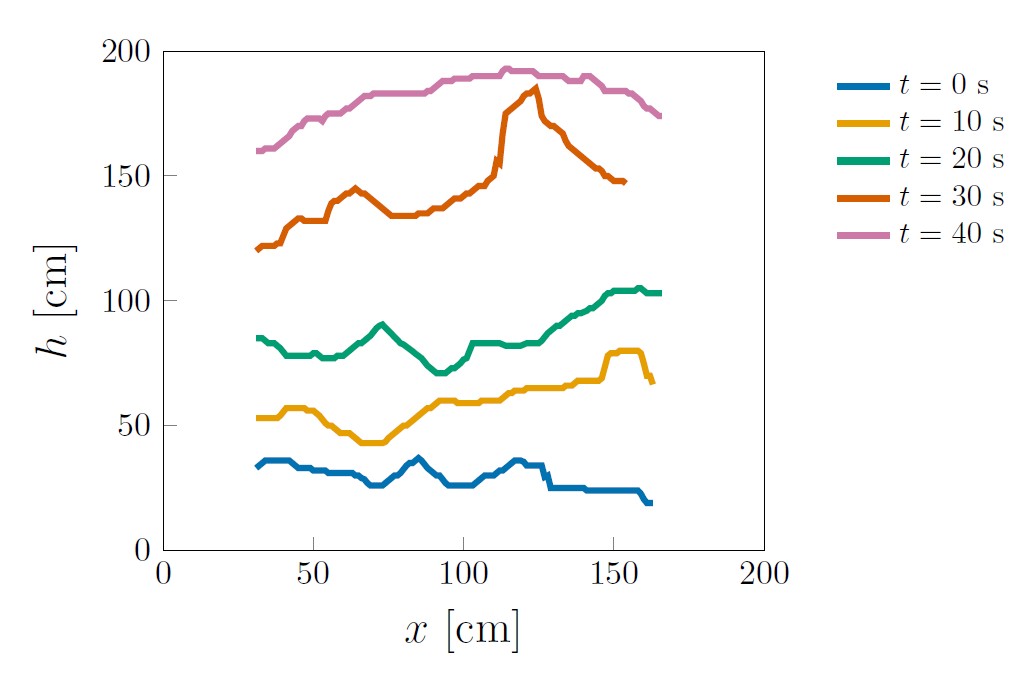
Once the perimeter of the burning region was determined at each frame, we focused on the region farthest downwind, known as the fire head. We introduced the independent variable \(x\) to denote the direction perpendicular to the wind direction, and the dependent variable \(h(x,t)\) as the location of the head of the fire at location \(x\) and time \(t.\) Figure 2 shows firelines at \(10\) second intervals.
Results
We then applied wSINDy to the extracted fireline data to learn an interpretable model of fire spread. The first step was to choose a library of candidate terms. To capture nonlinear processes, but without introducing too many unknowns, we seek a model for the fireline
\[\frac{{\partial}h}{{\partial}t}=p_0(h)+\frac{\partial}{{\partial}x}p_1(h)+\frac{\partial^2}{{\partial}x^2}p_2(h),\]
where \(p_0,\;p_1,\) and \(p_2\) are quadratic functions. The coefficients of these polynomials are found by applying a sparsity-promoting least-squares method to the weak form of the partial differential equation (PDE)
\[{\bigg\langle}h, \frac{{\partial}{\psi_k}}{{\partial}t}{\bigg\rangle}={\langle}p_o(h), \psi_k{\rangle}-{\bigg\langle}p_1(h),\frac{\partial}{{\partial}x}\psi_k{\bigg\rangle}+{\bigg\langle}p_2(h),\frac{\partial^2}{{\partial}x^2}\psi_k{\bigg\rangle}, \tag1\]
where \(\psi_k(x,t)\) are smooth test functions that are compactly supported in both space and time, and \({\langle}{\cdot},{\cdot}{\rangle}\) denotes the integral over the entire space-time domain. Notice that \((1)\) avoids differentiating noisy data but instead integrates it against the smooth test functions \(\psi_k.\) The learned PDE for the fireline spread is
\[\frac{{\partial}h}{{\partial}t}=c_1+c_2h+c_3h^2+c_4\frac{{\partial}h}{{\partial}x}+c_5\frac{\partial}{{\partial}x}h^2.\]
The dimensioned coefficients are
\[\begin{array}{c}c_1=+4.6\times10^0\;\textrm{cm}{\cdot}\textrm{s}^{-1}, \\ c_2=+7.0\times10^{-2}\;\textrm{s}^{-1}, \\ c_3=-6.0\times10^{-4}\;\textrm{cm}^{-1}{\cdot}\textrm{s}^{-1}, \\ c_4=+8.0\times10^0\;\textrm{cm}{\cdot}\textrm{s}^{-1}, \\ c_5=-3.0\times10^{-2}\;\textrm{s}^{-1}. \end{array}\]
This learned model can be used to describe the mechanisms that result in fire spread. First, the coefficient \(c_1\) determines the average speed that the fireline propagates downwind; its value agrees with the average rate of spread determined by FDV [7]. The coefficient \(c_2\) indicates exponential growth, with the value of \(h\) doubling approximately every \(10\) seconds. The coefficient \(c_3 < 0\) denotes that fuel depletion modulates the fireline growth, while the coefficient \(c_4\) describes fireline movement that is lateral to the wind direction. Finally, \(c_5\) multiplies the nonlinear Burgers’ term responsible for the zippering effect, which closes gaps in the fireline. Collectively, these terms provide a mechanistic description of fireline spread learned directly from experimental observations.
The overall fireline motion is dominated by wind-driven advection. To isolate the contribution of other physical processes, we remove this dominant wind-driven effect by defining
\[\tilde{h}(x,t)=h(x,t)-\bar{h}(t),\]
where \(h(t)\) is the spatial average of \(h(x,t).\) When wSINDy is applied to these fluctuations, the learned PDE is
\[\frac{{\partial}\tilde{h}}{{\partial}t}=c_2\tilde{h}+c_3\tilde{h}^2+c_5\frac{\partial}{{\partial}x}\tilde{h}^2. \]
As expected, \(c_1 = 0\) since the average value of \(\tilde{h}\) is zero for all time. The coefficient \(c_2=-2.3\times10^{-2}\;\textrm{s}^{-1}\) indicates that the fluctuations decay exponentially with a half-life of approximately \(25\) seconds. The coefficient \(c_3=2.17\times10^{-3}\;\textrm{cm}{\cdot}\textrm{s}^{-1}\) indicates that fuel depletion modulates the fluctuation growth, and the coefficient \(c_5=1.40\times10^{-2}\;\textrm{s}^{-1}\) multiplies the nonlinear Burgers’ term, thus introducing shocks and rarefaction waves that sharpen and smooth the fireline. This learned PDE reveals that after removal of the mean advection, the dynamics of the fluctuations that remain are governed by nonlinear processes and an exponentially decaying component.
Outlook
The ability to learn governing equations directly from experimental observations opens new possibilities for understanding complex geophysical systems. While this study focuses on fireline dynamics, the approach is broadly applicable to other processes in wildfire behavior, including plume evolution and transport phenomena. A main challenge to address will be the inclusion of non-local effects, such as ember spotting, that are not captured by differential operators. More generally, weak-form equation discovery provides a pathway for integrating data-driven methods with physics-based modeling, potentially transforming how scientists study systems where controlled experiments are difficult and observations are noisy.
Bryan Quaife delivered a minisymposium presentation on this topic at the Third Joint SIAM/CAIMS Annual Meetings, which took place last summer in Montréal, Québec, Canada.
Acknowledgements: This work was supported by the Department of Defense, Strategic Environmental Research and Development Program, RC20-1298, and by Florida State University’s Council on Research and Creativity.
References
[1] Brunton, S.L., Proctor, J.L., & Kutz, J.N. (2016). Discovering governing equations from data by sparse identification of nonlinear dynamical systems. Proc. Natl. Acad. Sci., 113(15), 3932–3937.
[2] Linn, R., Reisner, J., Colman, J.J., & Winterkamp, J. (2022). Studying wildfire behavior using FIRETEC. Int. J. Wildland Fire, 11(4), 233–246.
[3] McGrattan, K., Hostikka, S., McDermott, R., Floyd, J., Weinschenk, C., & Overholt, K. (2013). Fire dynamics simulator user’s guide. NIST Special Publication, 1019(6), 1–339.
[4] Messenger, D.A. & Bortz, D.M. (2021). Weak SINDy for partial differential equations. J. Comput. Phys., 44, 110525.
[5] Rothermel, R.C. (1972). A mathematical model for predicting fire spread in wildland fuels. United States Department of Agriculture Forest Service Research Peper INT-115. Retrieved from: https://research.fs.usda.gov/download/treesearch/32533.pdf.
[6] Sagel, D. & Quaife, B. (2025). Fire dynamic vision: Image segmentation and tracking for multi-scale fire and plume behavior. Environ. Model. Softw., 185, 106286.
[7] Sagel, S., Speer, K., Pokswinski, S. & Quaife, B. (2021). Fine-scale fire spread in pine straw. Fire, 4(4), 69.
About the Authors
Bryan Quaife
Professor, Florida State University
Bryan Quaife is a professor in the Department of Scientific Computing at Florida State University. He is interested in the development of integral equation methods for complex fluids and fire dynamics.
Jhamieka Greenwood
Ph.D. candidate, Florida State University
Jhamieka Greenwood is a Ph.D. candidate in the Fire Dynamics program in the Department of Scientific Computing at Florida State University. Her research focuses on discovering equations arising in fire dynamics.
Stay Up-to-Date with Email Alerts
Sign up for our monthly newsletter and emails about other topics of your choosing.